
7 companies compared
Make to Stock vs Make to Order: Decide Per Product
Make to stock vs make to order is decided per product, not per business. Compare the wait your customer accepts with your total lead time, and hold stock where that gap falls.

By Praveen Nune, Co-Founder & CEO · Updated 14 Nov 2026
On this page
- 01The shortlist
- 02How we ranked them
- 03The companies in detail
- 04How to choose
- 05Key takeaways
- 06What is the difference between make to stock and make to order?
- 07Should the choice cover the whole business or each product?
- 08How do you test one product: make to stock, assemble to order or make to order?
- 09What does the test cost in rupees for a worked example product?
- 10How do you run stocked and made-to-order products in one system?
- 11Method and sources
- 12Frequently asked
The short answer
Each product needs its own choice. One factory can stock a steady seller and build a special order to order. The two strategies differ in one respect only: the moment a product becomes tied to a particular customer's order.
The shortlist
How we ranked them
- Names production, bill of material or work-order features on its own pricing page
- Publishes its prices on its own pricing page, listed here as of November 2026
- Handles manufacturing or product-making inventory rather than stock counts alone
- Lists plan limits and contract terms openly enough to work out a twelve-month cost
The companies in detail
Arka Inventory
Inventory and manufacturing built natively on Salesforce
- Suits
- Manufacturers and distributors, especially on Salesforce
- Production features
- Standard and order-based bills of material, kitting
- Starting price
- Basic from $199 a month
- Billing
- Billed yearly (Basic); Advance $499; Enterprise custom
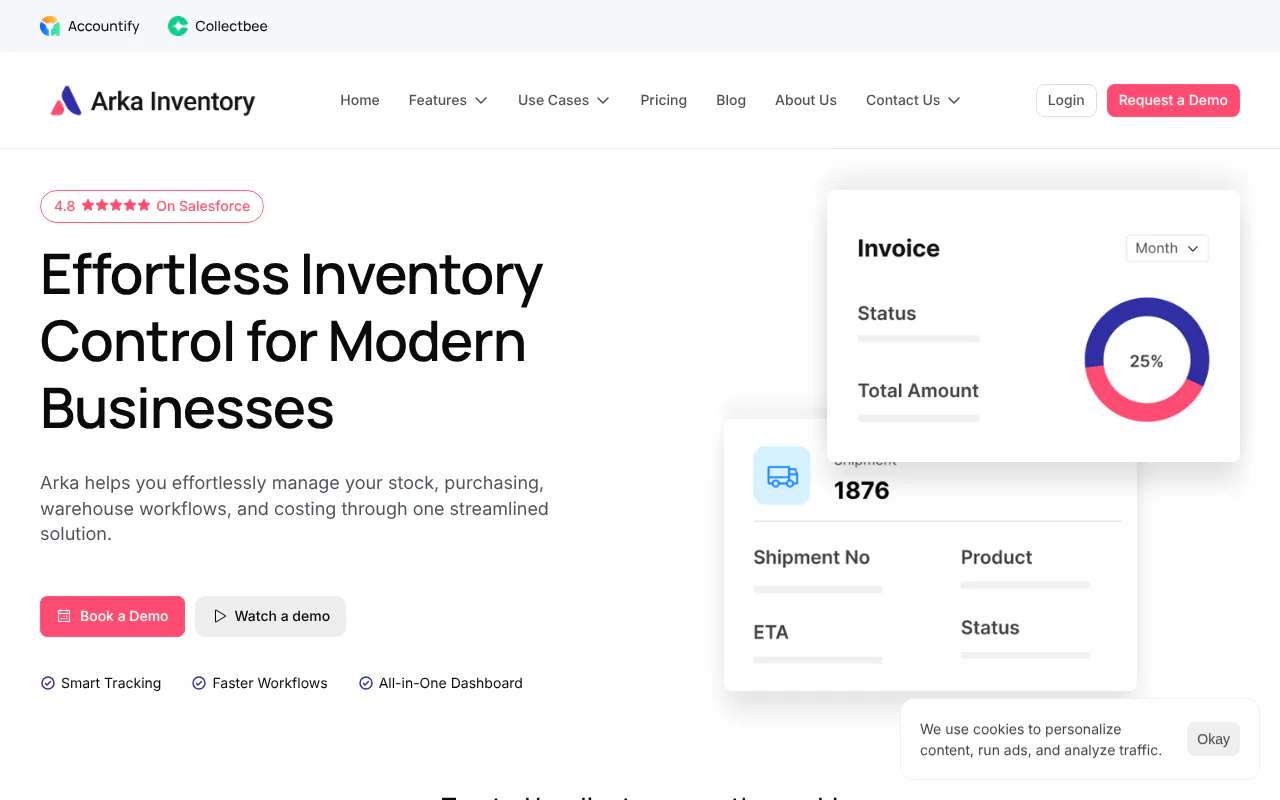
Arka Inventory is our first pick for teams that run Salesforce, because standard and order-based bills of material, material availability checks, kitting and committed stock sit inside Salesforce. It suits manufacturers and distributors, especially on Salesforce.
Strengths
- Standard and order-based bills of material
- Kitting and commit inventory
- Visibility across warehouses inside Salesforce
Fishbowl
Standalone inventory and warehouse platform
- Suits
- Teams wanting a standalone inventory and warehouse platform
- Production features
- Work orders, MRP, production scheduling
- Starting price
- Essentials $229 a month (2 users)
- Billing
- Billed annually
Fishbowl suits teams wanting a standalone inventory and warehouse platform. It does well on work orders and made-to-order builds, MRP and production scheduling.
Strengths
- Work orders and made-to-order builds
- MRP and production scheduling
- Advanced Manufacturing from $675
Limitations
- Standalone, not Salesforce-native
MRPeasy
Production planning and MRP for small manufacturers
- Suits
- Small manufacturers
- Production features
- Production planning, MRP, bill of material management
- Starting price
- Starter $49 per user a month
- Billing
- Per user a month (minimum 2 users)
MRPeasy suits small manufacturers. It lists production planning, MRP and bill of material management on every plan.
Strengths
- Production planning on every plan
- MRP on every plan
- Bill of material management on every plan
Limitations
- Serial numbers only from Professional
Katana
Bills of material, routings and orders for small product makers
- Suits
- Small product makers
- Production features
- Bills of material, routings, purchasing
- Starting price
- Free $0
- Billing
- Advantage custom
Katana suits small product makers. It lists bills of material, routings, purchasing and order management on both plans.
Strengths
- Bills of material on both plans
- Routings on both plans
- Purchasing and order management on both plans
Limitations
- Free plan stops at 30 SKUs
- Paid Advantage plan is a custom annual contract
Cin7 Core
Inventory platform for e-commerce product businesses
- Suits
- Product businesses selling through e-commerce
- Production features
- Bill of material tracking, production, unlimited locations
- Starting price
- Standard $349 a month (5 users)
- Billing
- Billed monthly
Cin7 Core suits product businesses selling through e-commerce. It lists bill of material tracking, production and unlimited locations on all plans.
Strengths
- Bill of material tracking on all plans
- Production on all plans
- Unlimited locations on all plans
Limitations
- Material requirements planning only from Pro
- Separate inventory platform
Odoo
Broad, modular ERP with inventory alongside other apps
- Suits
- Businesses wanting a broad, modular ERP
- Production features
- Inventory alongside sales, accounting, CRM apps
- Starting price
- Standard $31.10 per user a month
- Billing
- Per user, discounted for 12 months
Odoo suits businesses wanting a broad, modular ERP. It offers inventory alongside sales, accounting and CRM apps.
Strengths
- Inventory alongside sales, accounting and CRM apps
- Modular ERP
- Standard plan discounted from $38.90 for 12 months
Limitations
- Priced per user, so cost rises with headcount
Zoho Inventory
Inventory for small teams already in the Zoho ecosystem
- Suits
- Small teams already in the Zoho ecosystem
- Production features
- Composite items, sales orders, purchase orders
- Starting price
- Free; Standard $29 a month
- Billing
- Billed annually
Zoho Inventory suits small teams already in the Zoho ecosystem. It lists composite items, sales orders and purchase orders on all plans.
Strengths
- Composite items on all plans
- Sales orders and purchase orders on all plans
- A free plan
Limitations
- Standard plan caps at 3 users, 2 locations and 500 orders a month
How to choose
- 1
Two bill of material types
Pass: you can keep stocked and made-to-order products on different bills of material. Fail: one structure serves both. - 2
Availability before promising
Pass: a real order shows whether components cover it before you quote a date. - 3
Stock tied to orders
Pass: reserving stock for a customer order removes it from available stock. Fail: two orders can claim the same units. - 4
Plan limits
Pass: your users, locations, SKUs and orders for the next 12 months fit under the plan with room to spare. Fail: you would need the next tier within the year. - 5
Twelve-month cost
Pass: for per-user plans, price × users × 12 is within budget; for flat plans, the yearly total is.
Key takeaways
- Make to order is feasible for a product when the customer will wait at least as long as your total lead time (materials, production and dispatch). When they will not, hold stock at the stage that closes the gap.
- Hold finished goods when demand is steady and variants are few. Hold components when many variants share parts. Hold raw material only, or nothing, when orders are custom or lumpy.
- Annual holding cost = daily demand × days of cover × unit cost × annual carrying rate. In our illustrative case, stocking components costs ₹64,000 a year against ₹96,000 for finished goods.
- In Arka Inventory, a standard bill of material suits stocked products and an order-based bill of material suits made-to-order products. Material availability checks and commit inventory keep both honest.
What is the difference between make to stock and make to order?
Make to stock builds products ahead of orders, to a forecast, and ships from finished goods. Make to order starts production only after a confirmed order. The real difference is the point where a product becomes tied to a specific customer, which researchers call the customer order decoupling point.
The customer order decoupling point has five recognised positions: make to stock, assemble to order, make to order, purchase and make to order, and engineer to order. If the point sits at finished goods, you make to stock. If it sits at components, you assemble to order: parts are stocked and final assembly waits for the order. If it sits at raw material, you make to order. If even purchasing waits for the order, you purchase and make to order. If design waits for the order, you engineer to order.
- Aspect
- Production starts
- Make to stock
- Before the order, on a forecast
- Make to order
- After the order is confirmed
- Aspect
- Stock held
- Make to stock
- Finished goods
- Make to order
- Little or none
- Aspect
- Customer wait
- Make to stock
- Short
- Make to order
- Your full lead time
- Aspect
- Main risk
- Make to stock
- Unsold or obsolete stock, forecast error
- Make to order
- Lost orders to faster suppliers
- Aspect
- Typical product
- Make to stock
- Standard, repeat items such as packaged fasteners
- Make to order
- Made-to-measure items such as glass partitions
Should the choice cover the whole business or each product?
Each product needs its own choice. One factory can stock a steady seller and build a special order to order. A practitioner rule of thumb is that stable, high demand suits make to stock and small, highly fluctuating demand suits make to order.
Roser's rule of thumb is that when make-to-order jobs are no more than about 30% of the workload, they can be given priority over stocked items. Check this against your own plant.
For a quick check, look at where your stock value sits today. Split your last stock valuation into finished goods, work in progress and raw material. That is the same split the Reserve Bank of India collects from manufacturers in its quarterly order books and inventories survey. Mostly finished goods means you are already stock-led. Mostly raw material means you are order-led. Our recommendation is to compare that picture with the product-by-product test below, because a gap between the two usually marks a product placed wrongly.
How do you test one product: make to stock, assemble to order or make to order?
Run five steps for each product and write the results on one line. The result is a stocking point and a yearly holding cost you can compare. A pros-and-cons list cannot tell you whether to stock a particular product, because the answer depends on what your customer will wait, how long you take, and what a day of stock costs you.
- Customer wait (a, in days). Ask your three biggest customers how long they will wait, and check your lost quotes for the delivery time that cost you the order.
- Total lead time (L, in days). L = materials lead time (b) + production time (c) + dispatch time (d). Use your actual averages, not the supplier's quoted best case.
- Gap (G, in days). G = L − a. If G is zero or less, make to order works for this product.
- Stocking point. If G is above zero, pick the stage to stock from the table, then confirm the lead time left after that stage is no longer than a.
- Holding cost. Annual holding cost = daily demand × days of cover (days of demand held) × unit cost at that stage × annual carrying rate. Build your carrying rate with Inventory Carrying Cost in India.
Variant count and shared parts decide between the first two rows. Forecast error is the tiebreaker: when MAPE is high, stock components rather than finished goods, because parts shared across variants absorb forecast misses that a single finished product cannot. This is our recommendation. Measure forecast error as mean absolute percentage error (MAPE): for each month, take the gap between actual and forecast sales as a percentage of actual, then average the months. Inventory Forecasting Methods shows how to run that on your own sales.
- Product profile
- Steady demand, few variants, customer wait shorter than lead time
- Hold stock at
- Finished goods
- Strategy
- Make to stock
- Product profile
- Many variants built from shared parts, customer wait shorter than lead time
- Hold stock at
- Components and subassemblies
- Strategy
- Assemble to order
- Product profile
- Customer wait at least as long as total lead time
- Hold stock at
- Raw material only, or nothing
- Strategy
- Make to order
- Product profile
- Custom design for each customer
- Hold stock at
- Nothing before the order
- Strategy
- Engineer to order
What does the test cost in rupees for a worked example product?
In the example below, stocking components costs ₹64,000 a year and stocking finished goods costs ₹96,000. All inputs are illustrative and the working is our model, not a published figure.
- Customer wait a = 5 days. Materials b = 10 days, production c = 3 days, dispatch d = 2 days.
- Total lead time L = 10 + 3 + 2 = 15 days. Gap G = 15 − 5 = 10 days.
- Daily demand is 4 units, so 1,460 units a year (4 × 365). Finished unit cost is ₹12,000, of which components are ₹8,000 (assumed). Annual carrying rate is 20% (assumed).
Finished goods: 4 × 10 = 40 units, worth 40 × ₹12,000 = ₹4,80,000. Holding cost is ₹4,80,000 × 20% = ₹96,000 a year.
Components: 40 × ₹8,000 = ₹3,20,000. Holding cost is ₹3,20,000 × 20% = ₹64,000 a year. Lead time after the components stage is 3 + 2 = 5 days, which equals the customer wait, so the gap closes.
Pure make to order: nothing held, but the customer waits 15 days against 5. Holding components pays only if make to order would lose more than ₹64,000 of margin a year. At an assumed ₹3,000 margin a unit, that is about 21 units (64,000 ÷ 3,000 = 21.3), or roughly 1.5% of the 1,460 units sold. If more than that many customers walk away from a 15-day wait, hold the components.
The model ignores safety stock and reorder cycles, so real stock will be higher. Change the inputs to yours and the ranking can change. For steady, high-volume items made in large batches, check Batch Production before assuming a stock build costs what the example shows.
How do you run stocked and made-to-order products in one system?
Keep separate records for the two types, and tie every order to stock or to a production run. In Arka Inventory, which we build natively on Salesforce, that means the following.
Two kinds of bill of material. We offer a standard bill of material and an order-based bill of material. We suggest the standard form for stocked and repeat products and the order-based form for products made to a customer's specification. Bill of Material feature is on our Advance and Enterprise plans. Bill of Materials Example shows a layout to start from.
A material availability check. You can assess the availability of materials against the bill of material before you promise a date. That is the check that shows whether component stock really closes your gap.
Kitting for assemble-to-order work. Kitting and Bundling combines items into a kit and tracks component availability, which supports assemble-to-order work. It is on our Advance and Enterprise plans.
Forecasting for stocked items. Forecasting and Purchase Automation plans purchases from real orders, forecasts and stock, which supports stocked items.
Committed stock. Commit Inventory lets you commit inventory to orders and allocate or reallocate it by delivery date, which helps prevent overselling.
Visibility. Your team sees stock across warehouses, inventory on order, lead times and raw material availability inside Salesforce, so sales can promise from what is available.
Whatever system you use, test the switch before you rely on it. Raise one sales order for a stocked product and one for a made-to-order product. Check that each links to stock or to a production run, and that costs post to the accounts you expect. If you move a product from one strategy to the other, repeat the test.
For the idea behind stocking nothing at all, see Just in Time Inventory.
Run the five checks in the how-to-choose list on a trial with your own data. As of November 2026, we offer a 15-day free trial with full access and no credit card. Standard onboarding takes at least two weeks, depending on how ready your data is. To run this test on your own products, book a demo on our contact sales page. Support: support@arkainventory.com or +91 93902 73833, Monday to Friday, 9 AM to 6 PM IST. More than 30 paying B2B customers use Arka Inventory.
How we built this list
Arka Inventory is listed first as our own product. The others are ordered by how directly their pricing pages name production and work-order features. Each entry uses only what the company's own pricing page lists. We publish this page, and Arka Inventory is among the tools listed. Prices are in US dollars as listed on each company's own pricing page in November 2026.
This page is published by Arka Inventory. If anything here is out of date, tell us and we will correct it.
Sources
- 1.Managing Customer Order Decoupling Points in Supply Chains, University of Groningen research portal, 2023
- 2.When to Produce Make-to-Order, When Make-to-Stock?, AllAboutLean, 23 November 2021, updated 13 May 2026
- 3.RBI launches Round 74 of the Order Books, Inventories and Capacity Utilisation Survey, Reserve Bank of India, 1 July 2026
- 4.Bill of Material feature, Arka Inventory
- 5.Kitting and Bundling feature, Arka Inventory
- 6.Forecasting and Purchase Automation feature, Arka Inventory
- 7.Commit Inventory feature, Arka Inventory
- 8.Arka Inventory pricing, Arka Inventory, November 2026
- 9.Fishbowl pricing, Fishbowl, November 2026
- 10.MRPeasy pricing, MRPeasy, November 2026
- 11.Katana pricing, Katana, November 2026
- 12.Cin7 Core pricing, Cin7, November 2026
- 13.Odoo pricing, Odoo, November 2026
- 14.Zoho Inventory pricing, Zoho, November 2026