
Glossary
Just in Time Inventory
Just in time inventory means receiving materials close to when production or sales need them, so less cash sits in inventory. It still needs buffer stock wherever suppliers deliver late.

By Praveen Nune, Co-Founder & CEO · Updated 24 Oct 2026
On this page
- 01Definition
- 02What is just in time inventory, and is it the same as holding no stock?
- 03How much stock do Indian just in time companies actually hold?
- 04What goes wrong when just in time inventory leaves stock too lean?
- 05How do you test whether an item can run just in time?
- 06Which terms get confused with just in time inventory?
- 07How Arka Inventory handles it
- 08Example
- 09Related terms
- 10Frequently asked
What is just in time inventory?
Just in time inventory is a method of receiving materials or goods close to the moment production or sales use them, instead of buying ahead. It is not the same as holding no stock.
Key takeaways
- Just in time inventory means receiving materials close to the moment you use them. It cuts stock where deliveries are predictable and does not remove the need for buffer stock elsewhere.
- Maruti Suzuki held 19 to 31 days of inventory between March 2015 and March 2026 on Screener's ratio table. Component makers held more.
- Lean stock trades profit for exposure: in a calibrated economic model (Ortiz, Federal Reserve, April 2022), an economy using just in time gained 1.3% in firm value, but an unanticipated shock caused a roughly 15% deeper output contraction.
- To test an item, compare the cover you plan to hold at reorder (the days of use your stock will last) with the 90th-percentile lead time (the lead time that nine in ten deliveries beat) from your last 12 goods receipts.
Just in time is usually taught as a way to stop holding stock. In practice it is a way to stop holding stock you do not need. That difference decides whether a business saves money or runs out of a part on its busiest day.
The idea is easy to state and hard to run. A supplier that delivers on the promised day every time lets you carry almost nothing. A supplier that is sometimes three days late, or demand that swings, turns the same plan into a stockout.
Students search the term for definitions and examples. Owners and purchase heads search it to learn whether they can cut stock without losing sales.
This page defines the term and shows how much stock Indian vehicle and component makers actually hold. It also gives a test you can run on your own goods receipts before you change a single reorder level.
What is just in time inventory, and is it the same as holding no stock?
Toyota developed it in Japan in the 1970s under Taiichi Ohno, and the University of Cambridge's Institute for Manufacturing treats it as a management philosophy rather than a single technique.
Its tool set includes kanban (a signal, often a card, that triggers replenishment only after material is used), levelled production schedules and shorter setup times.
How much stock do Indian just in time companies actually hold?
Indian vehicle makers held between 14 and 54 days of inventory across the period below, and the component makers supplying them mostly held more. Inventory days is the number of days of stock a company holds. Screener is an Indian listed-company data site; its inventory days ratio is computed from each company's annual accounts (see its ratio definitions for the basis), so the figures below are computed ratios for March 2015 to March 2026, not audited stock counts.
The component makers' ranges sit higher than the vehicle makers'. The inference is that part of the vehicle makers' leanness is stock carried upstream by suppliers. With eight companies and different product mixes, treat that as a pattern to check, not a proven rule.
- Company
- Maruti Suzuki
- Type
- Car maker
- Inventory days, range
- 19 to 31
- March 2026
- 31
- Company
- Hero MotoCorp
- Type
- Two-wheelers
- Inventory days, range
- 14 to 31
- March 2026
- 31
- Company
- TVS Motor
- Type
- Two-wheelers
- Inventory days, range
- 26 to 51
- March 2026
- 26
- Company
- Bajaj Auto
- Type
- Two-wheelers
- Inventory days, range
- 16 to 54
- March 2026
- 54
- Company
- Endurance Technologies
- Type
- Components
- Inventory days, range
- 45 to 62
- March 2026
- 50
- Company
- Uno Minda
- Type
- Components
- Inventory days, range
- 35 to 72
- March 2026
- 62
- Company
- Bosch Ltd
- Type
- Components
- Inventory days, range
- 61 to 87 (from March 2016)
- March 2026
- 61
- Company
- Sundram Fasteners
- Type
- Components
- Inventory days, range
- 117 to 175
- March 2026
- 175
What goes wrong when just in time inventory leaves stock too lean?
Lean stock lowers costs in normal times and deepens losses when supply breaks. In a calibrated economic model (Ortiz, Federal Reserve, April 2022), an economy using just in time gained 1.3% in firm value, but an unanticipated shock caused a roughly 15% deeper output contraction.
A real case: on 28 February 2022 Toyota announced that it would suspend all 28 lines at 14 Japanese plants from 1 March after a suspected cyberattack on its supplier Kojima Industries. Parts arriving straight to the line meant no buffer.
The remedy is not to abandon the method. Choi and co-authors (Production and Operations Management, July 2023) argue for using just in time on segments chosen fittingly, item by item.
How do you test whether an item can run just in time?
An item can run lean when the cover you plan to hold at reorder is at least its 90th-percentile lead time in days of use. Cover is the days of use your stock will last: stock on hand divided by daily use. The 90th percentile is the lead time that nine in ten deliveries beat. Run the test with your own goods receipt notes:
Planned cover versus 90th-percentile lead time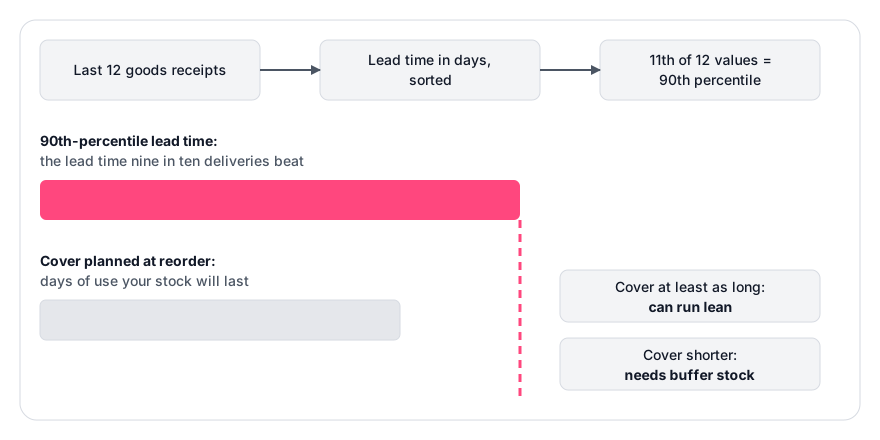
- List the last 12 receipts for one item, with order date and receipt date.
- Write each lead time in days, and sort them.
- Take the 11th value of 12 (the 18th of 20) as the 90th percentile.
- Multiply by daily use to get the cover needed at reorder.
- Pass if your planned cover is at least that. Fail if it is lower; more than one delivery in ten is likely to arrive after your stock runs out, and the gap between planned and required cover shows how much worse.
With 12 receipts the percentile is rough, so rerun it each quarter. The test only works if recorded stock matches the shelf, which a perpetual inventory system is meant to ensure. Where demand swings, a conventional buffer is set by safety stock.
- Demand
- Steady
- Supplier
- Delivers within promised days
- What to do
- Run lean: daily use × promised lead time, plus one extra day of use as a small buffer (recommended)
- Demand
- Steady
- Supplier
- Sometimes late
- What to do
- Hold cover to the 90th-percentile lead time
- Demand
- Swinging
- Supplier
- Any
- What to do
- Keep a conventional buffer, set by safety stock
Which terms get confused with just in time inventory?
Five terms sit close to it and are often mixed up with it:
- Just in case: the opposite approach, holding extra stock against disruption. Most firms mix both.
- Safety stock: the buffer that protects against late delivery or demand swings, which lean plans still need.
- Reorder point: the stock level that triggers an order, set from lead time and use.
- Inventory lead time: the days from ordering to receipt, the number the test above is built on.
- Vendor managed inventory: the supplier manages your stock levels. Just in time is about delivery timing, not who manages the stock.
How Arka Inventory handles it
Our inventory visibility shows stock across all warehouses, inventory on order and expected lead times, so you can compare planned cover with what is on hand and inbound. You still compute the 90th-percentile lead time from your own goods receipts. Our inventory alerts warn you when items approach or fall below minimum levels and when back-ordered items arrive. Set those minimums from the cover your test produces. Our forecasting and purchase automation lets you plan purchases and schedule purchase requisitions or purchase orders against stock levels and forecasts.
As of October 2026, the Basic plan costs $199 a month, billed yearly, and includes inventory alerts, multiple warehouses and purchase orders and transfers (see pricing). A 15-day free trial gives full access with no credit card.
Example
An item uses 40 units a day and the supplier promises 5 days. Twelve actual lead times are 5, 5, 6, 5, 9, 5, 5, 7, 5, 12, 5 and 6 days, so the mean is 6.25 days, the 90th percentile is 9 days and the worst is 12. Planning on the promise gives 5 × 40 = 200 units, which covers only the 7 of 12 receipts that arrived within 5 days. The test needs 9 × 40 = 360 units, so the plan is 160 units (4 days) short. These numbers are illustrative.
Frequently asked
Sources
- 1.Cambridge Institute for Manufacturing: JIT Just-in-Time manufacturing, University of Cambridge
- 2.Ortiz, Spread Too Thin: The Impact of Lean Inventories, Federal Reserve, April 2022
- 3.Choi, Netland, Sanders, Sodhi and Wagner, Just-in-time for supply chains in turbulent times, Production and Operations Management, July 2023
- 4.Toyota suspends all Japan factory operations after suspected cyberattack, CNBC, 28 February 2022
- 5.Screener ratio table: Maruti Suzuki, Screener, October 2026
- 6.Screener ratio table: Hero MotoCorp, Screener, October 2026
- 7.Screener ratio table: TVS Motor, Screener, October 2026
- 8.Screener ratio table: Bajaj Auto, Screener, October 2026
- 9.Screener ratio table: Endurance Technologies, Screener, October 2026
- 10.Screener ratio table: Uno Minda, Screener, October 2026
- 11.Screener ratio table: Bosch Ltd, Screener, October 2026
- 12.Screener ratio table: Sundram Fasteners, Screener, October 2026