Minimum Order Quantity: Test a Supplier's MOQ as Months of Cover
A minimum order quantity (MOQ) is the smallest amount a supplier will sell per order. Accept it only if the months of sales it adds fit your shelf life and cash.

By Praveen Nune, Co-Founder & CEO · Updated 14 Nov 2026
Key takeaways
- Accept an MOQ when the stock you hold just after delivery, divided by monthly sales, stays within your shelf life and the cash you can carry. Three months of cover is our starting ceiling for non-perishable goods.
- Ask which kind of MOQ you have: per order, per SKU (stock-keeping unit, one product variant), a pack multiple, or a rupee value. Each is negotiated differently.
- Batch, dye-lot (the fabric dyed in one batch, so a minimum run is one vat) and machine-setup minimums are fixed. Mix, delivery timing, packaging and payment terms are what suppliers move.
Netyex's published trial MOQs are 19% to 63% of its quoted MOQs in four categories (our midpoint calculation).
In this article
- 1What is a minimum order quantity (MOQ), and what forms does it take?
- 2Should you accept a supplier's MOQ? Run the cover test
- 3A worked example with a beverage MOQ
- 4What to do when the test fails
- 5What can you negotiate in a supplier's MOQ, and what is fixed?
- 6Five questions to put to the supplier
- 7How large are minimum order quantities in India, and how much smaller is a trial order?
- 8How does Arka Inventory help you keep MOQ-driven buying in check?
- 9Frequently asked questions
A supplier's MOQ looks like one number on a quote. The number you can act on is different: how many months of sales it puts on your shelf, and how much cash it locks up until that stock sells.
That is why two buyers facing the same MOQ can reach opposite decisions. A buyer with fast-moving, long-life stock should usually accept it. A buyer with slow or perishable stock may do better to pay a surcharge for a smaller order or split the batch.
This page gives you a cover test you can run in Excel in a few minutes. It also shows what Indian MOQs and trial orders look like in published figures, and which minimums a supplier can move and which it cannot.
Choosing the ideal quantity to order is a separate calculation, covered on our Economic Order Quantity page. Here the question is whether to take, split or negotiate a quantity the supplier has already set.
What is a minimum order quantity (MOQ), and what forms does it take?
A minimum order quantity (MOQ) is the smallest quantity a supplier accepts on one order, set so the order covers the supplier's setup, handling and material costs. It reaches you in four forms, and each needs a different question.
- Per order: a total number of units across everything you buy.
- Per SKU: a minimum for each size, colour or design, so ten variants multiply the commitment.
- Pack multiple: you can only buy whole cartons or pallets, so a figure of 1,000 may really mean "1,000 rounded up to full cartons".
- Order value: a minimum invoice amount in rupees, whatever the quantity.
Should you accept a supplier's MOQ? Run the cover test
Accept an MOQ when three checks pass: unsold stock at the end of shelf life, cover after delivery, and cash committed. Cover is the months of sales your stock will last. Use the model below, which is ours and not an official method. Put these inputs in Excel cells B2 to B9.
| Cell | Input |
|---|---|
| B2 | Stock on hand now |
| B3 | Stock already on order |
| B4 | Supplier MOQ |
| B5 | Average monthly sales |
| B6 | Supplier lead time, in months |
| B7 | Cost per unit (₹) |
| B8 | Months you can sell before expiry or obsolescence |
| B9 | Monthly cash budget you can set aside for this SKU (₹) |
- Cover after delivery, in months
Stock when the delivery lands is on hand plus on order minus sales during the lead time (use 0 if that is negative). Add the MOQ and divide by monthly sales:
=(MAX(0,B2+B3-B5*B6)+B4)/B5 - Cash committed
=B4*B7, to be compared with the budget in B9. For a fuller picture of what holding that stock costs, build your own rate with our guide to inventory carrying cost in India. - Unsold stock at the end of shelf life
=MAX(0,MAX(0,B2+B3-B5*B6)+B4-B5*B8)
Pass: all three hold. Unsold stock at the end of shelf life is zero (which also means cover is within shelf life). Cover after delivery is 3 months or less. Cash committed (B4×B7) is no more than the budget in B9. Fail: any of these breaks.
The three-month ceiling is our recommendation, to be raised only with a reason. One Indian planner has published a similar workplace rule: refuse an MOQ above three months of inventory, with orders under ₹20,000 assessed separately, and require both buyer and planner to approve any MOQ (SuppChainTalks, July 2022). That is one workplace's rule, not a standard.
A worked example with a beverage MOQ
The MOQ range and cost per litre come from a contract manufacturer, Foodsure, which publishes a juice MOQ of 2,000 to 5,000 litres and a manufacturing cost of ₹50 to ₹150 per litre (Foodsure, 9 March 2026). Every buyer input below is our assumption: 1,200 L on hand, none on order, 800 L sold a month, a one-month lead time, ₹100 per litre and four months of shelf life.
Stock on arrival is 1,200 − (800 × 1) = 400 L.
| Check | MOQ 2,000 L | MOQ 5,000 L |
|---|---|---|
| Cover after delivery | (400 + 2,000) ÷ 800 = 3.0 months | (400 + 5,000) ÷ 800 = 6.75 months |
| Cash committed | ₹2,00,000 | ₹5,00,000 |
| Unsold at 4 months | 0 L | 400 + 5,000 − (800 × 4) = 2,200 L (₹2,20,000 at cost) |
| Result | Passes the unsold-stock and cover tests, the latter at the ceiling; the cash test depends on your B9 | Fails the unsold-stock and cover tests |
What to do when the test fails
| Result | What to try |
|---|---|
| Cover is over the ceiling but shelf life is fine, and the MOQ is per order or per SKU | Ask to mix SKUs, or to commit to the full quantity and take delivery in lots. |
| Cover is over shelf life and the MOQ is set by batch size | Change the pack format, share a batch with another buyer, or find another supplier. In Foodsure's figures, Tetra Pak has about 40% lower MOQ than cans. |
| Cash is the problem | Ask for staged deliveries or longer credit; do not offer advance payment. |
| The MOQ is a handling minimum and you can pay early | Offer 100% advance payment in exchange for a smaller trial quantity, if you can afford the cash. |
What can you negotiate in a supplier's MOQ, and what is fixed?
Negotiate what does not change the supplier's cost per batch: the mix of sizes, colours or SKUs, delivery timing, packaging and payment terms. Raw-material minimums, dye-lot sizes and machine setup runs are non-negotiable (Netyex, 25 August 2026).
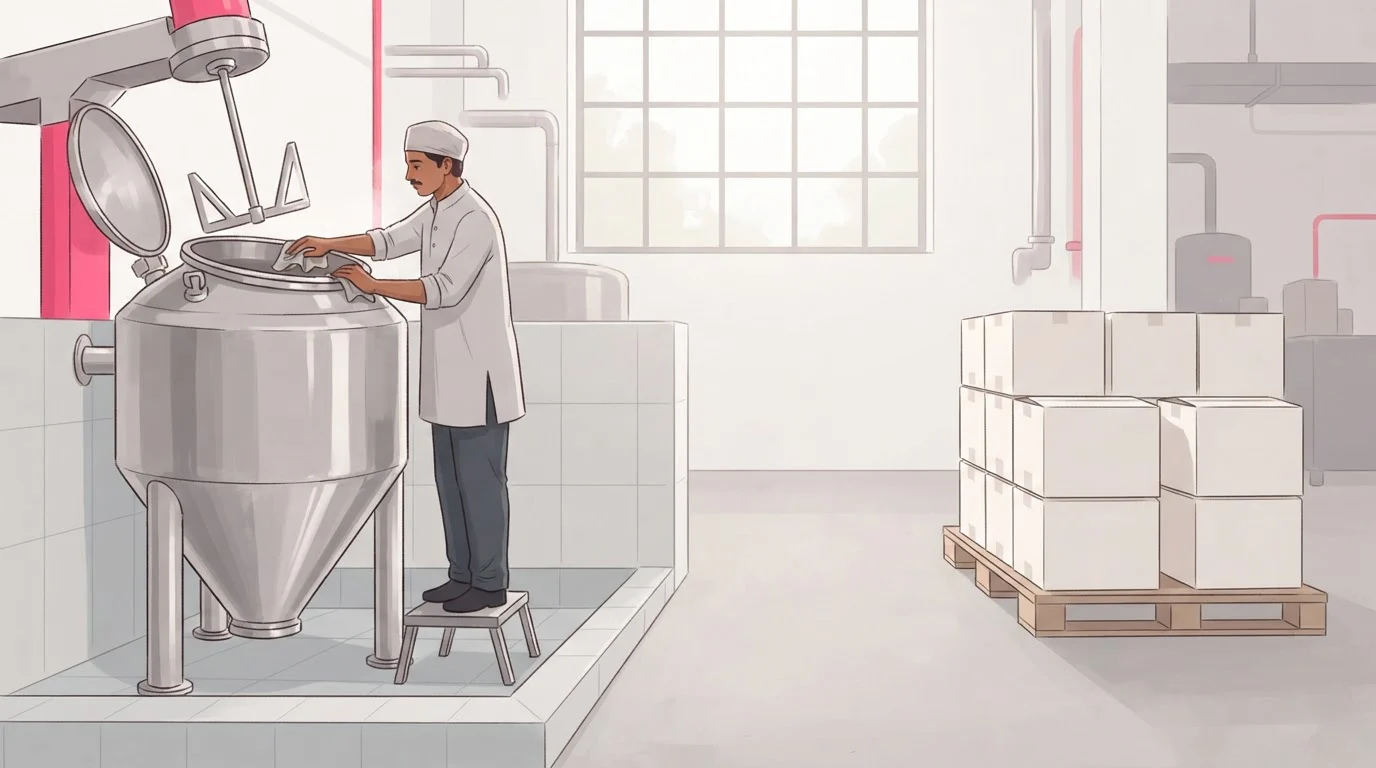
Changing flavour on a line needs 4 to 8 hours of cleaning (Foodsure, 9 March 2026). Our reasoning: a changeover of 4 to 8 hours costs the same whatever the order size, so a small order carries all of it. The MOQ is that cost spread across a minimum run.
Quantity within limits and private labelling can also move (Netyex, 25 August 2026). Offering 100% advance payment in place of the usual 30/70 milestone split is worth testing: it removes the supplier's cash-flow risk on a small batch, and Netyex reports it typically moves suppliers further than price does. That is one firm's report, so treat it as a lever to test.
Ask what sets the number before you ask for a lower one.
Five questions to put to the supplier
- Is the MOQ per order, per SKU, or per size or colour? A pass is an answer in writing.
- What sets it: batch size, a raw-material or dye-lot minimum, packaging, or order handling? Batch and dye-lot answers mean the number will not move.
- What is the smallest trial order, and at what price per unit?
- Can we mix SKUs, or commit to the full quantity and take delivery in lots?
- What changes if we pay in advance or accept a different pack format?
A short email you can adapt:
Subject: Trial order request for [product]
Hello [name], we would like to buy [product]. Your quoted minimum is [MOQ]. Is it per order or per [size/colour/SKU]? We would like to place a trial order of [quantity] and reorder every [period] if sales are steady. Please share your price per unit at that quantity, and whether mixing [sizes] or delivery in [number] lots would help meet your minimum. We are open to discussing payment terms. Regards, [name, company]
How large are minimum order quantities in India, and how much smaller is a trial order?
Published Indian MOQs range from a few hundred pieces for handicrafts to thousands of litres for beverage co-packing (a contract manufacturer filling your product). In the four categories where a sourcing firm publishes both a quoted and a trial MOQ, the trial order is 19% to 63% of the quoted figure (our calculation).
Foodsure's published MOQs (Foodsure, 9 March 2026):
| Product | Published MOQ |
|---|---|
| Juices | 2,000–5,000 litres |
| Carbonated drinks | 5,000–20,000 litres |
| Health drinks | 1,500–4,000 litres |
| Private label | 2,500–7,500 units |
Netyex's quoted and trial MOQs (Netyex, 25 August 2026), with our trial share. We took the midpoint of each range and divided trial by quoted. We used the four of its six categories that give numeric ranges and left out hotel textiles ("1,000+") and furniture (container loads).
| Category | Quoted MOQ | Trial MOQ | Trial as share of quoted |
|---|---|---|---|
| Handicrafts | 300–500 pcs | 50–100 pcs | 75 ÷ 400 = 19% |
| Home linen | 500–1,000 pcs | 100–300 pcs | 200 ÷ 750 = 27% |
| Kitchenware | 1,000–2,000 pcs | 500–800 pcs | 650 ÷ 1,500 = 43% |
| Hand-tufted rugs | 30–50 sq m | 20–30 sq m | 25 ÷ 40 = 63% |
These figures come from one beverage co-packer and one sourcing firm. They show scale and spread, and they do not show what your supplier will accept. Use them to judge whether a trial quote is in a believable range, then confirm with the supplier.
How does Arka Inventory help you keep MOQ-driven buying in check?
We keep the three inputs of the cover test in one place: stock on hand across locations, stock on order, and expected lead times, shown on our inventory visibility view. You take those figures into the test above before you confirm an order.
- Alerts: inventory alerts warn you when items approach or fall below minimum stock levels, so your own reorder trigger fires before the order is urgent.
- Plan and price: as of November 2026, the Basic plan, which includes purchase orders, warehouse transfers and inventory alerts, costs $199 a month, paid yearly (Arka Inventory pricing).
- Purchase planning: forecasting and purchase automation lets you plan purchases from real orders, forecasts and stock, and schedule purchase requisitions or purchase orders.
Lead time is easy to guess wrong, so measure it. Our glossary entry on inventory lead time explains how to measure it.
Our 15-day free trial gives full access to all features, with no credit card. To see it with your own suppliers, talk to us through contact sales.
Frequently asked questions
Sources
- 1.Foodsure, "Beverage Manufacturing MOQ in India", Foodsure, 9 March 2026
- 2.Netyex, "Minimum Order Quantity for Trial Orders in India: What's Actually Negotiable", Netyex, 25 August 2026
- 3.SuppChainTalks, "Why sometimes lays are available in 30 rupees pack?", SuppChainTalks, 24 July 2022
- 4.SAP Note 2468048
- 5.Arka Inventory, Inventory Visibility, Arka Inventory
- 6.Arka Inventory, Pricing, Arka Inventory