Bill of Materials Example: Layout, Fields and a Worked Product
A bill of materials example lists one finished product and each part in it, with quantity, unit and make or buy. Building it lowers part stock and raises finished stock.

By Praveen Nune, Co-Founder & CEO · Updated 13 Nov 2026
Key takeaways
- A BOM example needs one finished item and, for each part, a part number, description, quantity per unit, unit of measure and make or buy. Packaging and consumables count as parts, because they leave stock when you build.
- Put scrap into the quantity. The gasket is 1.03 per set (1 plus 3% scrap), so 100 sets take 103 gaskets, and the build adds 100 finished sets.
- Pack sizes need a whole-number decision. By the BOM, 100 sets use 16.67 master cartons (100 ÷ 6), and the stores issue 17.
- Five pass or fail checks (units, packaging, shared parts, scrap, review date) catch the errors that make a stock record drift from the shelf.
- As of November 2026, BOM, production and kitting start on the Advance plan in Arka Inventory. Salesforce licences are bought separately.
In this article
- 1What does a bill of materials example look like?
- 2What does a bill of materials include, and which fields does every line need?
- 3How do you write a manufacturing bill of materials example for a 3-tier steel tiffin set?
- 4The flat parts list
- 5The same tiffin set with one subassembly (indented view)
- 6Quantities for a batch of 100
- 7What happens to your stock when you build 100 tiffin sets?
- 8Which five mistakes break a first BOM?
- 9Do your units match what you issue and buy?
- 10Is the packaging on the BOM?
- 11Is each shared part keyed once?
- 12Is scrap written into the quantity?
- 13Does the BOM carry a review date?
- 14How do we turn a BOM into production records in Arka Inventory?
- 15Which five checks should you run on your own product first?
- 16Frequently asked questions
All figures below are illustrative assumptions, not customer data, written for small Indian manufacturers and assemblers building a first bill of materials (BOM).
A bill of materials example is quick to write and harder to get right. For a 3-tier steel tiffin set, the parts list takes minutes. The real test comes when 100 sets are built and the stock record has to agree with the shelf. In this BOM example, three gaskets in every hundred are spoiled when fitted, so the BOM has to carry that scrap.
It is small enough to copy, and every number is worked out on the page, so you can swap in your own parts and redo the sums. The effort pays off because inputs are most of what a factory turns into output. In the Annual Survey of Industries 2024-25, India’s registered factories reported total input of ₹138.3 lakh crore against output of ₹165.2 lakh crore, about 84% (our arithmetic). A BOM is where those inputs are counted, one unit at a time.
What does a bill of materials example look like?
A bill of materials example is one finished product at the top and one row for every part that goes into a single unit, each with its quantity. That layout, the bill of materials format, stays the same whether you build tiffin sets or electronic assemblies. Table 1 shows the 3-tier steel tiffin set.
| Item | Quantity per set |
|---|---|
| Container, 14 cm | 3 |
| Lid | 1 |
| Gasket | 1.03 (1 plus 3% scrap) |
| Carrier frame | 1 |
| Locking clip | 1 |
| Handle | 1 |
| Rivet | 4 |
| Polishing compound | 5 g |
| Label | 1 |
| Polybag | 1 |
| Gift box | 1 |
| Master carton (holds 6 sets) | 1/6 (0.1667) |
Read it as a recipe for one set. Quantities are always per one finished unit, never per batch, so the same BOM serves an order of 10 or 1,000.
What does a bill of materials include, and which fields does every line need?
A bill of materials includes the finished item and, for every part, a part number, description, quantity per unit, unit of measure, make or buy, and a note. Packaging and consumables such as polishing compound belong on it as well, because they leave stock every time you build.
| Field | Why it matters | Example value |
|---|---|---|
| Part number | Gives each part one name across purchasing, stores and BOMs | CNT-14 |
| Description | Lets the shop floor recognise the part | Container, 14 cm |
| Quantity per unit | Drives every requirement, for one finished set | 3 |
| Unit of measure | Must match how you issue the part; convert it to the unit you buy in | Gasket in nos (numbers of pieces), bought as a 50 m sealing strip at 0.4 m each, so 1 roll = 125 nos. Polishing compound in g, bought by the kg (1 kg = 1,000 g) |
| Make or buy | Tells you whether to purchase the part or build it first | Tiffin set: make. Container: buy |
| Notes | Records packaging, consumables and scrap allowance | Gasket: 1.03 per set (1 plus 3% scrap). Carton: 1 per 6 sets |
Keep one unit of measure per part and write the conversion once. Cost is a useful extra column, but this page leaves it off so the quantities stay clear.
How do you write a manufacturing bill of materials example for a 3-tier steel tiffin set?
Write it in three passes: list every part flat, indent the one part you assemble yourself, then multiply by the batch size. This simple bill of materials example assumes you buy containers, lids, gaskets and cartons, and assemble the carrier in-house from a bought frame, clip, handle and rivets.
The flat parts list
A flat parts list shows every part at one level under the finished set. Table 3 is the one full table, with unit of measure, make or buy and notes.
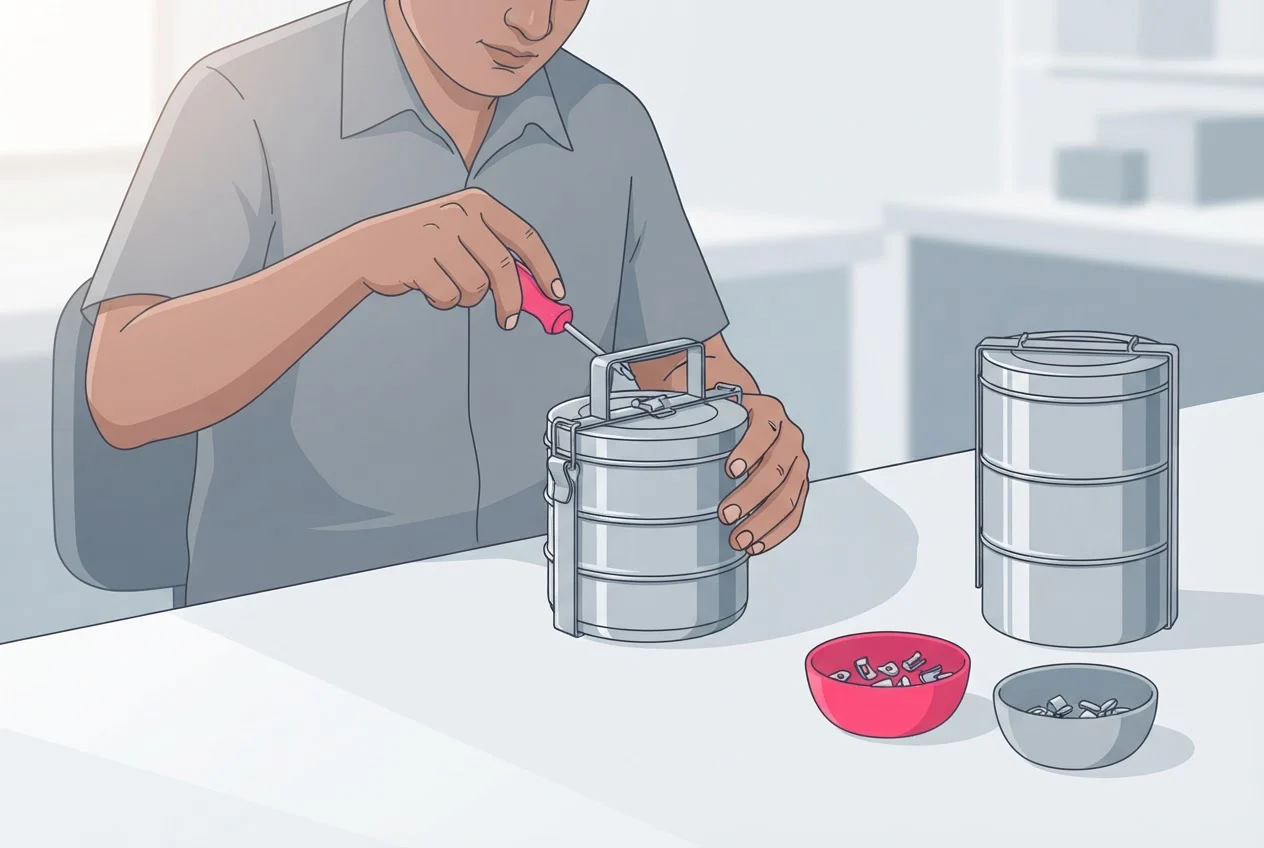
| Part no. | Item | Qty per set | Unit of measure | Make or buy | Notes |
|---|---|---|---|---|---|
| FG-TIF-3T | Tiffin set, 3-tier (output) | 1 | nos | Make | Polished and packed |
| CNT-14 | Container, 14 cm | 3 | nos | Buy | Bought formed |
| LID-14 | Lid | 1 | nos | Buy | |
| GSK-14 | Gasket | 1.03 | nos | Buy | Cut from sealing strip, 0.4 m each; 1 plus 3% scrap |
| CAR-FRM | Carrier frame | 1 | nos | Buy | Carrier part |
| CAR-CLP | Locking clip | 1 | nos | Buy | Carrier part |
| CAR-HDL | Handle | 1 | nos | Buy | Carrier part |
| RIV-4 | Rivet | 4 | nos | Buy | Carrier part |
| CON-POL | Polishing compound | 5 | g | Buy | Consumable; bought by the kg |
| PKG-LBL | Label | 1 | nos | Buy | Packaging |
| PKG-BAG | Polybag | 1 | nos | Buy | Packaging |
| PKG-BOX | Gift box | 1 | nos | Buy | Packaging |
| PKG-CTN | Master carton | 0.1667 | nos | Buy | Packaging; 1 per 6 sets |
The same tiffin set with one subassembly (indented view)
An indented view shows the carrier as a subassembly, a part you make in-house from other parts, with its own parts one step to the right. Figure 1 draws the same tiffin set as Table 3.
Figure 1: Indented view of the 3-tier steel tiffin set (illustrative assumptions, not customer data)
Tiffin set, 3-tier (FG-TIF-3T) x1
|-- Container, 14 cm (CNT-14) x3
|-- Lid (LID-14) x1
|-- Gasket (GSK-14) x1.03
|-- Carrier (CAR-ASM) x1 made in-house
| |-- Carrier frame (CAR-FRM) x1
| |-- Locking clip (CAR-CLP) x1
| |-- Handle (CAR-HDL) x1
| `-- Rivet (RIV-4) x4
|-- Polishing compound (CON-POL) 5 g
|-- Label (PKG-LBL) x1
|-- Polybag (PKG-BAG) x1
|-- Gift box (PKG-BOX) x1
`-- Master carton (PKG-CTN) 1 per 6 sets
The carrier is the only subassembly. The set takes one carrier, and the carrier takes one frame, one clip, one handle and four rivets. Giving the carrier its own recipe means you can reuse it in a second product later. For a fuller look at how nested parts lists are laid out, see our glossary.
Quantities for a batch of 100
For 100 sets, multiply every quantity per set by 100, a step planners call a BOM explosion. Gaskets are already 1.03 per set (1 plus 3% scrap), so 100 × 1.03 = 103. Cartons are the one line that needs a whole-number decision: they hold 6 sets, so 100 ÷ 6 = 16.67, rounded up to 17.
Carton rounding is a purchasing decision, not a BOM quantity. The BOM stays at one-sixth of a carton per set, because the next batch may fill the part-used carton. Everything else is quantity per set × 100, shown in Table 4. Costs are left out on purpose; once the quantities hold, you can put a rupee value on each line.
What happens to your stock when you build 100 tiffin sets?
In a system that records the build, each part falls by quantity per set × sets built, and finished goods rise by the sets completed. Building 100 tiffin sets takes 103 gaskets and 16.67 cartons by the BOM, issued as 17 whole cartons, and adds 100 finished sets, as Table 4 shows.
| Item | Before | Change | After |
|---|---|---|---|
| Container, 14 cm | 1,200 | −300 | 900 |
| Lid | 500 | −100 | 400 |
| Gasket | 400 | −103 | 297 |
| Carrier frame | 300 | −100 | 200 |
| Locking clip | 300 | −100 | 200 |
| Handle | 300 | −100 | 200 |
| Rivet | 2,000 | −400 | 1,600 |
| Polishing compound (g) | 3,000 | −500 | 2,500 |
| Label | 1,000 | −100 | 900 |
| Polybag | 800 | −100 | 700 |
| Gift box | 400 | −100 | 300 |
| Master carton | 60 | −16.67 (17 issued) | 43.33 (43 on the shelf) |
Tiffin set, finished | 20 | +100 | 120 |
The 103 gaskets leave stock because 100 are fitted and 3 are consumed as scrap, while finished sets rise by 100. By the BOM, cartons fall by 16.67 (100 × 1/6). The stores issue 17 whole cartons because the 17th is opened with 4 sets in it, two-thirds full, so the shelf shows 43 whole cartons. The 0.33 difference is the space left in the opened carton for the next 2 sets. The carrier is assembled from frames, clips, handles and rivets and then fitted, so its own stock ends where it began.
The stock record only matches the shelf if the quantity per unit already includes scrap.
A build has a before and an after. Before it, a gasket shortfall becomes a purchase, and how planning turns a BOM into dated purchases is covered separately. At release, confirm the job carries the BOM version you approved (what a production order checks before release).
Which five mistakes break a first BOM?
Five mistakes make a first BOM disagree with the shelf: mismatched units, missing packaging, shared parts keyed twice, scrap ignored and no review date. Run each as a pass or fail test on your own BOM, using the tiffin set as the model.
Do your units match what you issue and buy?
Pass: the gasket line is in nos, and receiving one 50 m roll adds 125 nos (50 ÷ 0.4). Fail: the stock is held in metres while the BOM line says 1.03, so 100 sets take 103 m off the record instead of 41.2 m (103 × 0.4).
Is the packaging on the BOM?
Pass: the label, polybag, gift box and master carton (1 per 6 sets) are all lines. Fail: the carton is missing, so 100 sets ship, carton stock never moves and you find the gap only when the shelf is empty.
Is each shared part keyed once?
Pass: the rivet is RIV-4 on every BOM that uses it. Fail: one BOM says "Rivet 4 mm" and another RIV-4, creating two stock records, so neither shows the true balance and you may reorder what you already hold.
Is scrap written into the quantity?
Pass: the gasket line is 103 per 100 sets, so the record matches the shelf after the batch. Fail: the BOM says 100, the shelf is 3 gaskets short after one batch, and after ten batches the record is 30 gaskets above the shelf (3 × 10).
Does the BOM carry a review date?
Pass: each BOM shows the date it was last checked and is rechecked when a part or supplier changes. Fail: the supplier moves to a 15 cm container, the lid line still reads LID-14, and nobody can say which BOM is current.
Leave cost off a first BOM until all five checks pass.
How do we turn a BOM into production records in Arka Inventory?
In Arka Inventory you create standard and order-based BOMs, check material availability against each BOM, plan purchases, and track consumption and production. A standard BOM suits the tiffin set you build every month. An order-based BOM suits a one-off order.
Before building 100 sets, the availability check shows whether each line has enough stock, such as the 300 containers in Table 4. You then plan the purchases that close any gap, and track what is consumed and produced as the build runs. It turns the BOM you wrote above into a working record.
As of November 2026, BOM, production and kitting start on the Advance plan; see our pricing page. We are built natively on Salesforce, so each user signs in with a Salesforce login, and Salesforce licences are bought from Salesforce and priced separately from our subscription.
We publish this page and sell inventory software, so weigh this section accordingly. If you are still choosing tools, what to ask before choosing a BOM tool sets out the questions.
Which five checks should you run on your own product first?
Take your own best-selling product, write its BOM in the layout of Table 3, and run the five checks above. If any check fails, fix the BOM before you record a build. If all five pass, build one small batch, count the parts on the shelf and compare the result with the stock change in Table 4. The two should agree, scrap included.
When the sheet gets hard to keep in step, move the BOM into a system. Standard and order-based BOMs in Arka Inventory come with availability checks, purchase planning and consumption tracking, and you can ask our team for the 15-day free trial to test your own product. Check the trial terms and the Salesforce licence each user needs before you start.
Frequently asked questions
Sources
- 1.Bill of Material feature page, Arka Inventory (ARKA BIZAPPS PRIVATE LIMITED)
- 2.Pricing page, Arka Inventory, November 2026
- 3.Kitting and Bundling feature page, Arka Inventory
- 4.Production Order glossary page, Arka Inventory