
Production Planning and Control: Link Schedules, BOMs and Stock Availability
An order that reaches the shop floor and stops for want of one component has already cost you the day it was meant to save. Production planning and control (PPC) is the routine that prevents this.

By Praveen Nune, Co-Founder & CEO · Updated 5 Nov 2026

Key takeaways
PPC is a loop. Planning sets the route, loading and dates, control tracks and corrects the work, and a release gate sits between the two.
Test every BOM line before release. An order goes to the floor only if each line has enough available stock on the start date. One failed line holds the whole order.
Most slipped schedules trace back to three causes. These are a stale BOM, committed stock counted as free, and a supplier date assumed to hold.
Run on a rhythm. Review shortages, late orders, work in progress and variances on a fixed schedule, and pass four data tests (BOM, item masters, bin counts, lot tracing) before you trust the gate.
In this article
- 1What is production planning and control (PPC)?
- 2Production planning vs production control
- 3Steps in the production planning and control process
- 4What are the objectives and functions of production planning and control?
- 5Why do production schedules slip when the plan and the stock data disagree?
- 6What inputs does PPC depend on: the BOM and production schedule, and stock availability?
- 7How do you run a material availability check before production order release?
- 8Which signals should production control review daily and weekly?
- 9Is your data ready for a pre-release check?
- 10How does Arka Inventory support the material side of PPC?
- 11Conclusion
- 12Frequently asked questions
PPC decides what to make, when and with which materials, then tracks the work and corrects any gap. Its most useful control is a pre-release check: release an order only when its parts list (BOM), start date and available stock all agree.
This guide walks through the steps of PPC, shows where the plan and your stock records drift apart, and gives you a line-by-line check you can run on any order before it reaches the floor.
What is production planning and control (PPC)?
PPC is the routine that turns demand into finished goods on time. Planning settles what to make, how much, by when and by which route. Control sends the work to the floor, compares progress with the plan and corrects any gap. It works as a loop, because every correction changes the plan for the next order.
Production planning vs production control
Production planning works before the work starts: it decides the route, the loading and the dates. Production control works once the work has started: it releases orders, watches progress and fixes deviations. Planning answers "what should happen?" Control answers "what is happening, and what do we do about it?"
Steps in the production planning and control process
The PPC steps run in two halves. Planning covers routing, loading and scheduling. Control covers dispatching, follow-up and corrective action. The release gate sits at the handover from planning to dispatching: an order moves on only when its materials are available.
Planning
- Routing: set the sequence of operations and where each one happens.
- Loading: assign the planned work to the people and machines that will do it.
- Scheduling: fix a start and finish date for each operation and each order.
Release gate: confirm the BOM, start date and available stock agree. If they do not, hold the order.
Control 4. Dispatching: release the order to the floor with its instructions and materials. 5. Follow-up: compare progress with the schedule while work is under way. 6. Corrective action: close the gap by chasing a part, re-dating an order or changing the plan. The correction feeds back into planning.

What are the objectives and functions of production planning and control?
PPC has four practical objectives: deliver orders on the promised date, use materials, people and machines well, hold stock at the level the plan needs, and keep work flowing without stoppages. The pre-release check serves all four by stopping orders that cannot be finished.
PPC does this through a set of working functions: routing the work, estimating times, scheduling and loading, controlling materials, dispatching orders, following up on progress, inspecting output and evaluating results against the plan. In this guide, materials control is the function that decides whether an order may leave the planning half of the loop.
Why do production schedules slip when the plan and the stock data disagree?
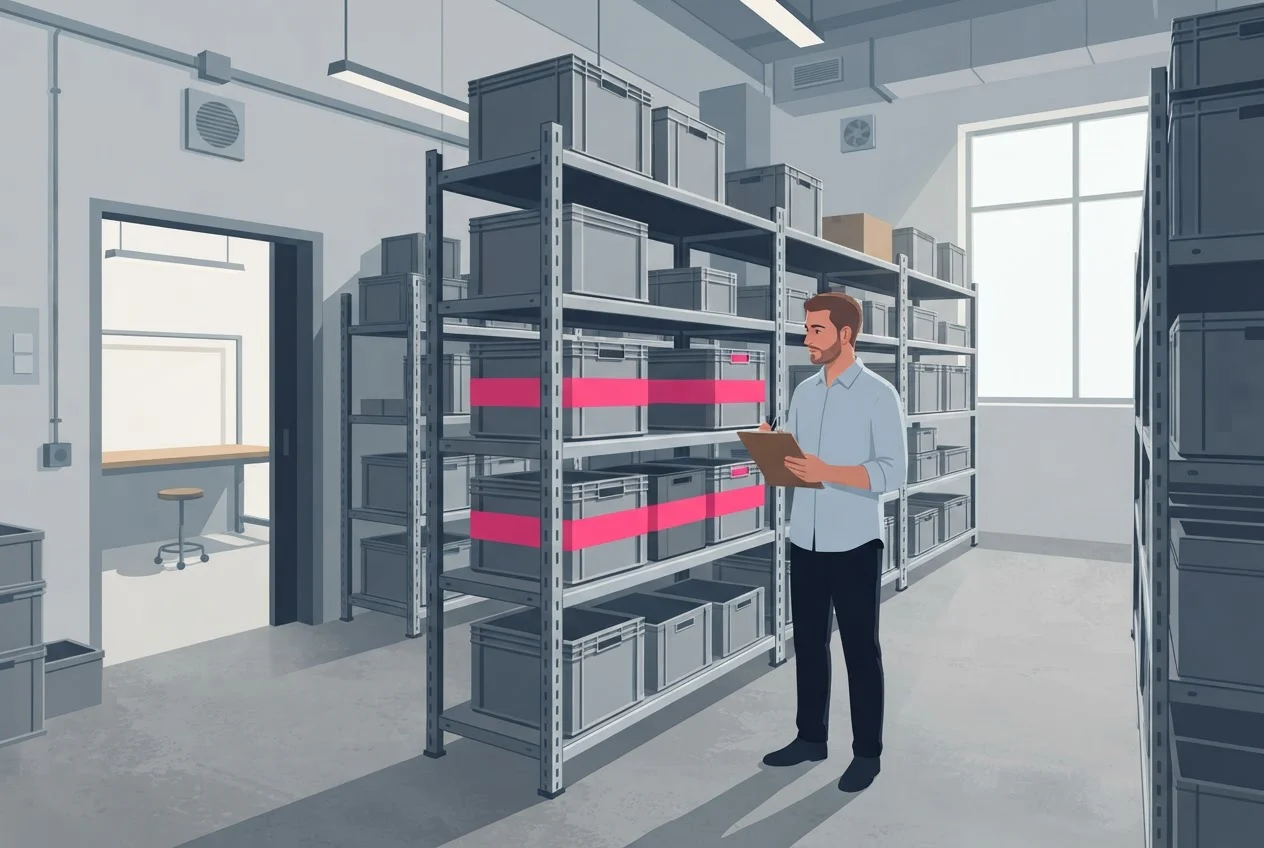
Schedules slip when the plan assumes stock the warehouse cannot supply on the start date. Three causes are common.
- A stale BOM. The product changed on the floor but the parts list did not. The plan then asks for the wrong parts or the wrong quantities.
- Committed stock counted as free. Illustratively, the shelf holds 80 enclosures, but 45 are promised to another order. The plan sees 80.
- An incoming purchase date assumed to hold. A delivery due on Friday is treated as stock on Wednesday.
Each cause is the plan and the records disagreeing. One number settles it before release: how much of each component this order can use on its start date. That is the figure covered in our guide to inventory visibility.
What inputs does PPC depend on: the BOM and production schedule, and stock availability?
PPC rests on three inputs: the production schedule, the BOM and stock availability. The schedule gives each order a start date. The BOM gives each order its required quantities. Stock availability says whether those quantities exist on that date.
- Schedule. Start dates come from customer orders and a forecast. For the forecast, see inventory forecasting methods. Our forecasting and purchase automation page covers planning purchases from orders, forecasts and stock.
- BOM. A bill of materials (BOM) lists the components and quantities needed for one unit. A multi-level BOM nests sub-assemblies inside assemblies. Our bill of material feature covers building and managing them.
- Stock availability. This means on-hand, committed and incoming stock. Incoming dates depend on supplier lead times.
Material requirements planning (MRP) nets requirements against stock across levels and weeks; see our guide to MRP netting. PPC needs only its result, order by order.
How do you run a material availability check before production order release?
Release an order only when the BOM, the schedule date and available stock agree. Available means on-hand, minus committed, plus incoming stock that arrives on or before the start date. Run this for every BOM line, and release the order only if every line passes. This is the production order release gate. For the order-level checklist (BOM version, components and partial starts), see our guide to the production order release check.
Terms used in the check:
- On-hand: the quantity physically in stock.
- Committed: the quantity already promised to other orders.
- Incoming: the quantity on open purchase orders, counted only if the supplier date falls on or before the start date.
Illustrative example (figures invented for teaching, not client data). An order for 50 motor starter boxes starts on Tuesday 24 November.
| BOM line | Required quantity | Schedule date | On-hand | Committed | Incoming (due) | Available now | Available by start date | Release / HOLD |
|---|---|---|---|---|---|---|---|---|
| Enclosure (1 per box) | 50 | 24 Nov | 80 | 45 | 0 | 35 | 35 | HOLD (short 15) |
| Terminal block (6 per box) | 300 | 24 Nov | 500 | 150 | 0 | 350 | 350 | Release |
| Cable gland (2 per box) | 100 | 24 Nov | 60 | 0 | 80 (20 Nov) | 60 | 140 | Release |
| Wiring harness (1 per box) | 50 | 24 Nov | 40 | 10 | 40 (27 Nov) | 30 | 30 | HOLD (short 20) |
Verdict: HOLD. Two lines fail. The cable gland line passes only because of its 20 Nov delivery, so it depends on that date holding. You have four ways to resolve the held lines:
- Expedite the purchase. Ask the supplier to bring the 40 harnesses forward to 24 Nov, which gives 70 available. Order at least 15 enclosures.
- Substitute a component. If an approved alternative enclosure is in stock and the BOM allows it, use it for the 15 short.
- Split the order. Release 30 boxes now, since the harness limits you to 30. Hold the other 20 until 15 more enclosures and the 27 Nov harnesses arrive.
- Move the date. The earliest full start is 27 Nov, when harness availability reaches 70. This works only if the 15 enclosures also arrive by then.
Run the check again at the moment of release, not only when you plan the order, because commitments change in between. One vendor's manufacturing documentation describes a report that separates orders with all material available from those with shortages (Material Readiness report); another product's documentation describes releasing work orders with all critical materials assigned and holding those with shortages (release note). This is documented practice, not a measured outcome. The gate is only as reliable as your records.
Which signals should production control review daily and weekly?
We recommend reviewing four signals: shortages, late orders, work in progress and variances. Each has a rhythm and a standing action, so a problem becomes a task instead of a surprise. Work in progress (WIP) is partly finished goods on the floor. See our WIP inventory guide for how to read its progress.
| Signal | Frequency | Action |
|---|---|---|
| Shortages: held orders, the short lines and how long each has been held | Daily | Expedite, substitute, split or re-date. A shortage found after release means the gate missed something, so trace why. |
| Late orders: orders past their start or due date | Daily | Find the blocking line or operation. Tell the customer the new date. |
| WIP progress: orders still at the same stage across two reviews | Daily, with a weekly summary | Walk the floor for that order and clear the blockage. |
| Variances: components used against BOM quantity | Weekly | If one item varies repeatedly, correct the BOM or the process. |
Is your data ready for a pre-release check?
Your data is ready when four tests pass. The gate cannot be better than the records behind it. Run each test on a small sample before you rely on the check.
BOM accuracy: take 5 finished items and compare one real build against its BOM. Pass: every line matches within your agreed scrap allowance. Fail: any component is missing or extra.
Item masters: check 20 components. Pass: each has one active code and the same unit of measure in the BOM and in stock. Fail: any duplicate code or unit mismatch.
Warehouse and bin data: count 10 components at their recorded bin. Pass: system quantity equals the physical count in that bin. Fail: stock sits in an unrecorded location.
Lot tracking: trace 5 recent receipts from lot number to the order that used them. Pass: every lot traces end to end. Fail: any lot cannot be found.
How does Arka Inventory support the material side of PPC?
We cover the material side of PPC: the BOM, the stock and the commitments the release check reads. Scheduling stays in your own process. You bring the start date, and the check runs against it. We do not set your schedule.
- BOM and manufacturing. Our manufacturing feature supports BOM-based builds, assemblies and disassemblies. It also gives batch traceability and visibility of work-in-progress cost. Our bill of material feature lets you assess the availability of materials against the BOM, which is the comparison the release check depends on. As of November 2026, Bills of Material, Production and Kitting are included from the Advance plan; lot and serial tracking is on Enterprise. See pricing.
- Commitments. Our Commit Inventory feature commits and allocates inventory for orders. Commit Inventory records what is committed to orders, which feeds the Committed column.
- Purchasing. Forecasting and purchase automation helps plan the purchases that arrive as incoming stock.
- Control views. Our custom reports and dashboards let you shape stock and production views around the signals above.
All of it runs natively inside Salesforce.
Conclusion
Before you release the next order, run the material check on every BOM line. If any line is short on the start date, hold the order and resolve that line first. Use a simple rule: if the gap is small and the supplier date is firm, expedite or substitute; if the gap is large, split the order or move the date, and tell the customer early. In the next two days, run the four data tests on one product family, because the check is only as reliable as your BOM, stock and commitment records. Then review shortages and late orders every day. Book a demo to see how Arka Inventory holds the BOMs, stock and commitments this check reads, natively inside Salesforce.
Frequently asked questions
Inventory sets what a plan can actually deliver. A schedule is only achievable if the components exist when the order starts. Reliable inventory visibility lets you judge that before you release.
Sources
- 1.Material Readiness report for production release, Manufacturing documentation (production control module; no date shown)
- 2.Material availability for work order prioritisation, Manufacturing release note (a different product, release 26A; no date shown)
- 3.Manufacturing, Arka Inventory
- 4.Bill of material, Arka Inventory
- 5.Commit Inventory, Arka Inventory
- 6.Forecasting and purchase automation, Arka Inventory
- 7.Custom reports and dashboards, Arka Inventory
- 8.Pricing, Arka Inventory