Inventory Visibility: The Number to Quote Before You Promise Stock
Inventory visibility means per-warehouse figures for on hand, committed, incoming and unreserved orders, so you can quote the lowest projected free stock from today to the end of the planning horizon.

By Praveen Nune, Co-Founder & CEO · Updated 1 Nov 2026

Key takeaways
- Quote available to promise (ATP), not total on hand: take each warehouse's projected free stock day by day and use the lowest point from today to the end of the planning horizon.
- Check one is that a salesperson sees free stock per warehouse on the quote line itself, with no call to operations.
- Microsoft documents the lowest-point-in-the-horizon rule for its Inventory Visibility add-in, with a schedule period that defaults to 30 days and can be set up to 180.
- You can run the checks on your own data in our 15-day free trial, with full access and no credit card.
In this article
- 1What is inventory visibility, and which number should you quote to a customer?
- 2Why does total on-hand stock across warehouses overstate what you can promise?
- 3How does the delivery date change available to promise?
- 4How do you work out ATP across two warehouses?
- 5How do you test whether your system shows ATP?
- 6Can a salesperson see free stock per warehouse on the quote or order line?
- 7Does the screen separate committed stock from on hand?
- 8Are unreserved orders and incoming deliveries visible with dates?
- 9Does the screen match the shelf?
- 10How does Arka Inventory show ATP inside Salesforce?
- 11Frequently asked questions
A business can hold 65 units of an item and safely promise only 15 of them. The shelf count is right. The figure a salesperson reads from the screen is the problem.
Many stock screens lead with one figure per item: physical stock added up across warehouses. A quote needs a different figure. It must leave out stock already reserved for other orders and stock sitting in the wrong warehouse. It must count orders sold for next week that nobody has reserved yet. A 20-unit order sold for next week but not yet reserved changes nothing on a screen that shows only today's stock. It must also count what is arriving, and when. Without that, a sales team promises from the wrong number, and operations finds out when the truck is due.
Below are a two-warehouse example with the arithmetic shown, a check you can run on your own stock this week, and how we handle it in Arka Inventory for teams that run on Salesforce.
What is inventory visibility, and which number should you quote to a customer?
Inventory visibility is knowing, for every item in every warehouse, how much is on hand, how much of that is committed, what is incoming and when, and which confirmed orders have not yet reserved stock. The number to quote is available to promise (ATP): the lowest projected free stock from today to the end of the planning horizon.
We use these terms throughout:
- On hand: units physically in the warehouse.
- Committed: units reserved against orders that have not shipped. They stay on the shelf but cannot be sold again. In Microsoft's documentation, a soft reservation leaves physical inventory unchanged but deducts from the quantity available for reservation.
- Free stock: on hand minus committed.
- Incoming: units due from purchase orders or production, with a date.
- Unreserved orders: confirmed customer orders with future delivery dates that have not yet reserved stock.
- Projected free stock on a given day: on hand − committed − unreserved orders due by that day + incoming due by that day.
- Available to promise (ATP): the lowest projected free stock from today to the end of the planning horizon.
For the wider split between tracking and control, see inventory control vs inventory management.
Why does total on-hand stock across warehouses overstate what you can promise?
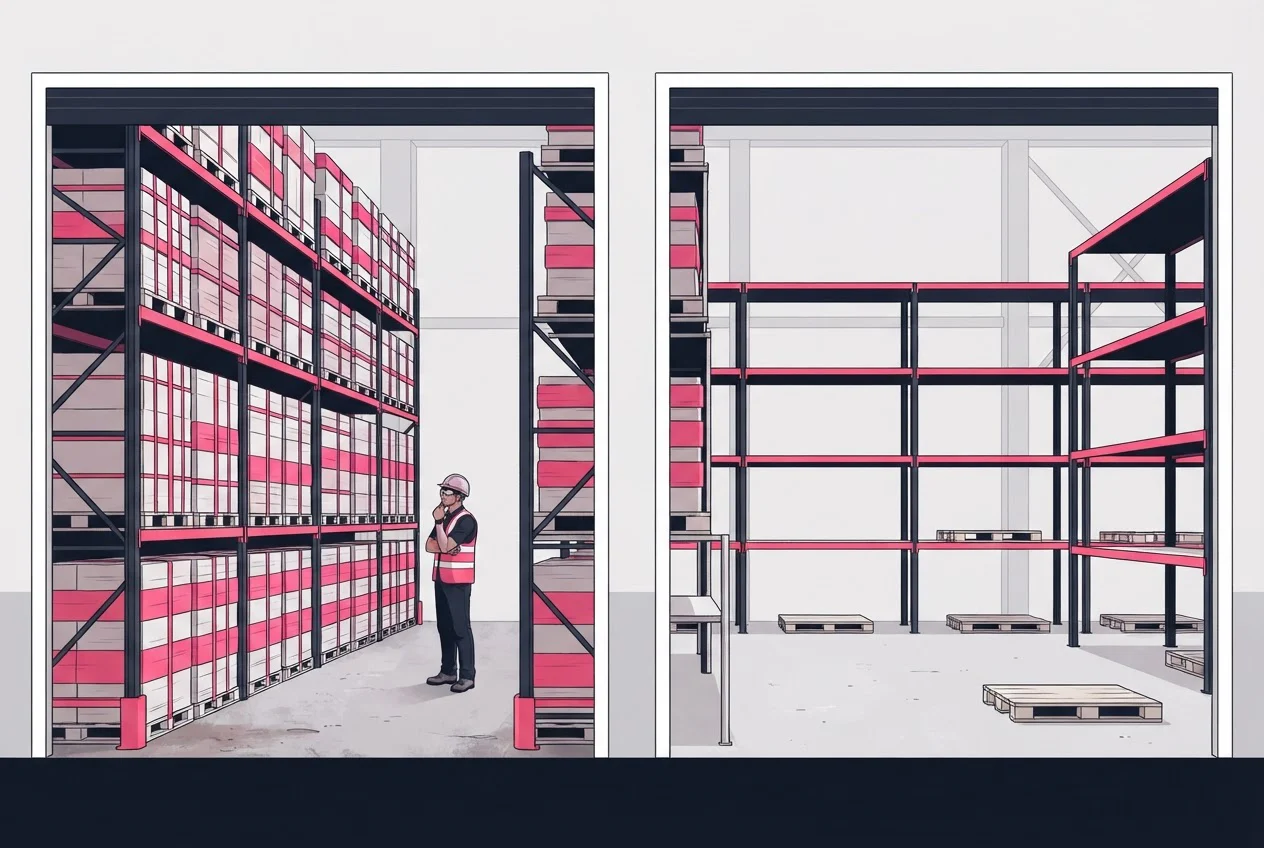
Total on hand overstates what you can promise for three reasons. Committed units are still on the shelf. Free stock may sit in the wrong warehouse for the customer. A count taken today cannot see orders and deliveries due next week.
Microsoft's Inventory Visibility documentation treats physical stock and promisable stock as separate measures.
How does the delivery date change available to promise?
The delivery date changes available to promise because a future order or a late delivery can lower free stock on a later day. The figure you can safely promise is therefore the lowest projected free stock from today to the end of the planning horizon, not today's balance.
Microsoft defines ATP as "the minimum projected on-hand quantity that's available from the specified date through the end of the schedule period" (Microsoft Learn, ATP). Microsoft's worked example (1 February 2022 start, 7-day schedule period):
- On hand is 20 on 1 February.
- A demand of 3 is scheduled that day, 10 units are due on 3 February, and a demand of 15 is due on 4 February.
- Projected stock runs 17, 17, 27, 12. Later supplies of 1 unit on 5 February and 3 units on 6 February lift it to 13 and 16, so they do not change the minimum of 12. ATP on 1 February is 12, not 17 or 27.
- If the 10 units never arrive, projected stock on 4 February falls to 2, and so does ATP.
Microsoft documents the lowest-point-in-the-horizon rule for its Inventory Visibility add-in, where the schedule period defaults to 30 days and can be set up to 180. We recommend it as our method for any item with confirmed future orders.
How do you work out ATP across two warehouses?
To work out ATP across two warehouses, calculate free stock per warehouse, apply each dated order and delivery, and take the lowest projected figure over your horizon. The figures below are illustrative and the model is ours, with a 14-day horizon.
| Measure | Pune | Bengaluru | Total |
|---|---|---|---|
| On hand | 40 | 25 | 65 |
| Committed (orders shipping this week) | 10 | 20 | 30 |
Free stock today | 30 | 5 | 35 |
Two dated events follow. An unreserved order of 20 units ships from Pune on day 8. A purchase order of 50 units lands in Pune on day 12.
| Days | Pune free | Bengaluru free | Total free |
|---|---|---|---|
| 0 to 7 | 30 | 5 | 35 |
| 8 to 11 (after the 20-unit order) | 10 | 5 | 15 |
| 12 to 14 (after the 50-unit delivery) | 60 | 5 | 65 |
ATP is the lowest figure in each column: Pune 10, Bengaluru 5, total 15. Quoting 35 breaks the day-8 order by 20 units.
Now a Bengaluru customer asks for 25 units in five days. Bengaluru has 5 free. Pune can spare at most 10 without breaking its own order. So you can promise 15, subject to transfer time, and the other 10 after the day-12 delivery. A combined total of 65 on hand would have hidden every one of these limits.
How do you test whether your system shows ATP?
You test it with four checks, each with a clear pass or fail. Run them on real items this week, in your current system or in a spreadsheet. Use this sheet for each item in each warehouse:
| Item | Warehouse | On hand | Committed | Free stock | Unreserved orders (qty, date) | Incoming (qty, date) | ATP (lowest projected free stock) |
|---|---|---|---|---|---|---|---|
Can a salesperson see free stock per warehouse on the quote or order line?
Pass: the line shows free stock for each warehouse, with no call to operations. Fail: it shows only a combined total, or you need a separate stock report.
Does the screen separate committed stock from on hand?
Pick an item with open sales orders. Pass: committed equals the sum of the reserved quantities on those orders, and free stock equals on hand minus committed. Fail: free stock equals on hand while orders are open.
Are unreserved orders and incoming deliveries visible with dates?
Pick an item with a confirmed order due next week and a purchase order due in 12 days. Pass: you can read both with dates and work out projected free stock by day. Fail: you see only today's figure, or orders appear only days before shipping.
Does the screen match the shelf?
Count 10 items per warehouse, mixing fast and slow movers, and compare with on hand. Pass: all match. Any difference is a fail to trace before the next count. Ten items is a smoke test, not a measure of your accuracy rate. For the causes of mismatches, see why system stock differs from the shelf, and for a routine count schedule, cycle counting.
Our rule of thumb: two or more fails mean your system is not showing visibility, so quote from the sheet above until it is fixed.
How does Arka Inventory show ATP inside Salesforce?
Arka Inventory helps sales teams know what they can confidently promise, not just what is physically on hand. It is built natively on Salesforce, so reps read visibility across warehouses, committed and reserved inventory, incoming stock, lead times and material availability where they quote.
- Inventory Visibility shows stock across locations, inventory on order, lead time insights and a raw material overview. See the Inventory Visibility feature.
- Commit Inventory lets you reserve and commit inventory against orders, and allocate or reallocate it based on delivery date, to prevent overselling.
- Inventory Alerts notify teams of low stock and of back-ordered items arriving.
- Custom reports and dashboards let you build reports and dashboards of inventory performance and operational metrics.
As of November 2026, our Basic plan is $199 a month paid yearly, with one user licence and extra users at $42 a month. It includes multiple warehouses, purchase orders and transfers, barcoding and packing slips, and inventory alerts. Our Advance plan is $499 a month paid yearly, with two user licences and extra users at $52 a month, and adds bills of materials, production and kitting. Sales orders are on our Enterprise plan, priced to your needs. Full plan details are on our pricing page. To confirm what you would pay in India, including tax, ask us.
You can run the four checks on your own data in our 15-day free trial, which has full access and needs no credit card. Typical onboarding takes at least two weeks, depending on data readiness and integrations. For you, that means bringing your inventory, product and warehouse data. If Salesforce is the platform you quote in, see also Salesforce inventory management routes and their costs.
Book a demo through our contact sales page and we will walk through your warehouses.
See your ATP across every warehouse in Salesforce
Frequently asked questions
Sources
- 1.Inventory Visibility Add-in overview, Microsoft Learn, Microsoft, 13 August 2025
- 2.Inventory Visibility on-hand change schedules and ATP, Microsoft Learn, Microsoft, 17 June 2025