
Glossary
Inventory Lead Time
Inventory lead time is the number of days from releasing a purchase order to having the goods ready to sell or use. Measure it from your own order dates, not the quote.

By Praveen Nune, Co-Founder & CEO · Updated 23 Oct 2026
Also called Replenishment lead time
On this page
- 01Definition
- 02Quick facts
- 03Why a supplier's quote is not your lead time
- 04What is inventory lead time, and where does it start and end?
- 05Inventory lead time vs quoted, confirmed, customer lead time and cycle time
- 06Where do the days go from purchase order to usable stock?
- 07How long customs release takes for imports
- 08How do you measure your real inventory lead time?
- 09How do you use your measured inventory lead time in a reorder decision?
- 10How Arka Inventory handles it
- 11Example
- 12Related terms
- 13Frequently asked
What is inventory lead time?
Inventory lead time, also called replenishment lead time, is the elapsed days between releasing a purchase order and the moment the stock is available to sell or issue to production. It includes the supplier's work, transport, and your own receiving and put-away.
Key takeaways
- Inventory lead time runs from the day you release the purchase order to the day the goods are available to sell or use, not to the day they reach your gate.
- A supplier's quoted lead time is a promise. Your own order dates are the evidence, and the spread between your shortest and longest order matters as much as the average.
- Replenishment lead time, not the quoted or customer lead time, is the number a reorder decision needs.
- Use the average actual days as the lead time in a reorder point, and size the safety stock from the gap between the longest order and the average.
Quick facts
- Also known as
- Replenishment lead time
- Starts
- When the purchase order is released
- Ends
- When the goods are available to sell or use
- Sample to measure
- At least ten orders per supplier
Why a supplier's quote is not your lead time
A supplier who quotes 21 days is describing only their own part of the wait. The number that decides when you reorder starts when you release the purchase order. It ends later, once the goods are received, checked and put away.
Quoted lead time versus your lead time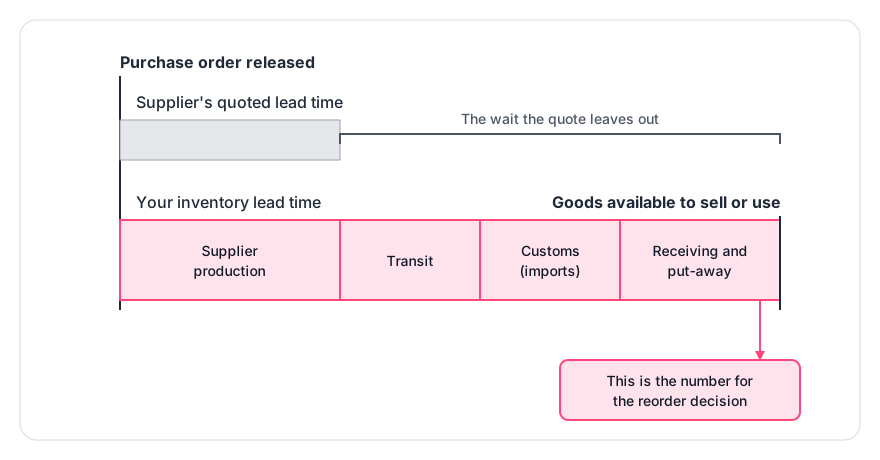
That is why two people can say "lead time" and mean different things. A buyer means the supplier's promise. A planner means the days until stock is usable. A sales manager means the days from a customer's order to delivery. Each is a valid number, but only one belongs in a reorder decision.
Using the quote as the planning number invites a stockout, because the real wait is longer than the planned one. The formulas that use the result sit on a separate page, linked below. Below, the term is defined, separated from the terms it gets confused with, and turned into a log you can fill in from your last ten purchase orders.
What is inventory lead time, and where does it start and end?
Put-away means moving received goods to their storage location so they can be picked. Time spent approving the need before you release the order sits outside the number.
Procurement practice splits total lead time into internal lead time (from identifying a need to issuing the order) and external lead time (the supplier's development, manufacture, dispatch and delivery). Replenishment lead time, as defined here, starts at the release of the order, so it leaves out the internal half. Quotes cover only part of the external half.
Where do the days go from purchase order to usable stock?
Once the purchase order is released, the days sit in four places: supplier production, transit, customs for imports, and receiving. Quotes usually cover the first, sometimes the second. The rest is yours to measure.
The receiving end is yours. Count the days from the gate to the posted receipt using your goods receipt note.
How long customs release takes for imports
For imports, customs is one slice. In the National Time Release Study 2025 by the Central Board of Indirect Taxes and Customs (CBIC), which sampled import bills of entry (the import declarations filed with customs) filed in the first week of January 2025, customs release took the averages below (PIB press release). That is one week's sample, so treat it as indicative. It is just over three days at a seaport (79.07 hours divided by 24). The study covers customs release only, not shipping, inland haulage or receiving. A broker's dates will differ, so log the date customs issues the "out of charge" order, which is the release to move the goods.
- Where customs release happened
- Seaports
- Average time
- 79 hours 4 minutes
- Where customs release happened
- Inland container depots
- Average time
- 83 hours 41 minutes
How do you measure your real inventory lead time?
Keep one row per purchase order (PO) line, and calculate lead time as the date the stock became available minus the date you released the order.
Columns: supplier, item, PO released, supplier-confirmed date, dispatched, arrived at gate, receipt posted, available to sell or use, actual days, quoted days, difference, notes.
Rules:
- Use the first full receipt. Note part shipments.
- Flag orders placed well ahead of need. For those, use the supplier-confirmed ready date or the dispatch date in place of the available date, so the order still counts.
- Exclude releases from a blanket purchase order, or mark them, because one order spans many deliveries.
- At least ten orders per supplier are recommended. With fewer, report only the shortest and longest.
How do you use your measured inventory lead time in a reorder decision?
Use the average actual days as the lead time in the reorder point, and size safety stock from the gap between the longest order and the average. In the example, that is 32 days average and a 6-day buffer to the 38-day longest.
The reorder point formula turns those two numbers into a reorder level and safety stock. Start the log from the purchase order process so every order carries its released date.
How Arka Inventory handles it
Record the released and receipt dates in your purchase orders, and our inventory alerts show when back-ordered items arrive and when stock nears its minimum. Our inventory visibility feature shows sales reps in Salesforce the lead time and inventory level for each product, plus inventory on order. Our forecasting and purchase automation feature plans purchases and schedules purchase requisitions or purchase orders.
As of October 2026, purchase orders and warehouse transfers are included from the Basic plan ($199 per month billed annually), and every plan can be tried free for 15 days with no credit card.
Example
Worked example (illustrative numbers, not real data): a supplier quotes 21 days, and ten purchase orders took 28, 29, 30, 30, 31, 32, 33, 34, 35 and 38 days. The total is 320 days, so the average is 32 days, and the range is 28 to 38. The gap to the quote is 11 days, about 52% longer than promised. Pass or fail test: compare the quote with your shortest actual. Here 21 is below 28, so the quote fails as a planning number.