Material Requisition: Slip, Approval and BOM Reconciliation
A material requisition is a request that authorises a store to issue stock to a job. Raise it against the production order, approve it by role, and reconcile what was issued, returned and scrapped against the bill of materials (BOM) quantity.

By Praveen Nune, Co-Founder & CEO · Updated 18 Nov 2026
Key takeaways
- A material requisition authorises stock issue to a named job. It controls cost only when issued quantities are compared with the production order's BOM quantity.
- Put the production order number and BOM version on every slip, along with the quantities requested and issued and the people who requested, approved, issued and received.
- Approve by case: within BOM, over BOM and substitution. Set any limit from your last ten closed orders, not from a borrowed percentage.
- Reconcile at order close: variance is consumed minus requirement, and net issued must tie to consumed plus the physical leftover count.
In this article
- 1What is a material requisition, and how does it differ from a purchase requisition?
- 2What should a material requisition slip or form contain?
- 3Material requisition format: a filled-in example
- 4How do you raise a requisition and issue raw materials against a production order?
- 5Who should approve a material requisition?
- 6How does the store issue raw materials against a production order and record the movement?
- 7How do you reconcile issued stock against a production order's BOM?
- 8Which five habits break requisition control?
- 9What does Arka Inventory offer for requisitions?
- 10What should you do with your next production order?
- 11Frequently asked questions
A material requisition slip gets signed, the store issues the stock and the order closes. At month end the sheet-metal count is short, and no one can say which order used it.
The slip rarely causes that gap. The gap appears when the slip is never compared with the bill of materials, the list of components and quantities needed for one unit of a product. The BOM says what a production order should use.
A production order is the instruction to make a set quantity of a product, and every requisition should name one. The requisition records what the store let out. Compared line by line, the two turn paperwork into control. Without that comparison, a material requisition only proves that someone asked.
Inputs take most of the money a factory earns. According to the Annual Survey of Industries 2024-25, total input was 83.7% of the output value of India's registered factories and net profit was 7.0% (our calculation from the survey's published totals). On margins that thin, a few unexplained kilograms of sheet metal on every order is a cost you will feel.
This guide gives you the slip fields, approval rules by case and a worked reconciliation for a 200-unit order. It is written for store in-charges, production supervisors and cost accountants at small and mid-size Indian manufacturers.
What is a material requisition, and how does it differ from a purchase requisition?
A material requisition is a request from the department that needs materials to the store that holds them, authorising the issue of named items to a named job. In the material requisition vs purchase requisition question, the test is where the stock sits. A material requisition draws on stock you already hold. A purchase requisition asks purchasing to buy stock you do not.
The Institute of Chartered Accountants of India's costing text describes the requisition note as "a voucher of authority used to get materials issued from store" (ICAI). Production usually prepares it and shares it with Store and Cost/Accounting. A BOM can serve as the requisition list for a job. A requisition can never replace a BOM, because the BOM sets the standard and the requisition shows what was actually drawn (ICAI).
| Document | Asks for | Usually raised by | Acted on by |
|---|---|---|---|
| Material requisition | Issue of stock you hold, to a named job | Production or the consuming department | Store |
| Purchase requisition | Purchase of items you do not hold | Any department, often the store for reorder | Purchasing |
| Issue slip | Records what the store actually let out | Store, often the completed requisition | Stores ledger and accounts |
Production order | Making a stated quantity by a date | Planning | Production |
For how buying-side requisitions and approval lanes work, use our separate guide. This page stays on the issuing side.
What should a material requisition slip or form contain?
A material requisition slip or form should carry 14 fields. A requisition serves three purposes: it picks items from stock, updates inventory records and charges the job (AccountingTools). Job number, date, item, quantity and an approval signature are the common core. The 14 fields below are our recommended set, not a legal or industry standard.
| Field | What to enter |
|---|---|
| Slip number | A unique serial, also written on the bin card line (the bin's running record of receipts, issues and balance) |
| Production order number | The order the stock is for. No number, no issue |
| BOM version | The BOM revision used to work out the quantities |
| Item | Item code and description |
| Unit of measure | kg, nos (numbers of pieces) or metres, matching the BOM |
| BOM quantity | BOM quantity per unit × order quantity, per line |
| Quantity requested | BOM quantity plus any scrap you add |
| Quantity issued | Filled in by the store at the counter |
| Issue-from location | Store, rack or bin |
| Requested by | The supervisor raising the slip |
| Approved by | The role the approval rules require |
| Issued by | The storekeeper |
| Received by | The person taking stock to the line |
| Date | Date, and time if you issue more than once a day |
Material requisition format: a filled-in example
Here is one slip filled in for the sheet-metal line of the 200-enclosure order used later in this guide. The numbers are illustrative.
| Field | Entry |
|---|---|
| Slip number | MR-0147 |
| Production order number | PROD-0312 |
| BOM version | v3 |
| Item | SM-02, sheet metal |
| Unit of measure | kg |
| BOM quantity | 480 (2.4 kg × 200 enclosures) |
| Quantity requested | 504 (480 plus 5% scrap, because this BOM carries none) |
| Quantity issued | 504 |
| Issue-from location | Raw material store, rack R2 |
| Requested by | Production supervisor |
| Approved by | Production head |
| Issued by | Storekeeper |
| Received by | Line helper |
| Date | 2 December 2026, 10:30 |
The 12 kg extra issue in the worked example below would go on its own slip, MR-0148, with a written reason and a second approver.
Keep the slip in copies. A common set sends the original to the store, a copy back to the requesting department and a copy to accounts for job costing, with another to purchasing if a line is short (AccountingTools).
How do you raise a requisition and issue raw materials against a production order?
Work from the production order, not from memory. Take the order number, BOM version and order quantity, then build the slip line by line.
- Read the production order number, the BOM version and the order quantity.
- Multiply each BOM quantity per unit by the order quantity. That is the line's BOM quantity. Our bill of materials example shows how quantities per unit are laid out.
- Add scrap only if the BOM does not already carry it. If a BOM line already includes an allowance, adding another counts it twice and inflates the issue. BOM quantity plus allowed scrap is the line's requirement.
- Check stock at the issue-from location. Short lines go to buying. Do not quietly shrink the slip. For a check that covers every component before the order is released, use the pre-release material check in our production planning and control guide.
- Raise the slip with the quantities in "quantity requested" and the requester's signature.
Staged or full issue. A full issue sends the whole requirement at once. A staged issue raises one slip per stage, each quoting the same order number. We recommend staging long orders and costly or perishable items, and issuing short, low-value orders in full. Every slip adds to the same order's issued total.
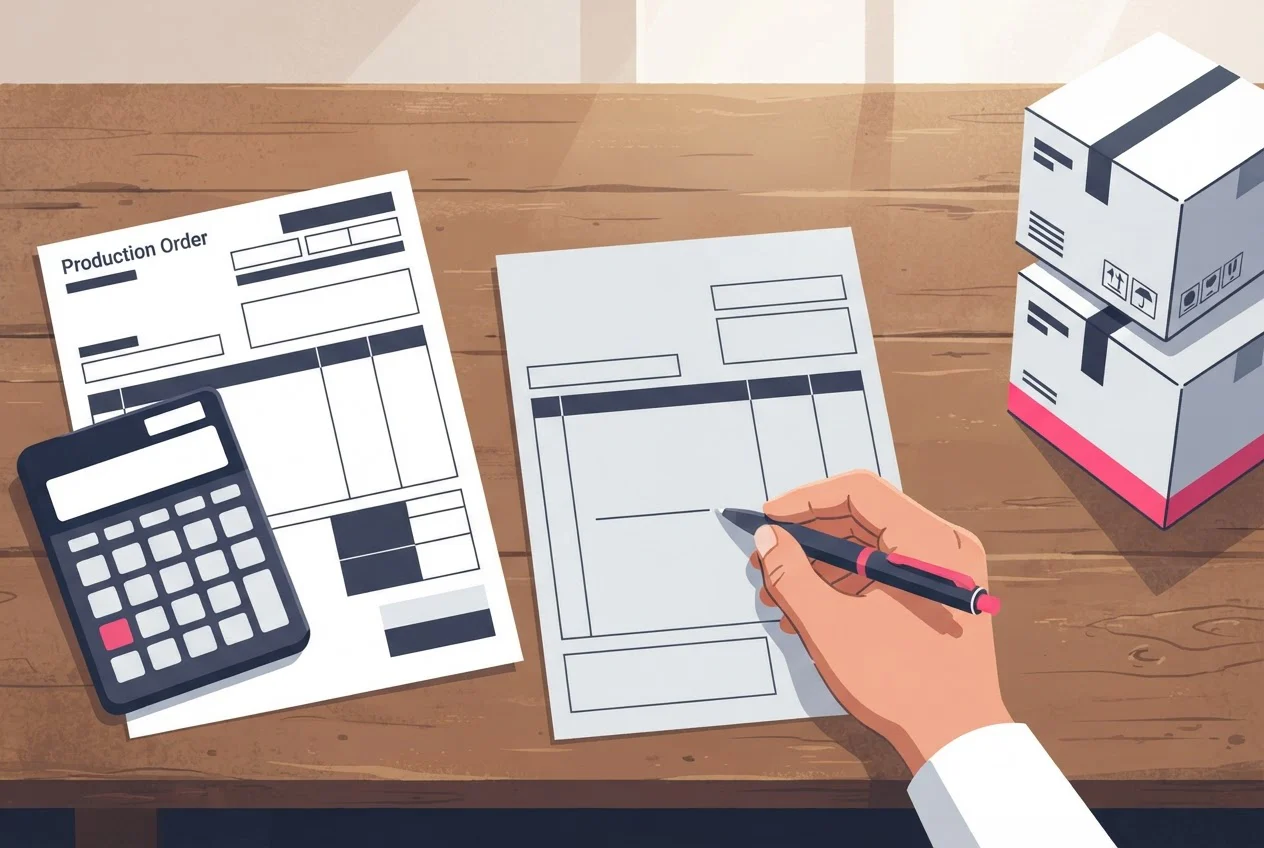
Extra issue beyond the BOM. If production needs more than the requirement, raise a separate slip marked "extra". Give a written reason, such as damage, a wrong cut or rework, and get a second approver. Never overwrite the original quantity. The extra issue is recorded on its own slip. After returns and scrap are booked, any difference between consumed and requirement is the variance you explain at reconciliation.
Who should approve a material requisition?
Approve by role and by case. A request that matches the BOM needs the least approval. One that goes beyond it, or changes a component, needs someone outside production.
| Case | Who approves | What they check |
|---|---|---|
| Within BOM | Production head or the department foreman, on a slip raised by the production supervisor | Order number is valid and quantity equals BOM quantity plus any allowance. The store in-charge repeats the quantity check before issue, as a check and not an approval |
| Over BOM | Production head, plus a second approver outside production and outside the store, such as the cost accountant or plant manager | A written reason, and whether the BOM or the process is wrong |
| Substitution | Planning or engineering (the BOM owner), with quality sign-off | The substitute is allowed, and the BOM or an exception record is updated |
Where a limit applies, set it from your last ten closed orders. List each line's variance, note how far normal orders go, and set the limit just above that. Anything over it goes to the second approver. We give no fixed percentage, because bulk items, high-value items and different processes behave differently. Auditors trace requisitions to confirm that materials were used and recorded under company procedure, and they look closely at approval records (AccountingTools).
How does the store issue raw materials against a production order and record the movement?
The store checks the approved slip, picks the quantity from the named location and posts three records for one issue: the issue entry, the bin card line and the stock movement. All three carry the slip number and the production order number. Step 5 of our warehouse SOP for Indian manufacturers sets the same rule: nothing leaves the store without an approved requisition slip.
- Issue entry. Write the quantity issued on the slip, with issued-by and received-by signatures and the date. Issued must not exceed requested unless an extra slip exists.
- Bin card line. A bin card is a quantity record of receipts, issues and balance kept at the bin. Add the date, the slip number as the document reference, the quantity issued and the new balance.
- Stock movement. Move the quantity in your stock register or system from the store location to the production order. This line charges the cost to the job. The slip usually carries quantities only. Accounts apply the rate from your inventory valuation method, such as FIFO or weighted average, when they post the cost to the job.
Where an issue method already records consumption automatically, a paper slip may be redundant for recording the issue. It still earns its place for control and approval, because it shows that someone with authority agreed the quantity before stock left. Our production order page covers how issue methods work.
How do you reconcile issued stock against a production order's BOM?
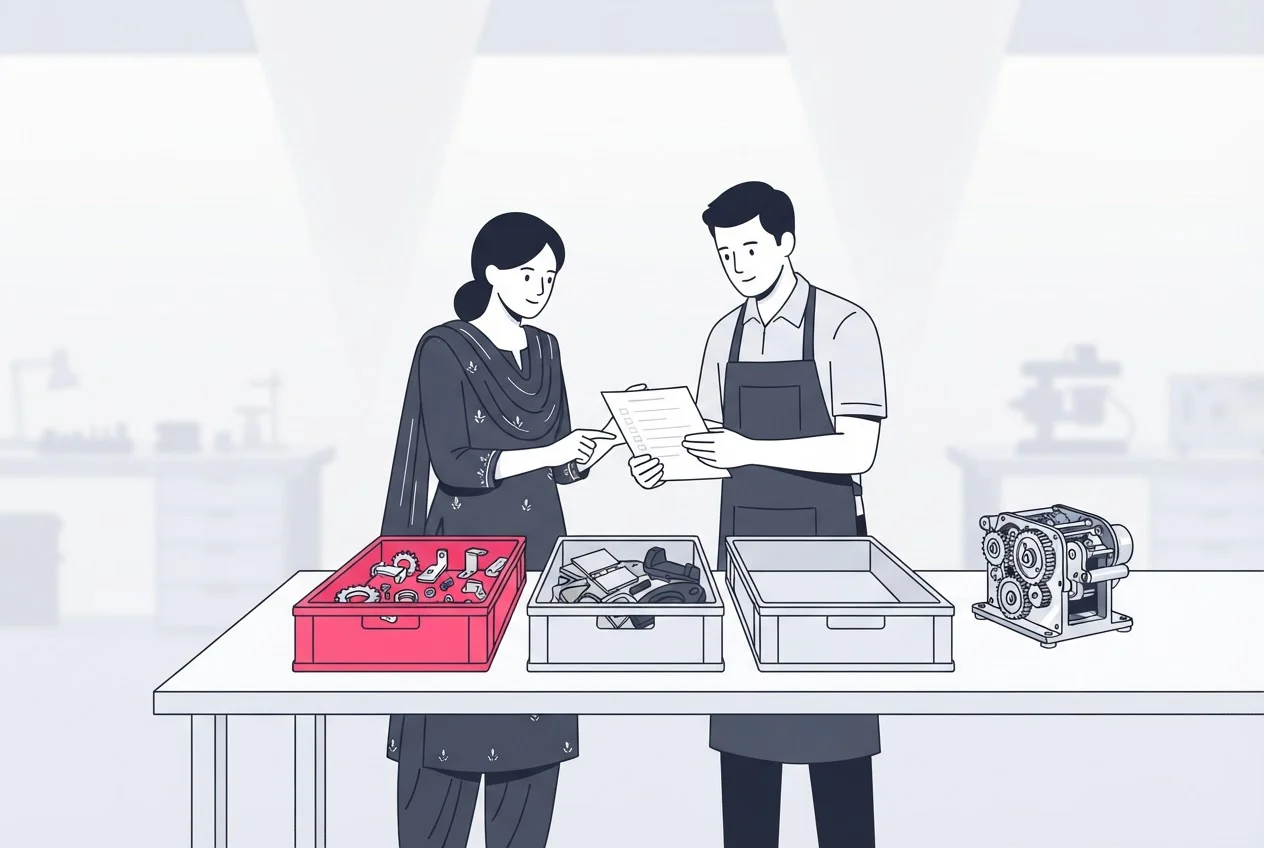
Reconcile when the order closes by comparing what the BOM required with what the store issued, less what was returned. Use one set of definitions throughout.
| Term | Definition |
|---|---|
| Requirement | BOM quantity (BOM quantity per unit × order quantity), plus allowed scrap if the BOM does not already carry it |
| Net issued | Issued − returned |
| Consumed | Good units made × BOM quantity per unit, plus booked scrap and rework |
| Variance | Consumed − requirement |
Consumed is worked out from the units production actually made and the scrap it booked, so it does not depend on what the store issued. That is what lets net issued be tested against it.
Worked example (illustrative numbers): 200 sheet-metal control-panel enclosures, all 200 good. The BOM carries no scrap, so the slip adds 5% on sheet and 20% on powder coat.
| Line | Requirement | Used in good output | Scrap booked | Consumed | Issued | Returned | Net issued | Variance |
|---|---|---|---|---|---|---|---|---|
| Sheet (kg) | 504 | 480 | 30 | 510 | 516 | 6 | 510 | +6 |
| Hinge (nos) | 600 | 600 | 0 | 600 | 600 | 0 | 600 | 0 |
| Powder coat (kg) | 36 | 30 | 6 | 36 | 36 | 0 | 36 | 0 |
The arithmetic:
- Sheet: 2.4 kg × 200 = 480, which is the BOM quantity and the amount used in good output. Allowed scrap at 5% is 24, so the requirement is 504. Scrap booked is 30, so consumed is 480 + 30 = 510. The extra issue of 12 kg (edge damage, approved) makes 516 issued. Net issued is 516 − 6 = 510, and the variance is 510 − 504 = +6 kg, about 1.2% of the requirement. The 6 kg is the booked scrap running above the 24 kg allowed.
- Hinge: 3 × 200 = 600.
- Powder coat: 0.15 kg × 200 = 30. Allowed scrap at 20% is 6, so the requirement is 36. Consumed is 30 + 6 = 36.
Registered manufacturers must also keep monthly production accounts showing the quantity of raw materials used and goods made, including waste and by-products, under Rule 56(12) of the Central Goods and Services Tax (CGST) Rules, 2017 (CBIC, text checked November 2026). The rule asks for the accounts, not for slips. In our view, a reconciled requisition for each order is a practical way to feed them.
Pass/fail test for one order:
- Net issued ties. Pass: net issued equals consumed plus the physical leftover count on the line. Fail: any gap. The sheet line gives 510 = 510 + 0.
- Variance inside tolerance. Pass: every line's variance is within the tolerance set from your last ten orders. Fail: any line outside it. The sheet's +6 kg is the figure to compare.
- Extra issue explained. Pass: each extra slip has a reason and an approver. The 12 kg here does.
- Returns and scrap booked. Pass: both are on the order before close. Here, 6 kg returned and 30 kg scrapped.
Which five habits break requisition control?
Five habits break requisition control, and each can be tested on the last ten slips you pulled. The reconciliation test above checks one order's numbers. This table checks whether the process holds across orders.
| Mistake | Test | Pass | Fail |
|---|---|---|---|
| Slip raised after stock has left | Compare each slip's date and time with the store's issue entry | Every slip is dated at or before issue | Any slip dated after |
| No production order number on the slip | Check the order number field on each slip | All ten carry a valid number | Any blank or invalid |
| Issue not compared with the BOM quantity | Compare quantity issued with BOM quantity × order quantity | Every excess has a reason and approver | Any unexplained excess |
| Returns and scrap not booked back | For closed orders, check returned and scrap quantities are recorded | Both recorded on every order | Any order with a gap |
| Slips left open after the order closes | List open slips against closed orders | None open | Any open slip |
The monthly issue check across all orders sits in our materials management five-row test.
What does Arka Inventory offer for requisitions?
We do not offer a dedicated requisition module. The slip stays a document you run on paper or in a spreadsheet. What we offer is the BOM and production side you check it against.
Our bill of materials feature lets you create standard or order-based bills of materials and assess material availability against them. Our Advance plan adds bills of material, production and kitting (grouping components into one issuable kit), which cover issue to production.
Our manufacturing feature lets you build items from a bill of materials while keeping inventory records accurate, which gives you the production side to reconcile against.
What should you do with your next production order?
A material requisition protects stock only when someone compares it with the production order's BOM quantity. Start with the next order you release. If the slip matches the BOM, approve it and issue in full.
If production asks for more, find out why before the extra stock leaves the store, because the answer shows whether the BOM, the process or the handling is wrong. When the order closes, tie net issued to consumed plus the leftover count, and record the variance even when it is zero.
After ten orders you will have your own tolerance, and the slips outside it show you where to look. If you want your bills of materials, production and stock records in one place to run this check against, talk to the Arka Inventory team about how our BOM and manufacturing features fit your orders.
Frequently asked questions
Sources
- 1.ICAI, Material Cost chapter, Cost and Management Accounting, The Institute of Chartered Accountants of India
- 2.Rule 56, Maintenance of accounts by registered persons, CGST Rules, 2017, Central Board of Indirect Taxes and Customs
- 3.Material Requisition Form, AccountingTools, 22 May 2026
- 4.Arka Inventory, Bill of Material feature