
Glossary
Bin Card
A bin card is a quantity-only record of receipts, issues and balance for one item, checked against the stores ledger.

By Praveen Nune, Co-Founder & CEO · Updated 24 Oct 2026
On this page
- 01Definition
- 02Quick facts
- 03Bin card basics
- 04What is a bin card, and how does it differ from a card BIN?
- 05What should a bin card contain?
- 06How do you fill in a bin card? A worked example
- 07Why keep the bin card and the stores ledger separately?
- 08Do Indian rules require a bin card?
- 09When should software replace the bin card?
- 10How Arka Inventory handles it
- 11Example
- 12Related terms
- 13Frequently asked
What is a bin card?
A bin card is a quantity record of the receipts, issues and balance of one item, kept attached to or near the bin where the item is stored.
Key takeaways
- A bin card records quantities only, per item per bin, at the moment stock moves. The stores ledger (the costing department's record of the same movements, with value) adds the money.
- The textbook layouts give a count correction no line of its own, so add one.
- Matching quantities between card and ledger is the control: reconcile before you adjust.
- Software replaces the card only if it passes the six checks below.
Quick facts
- What it records
- Quantities only: receipts, issues and balance
- Kept by
- The storekeeper, inside the stores
- Kept at
- The bin: a shelf, almirah or open floor space
- Checked against
- The stores ledger
- Legal basis
- Rule 56 of the CGST Rules requires stock accounts and does not name the bin card
Bin card basics
Bin card also appears in banking, where BIN means Bank Identification Number. This page covers the stores record kept beside a shelf, rack or almirah (cupboard) in a stores room.
A stores bin card is simple: quantity in, quantity out, balance. Its value comes from the discipline around it. Of the three printed layouts compared in October 2026 (listed below), none has a line for a count correction. When the shelf holds 1,460 pieces and the card says 1,500, the storekeeper is left to overwrite the balance. A card overwritten at count time loses the trail that Rule 56(8) of the Central Goods and Services Tax (CGST) Rules, 2017 asks registers to keep.
Below are a layout you can copy, a worked card that ties to the stores ledger, and six pass-or-fail checks for deciding when software should take over the card from the storekeeper.
What is a bin card, and how does it differ from a card BIN?
A bin can be a shelf, an almirah or open floor space. A bin card has nothing to do with a payment-card BIN. (Indira Gandhi National Open University (IGNOU) course text, BCOC-138 Unit 4)
Each item gets its own card. Two items in one almirah get two cards. The card also shows maximum, minimum and ordering levels. The ordering level is the balance at which a purchase requisition, a written request to buy, is raised, so ordering happens before stock runs out.
What should a bin card contain?
A bin card needs a header that identifies the item and its stock levels, and eight columns that record each movement. Copy this layout:
Header: Item description | Code | Bin no. | Location | Unit |
        Maximum | Minimum | Ordering level | Reorder qty | Stores ledger folio

Columns: Date | Document ref (goods receipt note or requisition no.) | Received | Issued |
         Adjustment (count correction, reason, approver) | Balance | Initials |
         Physical count and date
The printed layouts in three sources were compared in October 2026: the IGNOU course text (Figure 4.3, page 59), the Institute of Cost and Works Accountants of India (ICWAI) study material for the Controller General of Accounts (CGA) (PDF pages 37 and 38), and the World Food Programme (WFP) stock card guide (web page). Date, item, received, issued and balance appear in all three. A document reference and the maximum, minimum and ordering levels are on the IGNOU and ICWAI layouts but not the WFP one. None of the three has an adjustment line, and only WFP lists batch or expiry, as an optional extra for some goods.
This is a small sample of three sources, and the recommendation to add the adjustment line is not from them. The ICWAI procedure says bin card quantities are rectified to the verified physical quantity, and a separate line shows who corrected what, and why.
How do you fill in a bin card? A worked example
Write each entry when the stock moves, and carry the balance forward on every line. The figures below are an illustrative model for M8 hex bolts in bin B-04-02 (maximum 5,000, minimum 1,000, ordering level 2,000, reorder quantity 3,000).
The 16 October balance falls below the ordering level of 2,000, so a requisition is due. A Stores Adjustment Note is a form listing differences by item and valued at cost. The ICWAI material lists the usual causes of such differences: wrong-bin storage, wrong issues, unchecked package counts, pilferage, and unavoidable losses such as shrinkage.
Rules that keep the card trustworthy (recommended practice):
- One writer per card.
- A document reference on every line.
- Strike through a wrong entry and initial it; never overwrite.
- Investigate before adjusting. Cycle counting gives a count schedule, and inventory discrepancy causes covers the usual reasons.
- Date / Ref
- 1 Oct / Opening
- Received
- Issued
- Adjustment
- Balance
- 1,800
- Date / Ref
- 3 Oct / GRN 114
- Received
- 3,000
- Issued
- Adjustment
- Balance
- 4,800
- Date / Ref
- 5 Oct / Req 2207
- Received
- Issued
- 600
- Adjustment
- Balance
- 4,200
- Date / Ref
- 9 Oct / Req 2215
- Received
- Issued
- 900
- Adjustment
- Balance
- 3,300
- Date / Ref
- 12 Oct / Req 2221
- Received
- Issued
- 1,100
- Adjustment
- Balance
- 2,200
- Date / Ref
- 16 Oct / Req 2230
- Received
- Issued
- 700
- Adjustment
- Balance
- 1,500
- Date / Ref
- 17 Oct / Count 1,460
- Received
- Issued
- Adjustment
- −40
- Balance
- 1,460
Why keep the bin card and the stores ledger separately?
The two records are kept separately because they do different jobs. The bin card holds quantity only, inside the stores, kept by the storekeeper, with every transaction posted individually. The stores ledger holds quantity and value, sits in the costing department, and may be posted periodically in total. (IGNOU)
Bin card and stores ledger, side by side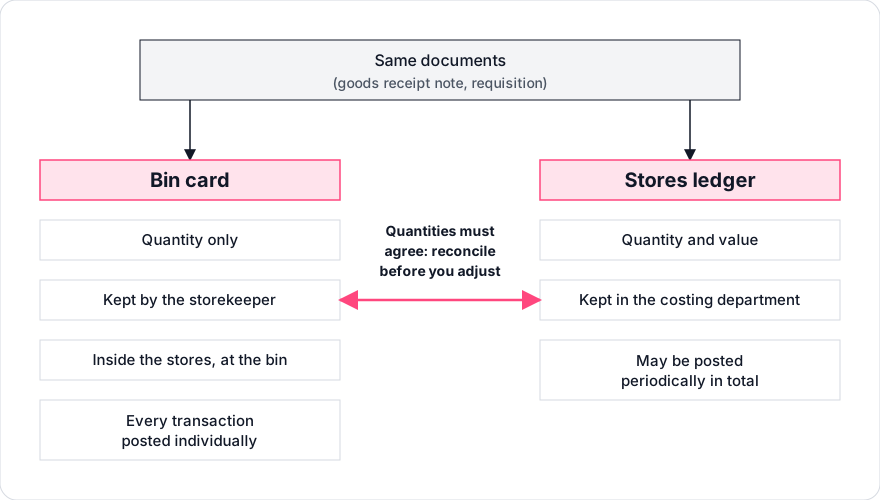
Both are written from the same documents, so their quantities must agree. Any quantity difference must be reconciled. (ICWAI study material) That cross-check is the point of keeping two records. The same logic underlies a perpetual inventory system.
Do Indian rules require a bin card?
Rule 56 of the CGST Rules requires stock accounts and does not name the bin card. Rule 56(8) bars overwriting entries in registers. By inference, a bin card with an adjustment line and strike-through corrections is one practical way to keep to the same discipline.
Rule 56(2) requires a registered person, other than one paying tax under section 10 of the CGST Act, to keep stock accounts with the opening balance, receipt, supply, goods lost, stolen, destroyed, written off or given as gifts or free samples, and the balance of stock, including raw materials, finished goods, scrap and wastage. Rule 56(8) says entries must not be erased, effaced or overwritten. Incorrect entries other than clerical ones are scored out under attestation, and the correct entry is recorded afterwards. Electronic registers keep a log of every entry edited or deleted. (CBIC consolidated CGST Rules, text dated 26 December 2022, read in October 2026)
For companies, the auditor reports under clause 3(ii)(a) of the Companies (Auditor's Report) Order (CARO) 2020 on inventory discrepancies of 10% or more in aggregate for each class, applied to value. (Bombay Chartered Accountants' Journal, August 2021) Whether your own records meet these rules is a question for your accountant.
When should software replace the bin card?
Software can replace the card when it passes all six checks, and a failure on any one means the paper card is still doing a job the system is not. Run these in any demo:
- Per-bin running balance. Pass: you open one bin and see its balance after every movement. Fail: only a warehouse total.
- Document reference. Pass: every line carries a goods receipt note (GRN) or requisition number. Fail: lines can be saved with no document number.
- Adjustments. Pass: a count correction is its own line with a reason and user. Fail: the only way to correct is to overwrite the balance.
- Count against book. Pass: counted quantity sits beside system quantity, with the difference. Fail: only the system quantity is shown.
- Edit trail. Pass: edits and deletions leave a log. Fail: an edit replaces the old value with no record of who changed it.
- Lot and expiry. Pass: balances are shown by lot where goods expire. Fail: only a total balance is shown for the item.
How Arka Inventory handles it
At Arka Inventory, pallets are put away into warehouse bins, and picking suggests the item and the bin location to pick from, with first-in-first-out and expiring-first lot picking. See warehouse management. We also track lots, batches, expiry dates and serial numbers, with location and quantity. Low-stock alerts warn when stock nears minimum levels, and our reorder point formula guide shows how to set them.
As of October 2026, the pricing page lists Basic at $199 a month and Advance at $499 a month, both billed yearly. Bin tracking is included on the Enterprise plan, which has custom pricing. Our 15-day free trial needs no credit card.
Example
For M8 hex bolts in bin B-04-02, the card runs 1,800 + 3,000 − 600 − 900 − 1,100 − 700 = 1,500. The 17 October count finds 1,460, which is 40 short. At an assumed ₹6.50 a piece that is ₹260, which goes on a Stores Adjustment Note, and both the card and the ledger are then corrected to 1,460.
Frequently asked
Sources
- 1.IGNOU, BCOC-138 Unit 4, Inventory Control (eGyanKosh)
- 2.ICWAI study material for the Controller General of Accounts JAO (Civil) examination
- 3.WFP and Logistics Cluster, warehousing documentation, 2022
- 4.CBIC, Central Goods and Services Tax Rules, 2017 (text dated 26 December 2022)
- 5.Bombay Chartered Accountants' Journal, August 2021