Discrete Manufacturing: A Six-Question Test for Each Product
Discrete manufacturing means building distinct, countable units, such as cars or furniture. Six questions, asked product by product, show whether yours is discrete, process or both, and what to set up first.

By Praveen Nune, Co-Founder & CEO · Updated 8 Nov 2026
Key takeaways
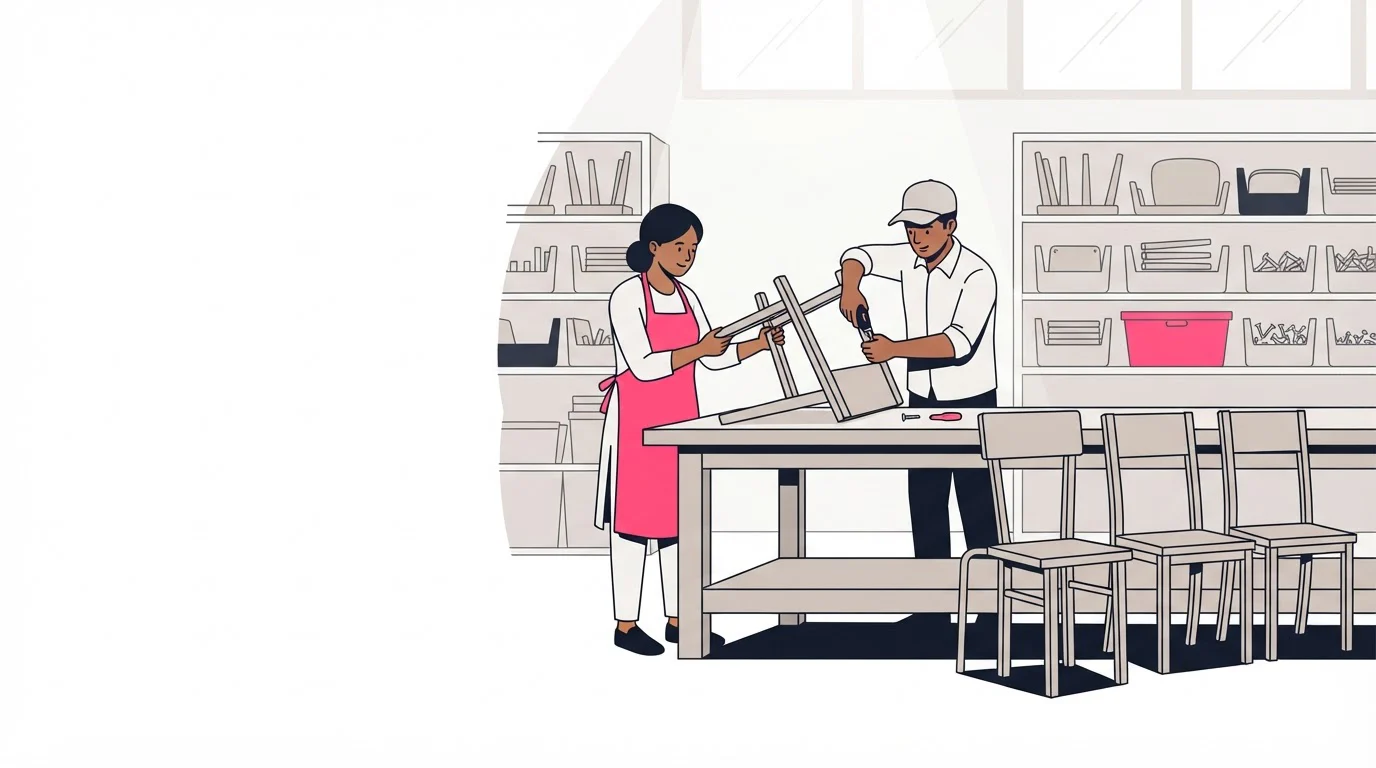
- Discrete manufacturing builds distinct, countable units, usually from components listed in a BOM. Process manufacturing makes bulk or batch output from a formula. Classify each product, not the whole company.
- Score each product on six questions. Five or six answers in one column settle it. Anything closer is a hybrid, so split the product into stages and score each stage.
In the Annual Survey of Industries 2024-25, four of the five industries adding the most value lean towards process by our classification, and one, motor vehicles, is clearly discrete. The survey does not publish the discrete share of all manufacturing.
- Your result decides the set-up: a BOM, production orders and serial numbers, or a formula, yields and batch numbers. Goods sent out on job work (processing by another business) have return deadlines under Goods and Services Tax (GST) law, as of November 2026: one year for inputs, three years for capital goods other than moulds and dies, jigs and fixtures, and tools.
In this article
- 1What is discrete manufacturing, and how does it differ from process manufacturing?
- 2How do you test whether a product is discrete, process or both?
- 31. What unit do you plan, cost and issue in during production?
- 42. What document drives the build?
- 53. Is each finished unit a separate, countable item with its own identity?
- 64. What do you trace after a complaint?
- 75. Does output differ from input by a planned loss or gain?
- 86. Does one run give a second saleable or reusable material?
- 9What should you set up in your stock records for each result?
- 10Is Indian manufacturing mostly discrete? What the Annual Survey of Industries shows
- 11How does Arka Inventory support a discrete manufacturer?
- 12Frequently asked questions
A steel cabinet is discrete manufacturing. The powder coating sprayed onto it is not. In our observation, many factories make both kinds of thing under one roof, so the label rarely settles much on its own.
What the label does decide is how you record what you make. Countable units built from a parts list need a bill of materials (BOM, the list of components and quantities in one unit), production orders and, where warranty demands it, serial numbers. Bulk output made from a formula needs yield records and batch numbers instead.
Getting this wrong shows up later as stock records that never reconcile: kilograms booked as pieces, batches that cannot be traced to a finished unit, components consumed without a production order.
Below: the definition in two lines, a six-question test to run on each product, the set-up that follows from your result, and what India's Annual Survey of Industries shows about the industry mix.
What is discrete manufacturing, and how does it differ from process manufacturing?
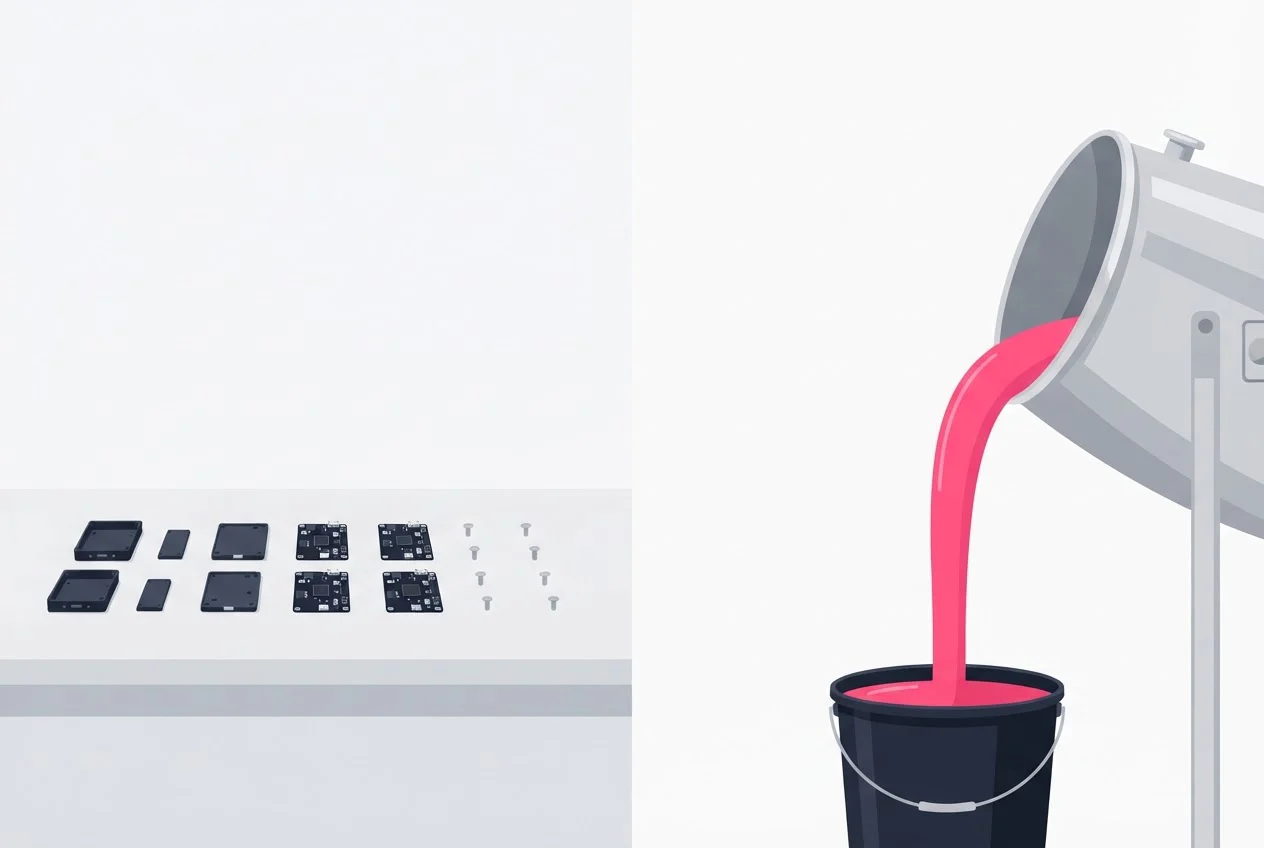
Discrete manufacturing is the production of distinct, countable items, such as cars, furniture, electronics and aircraft, usually built from components. Process manufacturing makes bulk or batch output, such as paint or syrup, from a formula. You cannot take that output back apart into its ingredients.
Oracle's JD Edwards documentation names three building blocks of a discrete system:
- Bill of materials: the items and quantities used to assemble a parent item.
- Routing: the sequence of operations needed to produce an item.
- Work centre: a shop-floor location, made up of people and machines, where routing operations happen.
Microsoft's Dynamics 365 training builds its discrete module on the same pieces: production orders, BOMs, resources, and routes and operations.
| Aspect | Discrete | Process |
|---|---|---|
| Output unit | Pieces | Kilograms, litres, metres |
| Driving document | BOM (a parts list) | Formula or recipe |
| Take it apart again? | Usually yes | No |
| Typical trace | Serial number | Batch or lot number |
Make-to-stock, make-to-order, job shop and repetitive production describe how you schedule work, not what you make. A discrete plant can run any of them, so "are we discrete?" and "are we a job shop?" are separate questions.
How do you test whether a product is discrete, process or both?
Score each product on six questions, using records you already have. Five or six answers in one column mean that mode. Anything closer, such as 3-3 or 4-2, means a hybrid. Split the product into stages (for example, "mix" and "assemble") and score each stage separately.
1. What unit do you plan, cost and issue in during production?
Check: read the unit on the production or costing record, not on the sales invoice. Discrete if it is Nos or pcs. Process if it is kg, litres or metres.
2. What document drives the build?
Check: open the costing sheet. Discrete if it is a parts list with fixed counts. Process if it is percentages of ingredients. A one-piece part, such as a machined or moulded part, has a one-line BOM: its raw material and quantity.
3. Is each finished unit a separate, countable item with its own identity?
Check: point to one finished unit and see whether you can tell it apart from the next. Discrete if yes. Process if the output is a bulk quantity that only becomes units when packed.
4. What do you trace after a complaint?
Check: look at how you traced your last complaint. Discrete if you traced the unit (serial number). Process if you traced the batch or lot.
5. Does output differ from input by a planned loss or gain?
Check: weigh inputs and outputs for one run. Discrete if there is no planned difference, apart from scrap. Process if there is a planned yield (output as a percentage of input).
6. Does one run give a second saleable or reusable material?
Check: look at the output of one run. Discrete if no. Process if yes (a by-product).
Worked example (our illustration, not survey data). A bolted steel cabinet scores six out of six discrete: planned and costed in pieces, built from sheet, hinges, a lock and screws, and traced by serial number for warranty. The powder used to coat it is consumed by weight. Record it as a kilogram component on the cabinet's BOM rather than switching the whole product to a process set-up.
Now take an adhesive you mix in-house and then use in a counted assembly. The mixing stage scores process: kilograms, a formula, batch tracing. The assembly stage scores discrete. This is a hybrid, and the mixed batch becomes a component of the assembly, with its batch number kept on the record.
When you evaluate any software for a hybrid, ask the vendor to run one of your products through both stages in a single demo. Do not accept two separate demonstrations.
What should you set up in your stock records for each result?
Set up the record keeping the result demands: a BOM, production orders and serial numbers for discrete products; a formula, yields and batch numbers for process products; and both, linked, for a hybrid. These choices need to be right before the first production order is booked.
| Result | Items and units | Driving document | Tracking | Cost and work in progress |
|---|---|---|---|---|
| Discrete | Pieces | BOM and production order | Serial number where warranty or customers need it | Component cost plus conversion, rolled up per unit |
| Process | Kg or litres, with a unit conversion to sales packs | Formula with planned yield | Batch or lot number | Cost per kg or litre, adjusted for actual yield |
| Hybrid | Both, with the batch as a component of the assembly | Formula for the batch stage, BOM for the assembly stage | Batch number carried into the unit record | One cost roll-up across both stages |
Build the BOM in layers if a sub-assembly is itself built from parts. That is a multi-level bill of materials. To see how schedules, BOMs and stock availability connect, read production planning and control. Work in progress (WIP) is stock that has left the store but not yet become a finished unit, and WIP inventory shows how to value and age it. Once the records are right, cost of goods manufactured shows how to build the schedule.
Job work needs its own check. Job work is processing done on your goods by another business, the job worker. You are the principal. A challan is the delivery document that records the send-out. Discrete makers often send parts out for machining or plating. Under section 143 of the Central Goods and Services Tax (CGST) Act, 2017, published by the Central Board of Indirect Taxes and Customs (CBIC), the principal must receive inputs back, or supply them from the job worker's premises, within one year, and capital goods within three years, except moulds and dies, jigs and fixtures, and tools, which have no three-year limit. The Commissioner may extend the periods on sufficient cause, by up to one year for inputs and two years for capital goods. Where inputs or capital goods are not back in time, they are treated as supplied by the principal on the day they were sent out. This is the position as of November 2026. Read the section text and the rules for your case before relying on it.
Our recommendation: record every send-out with its challan date and a return-due date. Flag any open send-out two months before its deadline.
Is Indian manufacturing mostly discrete? What the Annual Survey of Industries shows
Among the five industries adding the most value in 2024-25, four lean towards process and one, motor vehicles, is clearly discrete. The survey does not publish the discrete share of all manufacturing.
The Annual Survey of Industries 2024-25 factsheet, published by the Ministry of Statistics and Programme Implementation (MoSPI), covers April 2024 to March 2025. Its Table 4 ranks industries by gross value added (GVA, the value a factory adds to what it buys in):
| Industry (National Industrial Classification division) | Share of all-India GVA | Our classification |
|---|---|---|
| Basic metals | 11.58% | Process |
| Motor vehicles, trailers and semi-trailers | 9.54% | Discrete |
| Chemicals and chemical products | 8.45% | Process |
| Pharmaceuticals, medicinal chemical and botanical products | 8.08% | Process, with counted packs |
| Food products | 7.87% | Process, with counted packs |
Top five together | 45.52% |
How we worked it out. The shares are MoSPI's. The classification is ours. We labelled a division process when its main products are made by mixing or refining bulk inputs to a formula, so the output is a quantity by weight or volume before packing. We judged from the division names in Table 4 of the factsheet. This is our judgement, not an official category. The four process-leaning industries add up to 11.58 + 8.45 + 8.08 + 7.87 = 35.98 points, which is 79% of the 45.52 points held by the top five. Motor vehicles, at 9.54 points, is 21%.
What this does not show. The factsheet publishes only the top five for each measure, so we cannot state the discrete share of all manufacturing. It covers registered factories only. Divisions do not map cleanly onto discrete or process.
Our recommendation: expect some weight-based or formula-driven items in your item list whatever your label, because even a purely discrete maker buys process-type inputs such as paint, adhesive, coolant and powder.
How does Arka Inventory support a discrete manufacturer?
We build items from a BOM inside Salesforce, track consumption, and give you cost and work-in-progress visibility at each stage. Arka Inventory is cloud software built natively on Salesforce. Our manufacturing inventory feature covers assembly, disassembly and manufacturing, supports process and discrete manufacturing, and tracks the materials used in each production batch.
As of November 2026, plans, the 15-day trial and the two-week minimum onboarding are as follows:
- Advance plan ($499 a month, paid yearly; extra users $52 a month) and above: Bills of Material (standard and order-based), Production and Kitting, which bundles several items into one kit.
- Enterprise plan (flexible pricing; ask our sales team): everything in Advance plus lot and serial tracking (batch, expiry date and serial number), Sales Orders, and Landed Cost and bin tracking.
- Basic plan ($199 a month, paid yearly; extra users $42 a month): multiple warehouses, purchase orders and transfers, barcoding and packing slips, and inventory alerts. It does not include Bills of Material or Production.
See pricing for the current plan table.
Manufacturers already use us: HCPL Hexmoto for inventory and manufacturing operations, and Meta Power Solutions, a transformer manufacturer, for inventory and operations management. We integrate with Tally, so your accounts can stay where they are.
Typical onboarding takes at least two weeks, depending on data readiness, and we ask you for your inventory, product, warehouse and operational data to configure it. You can start with a 15-day free trial with full access and no credit card: request your trial. Support is available Monday to Friday, 9 AM to 6 PM IST, at support@arkainventory.com or +91 93902 73833.
Frequently asked questions
Sources
- 1.Annual Survey of Industries 2024-25 factsheet, Ministry of Statistics and Programme Implementation, Government of India
- 2.Central Goods and Services Tax Act, 2017, section 143 (job work), Central Board of Indirect Taxes and Customs tax repository
- 3.Overview to Discrete Manufacturing, Oracle JD Edwards World documentation
- 4.Configure and work with discrete manufacturing in Dynamics 365 Supply Chain Management, Microsoft Learn, 4 March 2026
- 5.Arka Inventory manufacturing feature
- 6.Arka Inventory pricing