Reverse Logistics in India: Returns Table and Tax Cut-Off
Reverse logistics moves goods back from the customer for resale, repair, return or disposal, and in India returns usually need a stock status and a Goods and Services Tax (GST) credit note.

By Praveen Nune, Co-Founder & CEO · Updated 5 Nov 2026

Key takeaways
- Treat a return as a record first and a restock decision second. Returned goods go to a hold location, and only a condition check moves them into sellable stock.
- Under section 34 of the Central Goods and Services Tax (CGST) Act, a credit note for returned goods must be declared by 30 November after the financial year of the original sale, or the date you furnish that year's annual return (GSTR-9) if that is earlier.
- Run three tests at receiving, match, condition and release, and let a named person other than the receiver approve the move to sellable stock.
- What a return recovers is resale value times recovery rate, less freight, inspection and repacking. Work that out before you agree to collect a low-value return.
In this article
- 1What is reverse logistics, and which part do stock teams control?
- 2How should returned goods be recorded? A disposition table
- 3Why is booking a return into stock not the same as deciding to restock it?
- 4What is the GST credit-note deadline for returned goods in India?
- 5What does a return actually recover?
- 6How do we help you run returns in Arka Inventory?
- 7Frequently asked questions
The costly mistakes in a return happen after the vehicle arrives, at the receiving bay and in the books.
Two mistakes are common (our observation): returned goods are booked straight back into sellable stock before anyone has judged their condition, so the system promises units that cannot ship. And the credit note is raised too late, after the date by which GST law lets a supplier declare it.
Both are avoided with a short routine. Below you get a disposition table (what happens to each returned item) that ties each return condition to a stock status, a stock movement and a GST document, the credit-note cut-off with worked dates, and a formula for what a return really recovers.
The routine suits small and mid-sized manufacturers, wholesalers and sellers who hold physical stock. It does not need a returns centre, only a rule about what happens on the day the goods arrive.
What is reverse logistics, and which part do stock teams control?
Reverse logistics is the flow of goods from the customer (or a later point in the chain) back to the seller, the maker or a processor. The goods end in one of a few outcomes: resold as they are, repacked and resold, repaired or refurbished, sent back to the supplier, or scrapped or recycled.
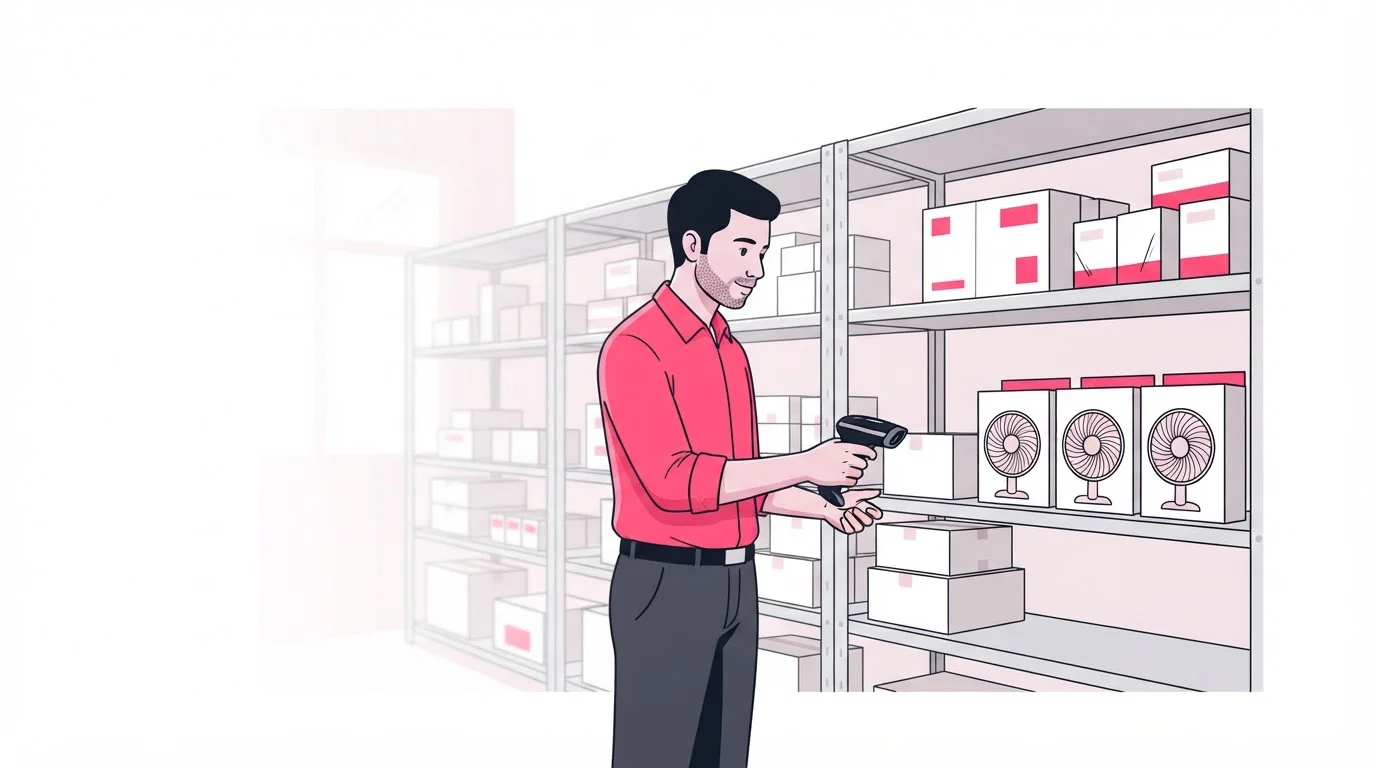
Transport is only one step. The part a stock team controls is what happens from the moment the goods are received: which status they get, where they sit, and which document goes with them.
How should returned goods be recorded? A disposition table
Record each return by its condition on receipt, because the condition decides the stock status, the stock movement and the paperwork. This is our recommended routine, and it works for sales returns from customers.
| Condition on receipt | Stock status | Stock movement | GST document |
|---|---|---|---|
| Sealed, in date, matches the invoice | Sellable | Receive, then release to sellable stock | Credit note, declared by the section 34 cut-off |
| Opened but repackable | Held, not sellable | Receive into the hold location; release after repacking | Credit note; book the repacking cost as its own expense |
| Damaged or expired | Not sellable | Never added to sellable stock; keep in hold until scrapped or returned to supplier | Credit note; see the proviso below |
| Wrong item or disputed | Held | Hold, photograph, do not restock | Credit note only once the dispute is settled |
The exact treatment depends on the original invoice and your registration.
Why is booking a return into stock not the same as deciding to restock it?
A return entry records that goods came back and that money is owed or credited. It does not say the goods can be sold. Condition is a human judgement made at receiving, and the system should wait for it.
Accounting packages already split these ideas. The help for Tally.ERP 9, a legacy release of the Tally accounting software, lists sales returns (Rejections In) and purchase returns (Rejections Out) as separate inventory vouchers. We apply the same split inside the warehouse: Received, then Held, then Released to sellable stock or Written off.
A common worry is how to post damaged returns so stock goes down. The sale already reduced stock when you invoiced. The credit note settles the money. The damaged units simply never enter sellable stock.
Run three tests at receiving, each with a pass or fail:
- Match test. Item code, lot number and quantity agree with the original invoice line. Any difference means Held as disputed. See our goods receipt note guide for tolerances.
- Condition test. Seal, visible damage and expiry date checked and photographed. Pass only if the item is sealed and meets the minimum remaining shelf life you set. Anything else stays in hold.
- Release test. A named person, not the person who received it, approves the move to sellable stock.
Keep the original lot number on a returned item. If lot and batch numbers are confused in your records, lot number versus batch number explains which to use, and inventory discrepancy causes shows what happens to stock counts when returns are booked wrongly.

What is the GST credit-note deadline for returned goods in India?
As of 5 November 2026, a credit note for returned goods must be declared in the GST return for the month you issue it, and no later than 30 November following the end of the financial year of the original supply, or the date you furnish the annual return (the yearly GST return, GSTR-9) for that year, whichever is earlier. This is set by section 34(2) of the CGST Act, published by the Central Board of Indirect Taxes and Customs (CBIC).
The deadline follows the financial year of the sale, not the date the goods come back. A credit note (the document a supplier issues to reduce an invoice) is allowed under section 34(1) where "the goods supplied are returned by the recipient".
Two worked examples, which are our illustrations:
| Invoice date | Financial year | Goods returned | Cut-off | Result |
|---|---|---|---|---|
| 12 August 2026 | 2026-27 | 8 December 2026 | 30 November 2027, or the earlier annual return date | Inside the window |
| 14 February 2027 | 2026-27 | 8 December 2027 | 30 November 2027 | Cut-off already passed |
Copies of the Act dated before 1 October 2022, such as the CBIC copy dated 1 January 2022, show September; the current text says 30 November (Finance Act 2022, section 102).
The proviso also matters. As of 1 November 2026, you cannot reduce your output tax liability (the GST you owe on your sales) through a credit note unless a registered recipient has reversed the input tax credit (ITC, the GST a buyer claims back on purchases) attributable to it, if availed. Section 126 of the Finance Act 2025 substituted this proviso with effect from 1 October 2025 (Notification 16/2025-Central Tax, 17 September 2025). From 1 November 2026, section 154 of the Finance Act 2026 adds post-supply discounts to section 34(1) (Notification 03/2026-Central Tax, 26 October 2026). It does not change the returns deadline.
Our recommendation: raise credit notes in the month the goods are accepted, and every October list returns still waiting for a decision. A credit note declared after the cut-off does not reduce your output tax, so the GST on that sale stays payable.
What does a return actually recover?
A return recovers resale value times the share you can resell, minus return freight, inspection and repacking. Calculate it before agreeing to collect a return, because low-value items often lose money.
Our model: net recovery = resale value × recovery rate − return freight − inspection − repacking.
With assumed inputs of a ₹1,000 item, a 70% recovery rate, ₹150 freight, ₹30 inspection and ₹20 repacking: ₹700 − ₹150 − ₹30 − ₹20 = ₹500. These inputs are examples; use your own.
With a ₹300 item and the same 70% recovery rate, ₹150 freight, ₹30 inspection and ₹20 repacking: ₹210 − ₹150 − ₹30 − ₹20 = ₹10 (our model with assumed inputs).

How do we help you run returns in Arka Inventory?
You can record returns with our purchase orders, warehouse transfers and multiple-warehouse stock records. As of November 2026, here is what applies to this routine.
- Hold, then release. Because we support multiple warehouses and warehouse transfers on our Basic plan, our recommendation is to set up a returns hold as its own warehouse. The transfer out of it is your release step.
- Lot, expiry and serial tracking. On our Enterprise plan, a returned item keeps its lot or batch number, expiry date and serial number. Our warehouse management feature picks the lots that expire first for lot- or batch-tracked items, and uses first-in, first-out (FIFO) picking for other items. Bin tracking is also on Enterprise.
- Barcodes, packing slips and alerts. All are on our Basic plan.
We are inventory software. Pickup, repair and recycling stay with your logistics and service partners; we keep the stock record they feed.
Every new account starts with a 15-day free trial with full access to all features and no credit card. Onboarding takes a minimum of two weeks, depending on data readiness and integrations. As of November 2026, Basic costs $199 a month billed annually, Advance $499 and Enterprise is custom-priced (pricing). Lot, serial and bin tracking need Enterprise. Book a demo with our team.
Frequently asked questions
Sources
- 1.CGST Act, 2017, section 34: Credit and debit notes, Central Board of Indirect Taxes and Customs, Government of India
- 2.CGST Act, 2017 as on 1 January 2022, Central Board of Indirect Taxes and Customs
- 3.The Finance Act, 2022, section 102, Government of India
- 4.The Finance Act, 2025, section 126, and Notification 16/2025-Central Tax, 17 September 2025, Central Board of Indirect Taxes and Customs
- 5.The Finance Act, 2026, section 154, and Notification 03/2026-Central Tax, 26 October 2026, Central Board of Indirect Taxes and Customs
- 6.Rejections Out Voucher (Purchase Returns), Tally.ERP 9 help, Tally Solutions