
Cycle Counting: A Schedule, Count Sheet and Adjustment Rules (India)
Cycle counting means counting a small, rotating slice of stock every working day instead of everything once a year; count high-value items most often and adjust the books only after a recount.

By Praveen Nune, Co-Founder & CEO · Updated 10 Oct 2026

Key takeaways
- 01Our recommended schedule: count A items monthly, B items quarterly and C items twice a year, then move A to fortnightly once its counts match consistently.
- 02Choose one accuracy formula and use it every cycle. A shortage on one item and an excess on another are two errors, not one that cancels.
- 03Every variance beyond tolerance needs a blind recount, a written cause and an approver before it becomes an adjustment.
- 04Check with your chartered accountant before posting a write-off. It affects your GST credit and what your auditor reviews.
In this article
- 1What is cycle counting, and how is it different from a physical count?
- 2How often should you count each item with cycle counting?
- 3How many counts a day will a 1,000-item cycle count plan create?
- 4How do you run one count so the result can be trusted?
- 5What should a cycle count sheet contain?
- 6Which accuracy formula should you use for cycle counting?
- 7When should you adjust the stock record, and who approves it?
- 8What do the auditor and GST rules say about a cycle count?
- 9How can Arka Inventory help with cycle counting?
- 10Frequently asked questions
Most teams can start counting stock tomorrow. Far fewer can say who is allowed to post the difference, or what happens to the Goods and Services Tax (GST) credit when the difference is a loss. Those two gaps, not the counting, are where cycle counting programmes stall.
The case for counting is strong. In a field quasi-experiment across 11 grocery stores covering about 24,000 stock keeping units (SKUs, individual item codes), inventory audits lifted store-wide sales by 11%, with the biggest gains where the system showed more stock than was on the shelf. That is grocery retail, but a record that overstates stock causes the same missed sales in a warehouse.
This page gives you the count schedule, the count sheet and the adjustment rules, with the workload and accuracy arithmetic worked out for an Indian business. It also sets out what your auditor and your tax adviser will want to see before a shortage is written off.
What is cycle counting, and how is it different from a physical count?
Cycle counting is a scheduled count of part of your stock, repeated through the year until every item has been counted. A physical count (a stock take) counts everything at one moment, usually at year end. Cycle counting keeps the warehouse running, and a yearly count cannot show when or why an error arose.
Five terms are used the same way from here on:
Definition
Definition
Definition
Definition
Definition
How often should you count each item with cycle counting?
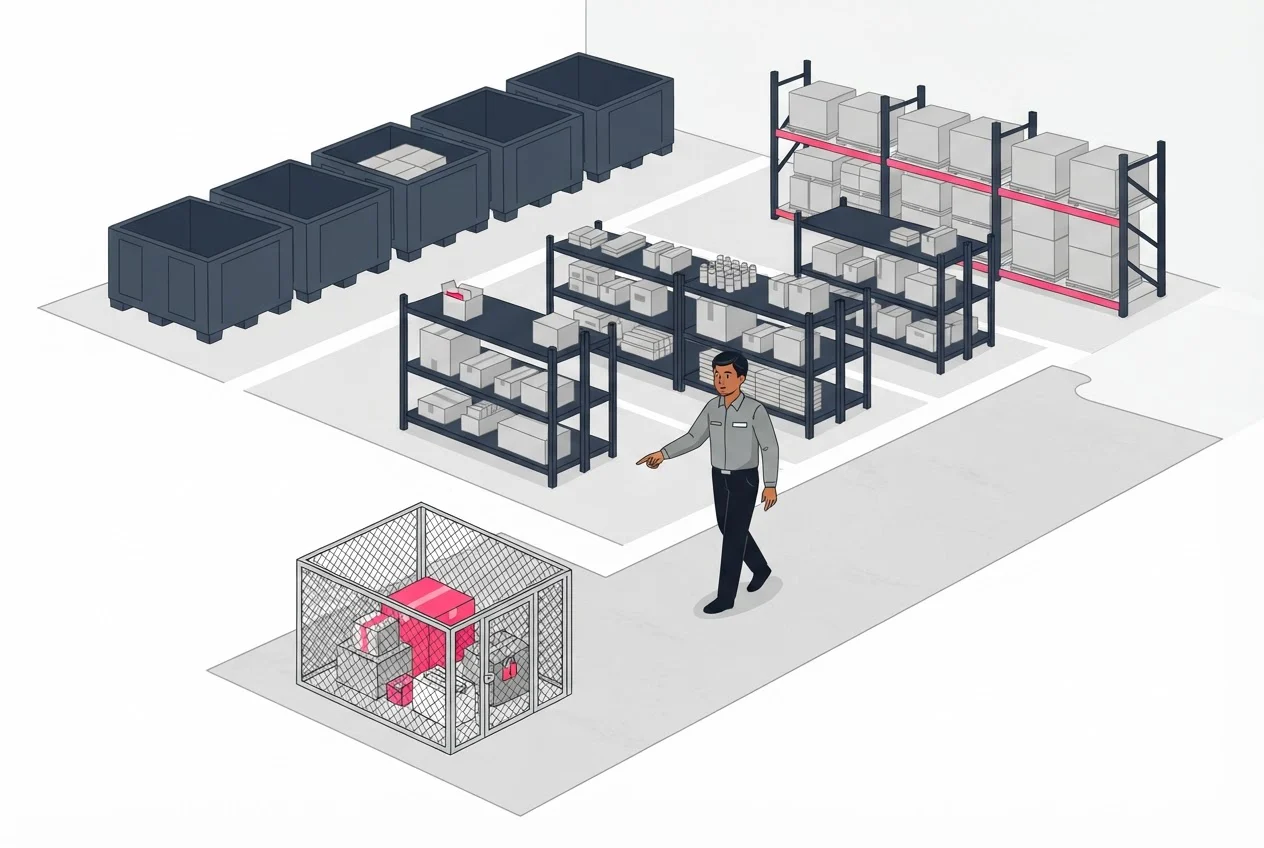
As our recommendation, count A items monthly, B items quarterly and C items twice a year. Move A items to fortnightly once their counts match consistently. The three classes come from ABC classification, where A is the highest-value class and C the lowest.
Work out annual consumption value
For each item, multiply the units issued or sold in the last 12 months by its unit cost. This is its annual consumption value.Sort and total
Sort items from highest to lowest and add the values as a running share of the total.Assign classes
Class A is the items up to about 80% of the total value, B the next 15%, and C the last 5%.
These cut-offs are our recommendation, not a rule. A small minority of items usually lands in A.
Add counts that no calendar schedules:
- Count an item when its system quantity reaches zero or goes negative.
- Count it when a picker finds a bin empty that the system says is full.
- Count it after a large receipt or an inter-warehouse transfer.
These catch errors on the day they appear.
How many counts a day will a 1,000-item cycle count plan create?
A 1,000-item plan creates between 14 and 47 counts a day, depending on the frequencies you choose. Work out the workload before you commit a team to it.
The formula is: counts a year = (A items × counts per year) + (B items × counts per year) + (C items × counts per year). Divide by working days for counts a day.
This is our model. It assumes 150 A items, 300 B items and 550 C items, and 290 working days: 312 days in a six-day week, less roughly 22 holidays. Replace the assumptions with your own.
| Scheme | A items (150) | B items (300) | C items (550) | Counts a year | Counts a day |
|---|---|---|---|---|---|
| Light: A monthly, B quarterly, C twice a year | 1,800 | 1,200 | 1,100 | 4,100 | 14 |
| Middle: A fortnightly, B monthly, C quarterly | 3,900 | 3,600 | 2,200 | 9,700 | 33 |
| Heavy: A weekly, B monthly, C quarterly | 7,800 | 3,600 | 2,200 | 13,600 | 47 |
Start with the Light scheme. Every item is still counted at least twice a year. A heavy plan abandoned in March protects less than a light plan kept all year.
To turn counts into staff time, time 20 counts in your own bins and take the average minutes per count. Staff hours a day = average minutes per count × counts a day ÷ 60. For example, at 6 minutes a count (an assumed figure), the Middle scheme's 33 counts a day need 33 × 6 ÷ 60 = 3.3 hours.
How do you run one count so the result can be trusted?
A trustworthy count has a fixed cut-off, a blind counter and a list that includes empty locations. Run each check below before you accept a count. Each has a pass test.

Fix the cut-off
Post every receipt, issue and transfer for the location up to a stated time. Pass: no unposted document exists for that location at the cut-off.Build the list from the item master and the location list, not from items with stock
Otherwise an item the system thinks is empty is never counted. Pass: the sheet includes zero-quantity locations.Count blind
The counter does not see the system quantity. Pass: the counter's sheet has no system quantity column.Match the unit
If the system holds pieces, count pieces, not boxes. Pass: the unit on the sheet equals the unit in the system.Recount beyond tolerance with a different person
Pass: every line outside tolerance (more than ±2% of system quantity, or ₹5,000 or more in line value, or any variance on an A item) has a second count by someone else.Handle sealed cartons by sampling
Count cartons by their label and open a random sample to confirm the contents. Record how many you opened. Open every carton only for A items or after a sampled carton fails. Pass: the sheet states the sample size.
What should a cycle count sheet contain?
A cycle count sheet has two copies: a counter copy that hides the system quantity, and an office copy that holds everything needed to decide an adjustment. Splitting them is what makes the count blind.
| Bin | Item code | Lot or serial | Unit | Counted quantity | Counter | Date |
|---|---|---|---|---|---|---|
| A-03-2 | RM-1042 | L2209 | pcs | 94 | Counter 1 | dd-mm |
| System quantity | Variance | Variance % | Variance value | Recount quantity | Cause code | Approver |
|---|---|---|---|---|---|---|
| 100 | −6 | −6.0% | −₹720 | 94 | Unrecorded issue | Finance |
Variance % = variance ÷ system quantity. Variance value = variance × unit cost. A cause code is a short fixed list, such as unrecorded issue, wrong bin, wrong unit, receiving error, damage or unknown.
Which accuracy formula should you use for cycle counting?
Use line accuracy to judge process health and report rupee variance to finance. Line accuracy shows how many bins are wrong; unit accuracy shows how many units are wrong. The two can disagree sharply, so pick one and keep it.
Take 20 counted lines holding 1,500 units on the system. Tolerance is zero in this example, so a line matches only if counted equals system. Three lines differ:
| Item | System quantity | Counted | Variance |
|---|---|---|---|
| Item 1 | 100 | 94 | −6 |
| Item 2 | 50 | 55 | +5 |
| Item 3 | 200 | 190 | −10 |
The other 17 lines match (1,150 units). The figures are ours and illustrative:
- Line accuracy: matching lines ÷ lines counted = 17 ÷ 20 = 85%.
- Unit accuracy: 1 − (sum of variances ignoring sign ÷ system units) = 1 − (6 + 5 + 10) ÷ 1,500 = 98.6%.
- Net accuracy: counted units ÷ system units = (1,500 − 6 + 5 − 10) ÷ 1,500 = 1,489 ÷ 1,500 = 99.3%.
Net accuracy hides 16 units of shortage behind 5 units of excess, so never net them. Line accuracy has its own blind spot: it ignores size. One line holding 1,000 of 1,050 units counted as zero gives 95% line accuracy and about 5% unit accuracy.
When should you adjust the stock record, and who approves it?
Adjust the stock record only after a written cause and an approval, and after a blind recount for any variance beyond tolerance. Posting a variance as an adjustment creates an accounting entry: it changes your stock value and your profit. The table below is our recommendation, and the ₹5,000 limit is an example to replace with one your finance team sets.
| Situation | Action | Approver |
|---|---|---|
| Counted equals system | Record the count; no entry | Counter |
| Variance within tolerance (within ±2% and under ₹5,000; never on A items) | Adjust without a recount | Stores supervisor |
| Variance beyond tolerance, or any variance on an A item | Blind recount by a second person; trace every receipt, issue, transfer and return since the last count; then adjust | Finance |
| Same item or bin off in two consecutive counts | Treat as a process fault: check unit of measure, wrong bin, unrecorded issues | Stores head |
| Cause is loss, theft, damage or destruction | Record a write-off with evidence and tell your chartered accountant | Finance and chartered accountant |
Obsolete or aged stock you decide to write off is a separate exercise; see how to find, cost and book slow-moving inventory.
What do the auditor and GST rules say about a cycle count?
A written, followed cycle counting programme can give your auditor evidence of management's verification. The auditor decides how much to rely on it and may still attend counts. Agree the plan with your auditor before the year starts. A write-off also has a tax effect.
Audit. Under clause 3(ii) of the Companies (Auditor's Report) Order, 2020 (CARO 2020), the auditor reports whether management verified inventory at reasonable intervals, whether the coverage and procedure were appropriate, and whether discrepancies of 10% or more in the aggregate for each class of inventory were properly dealt with in the books.
CARO 2020 applies to companies only; proprietorships and partnerships are outside it. It exempts banking and insurance companies, One Person Companies, Section 8 companies and small companies. As of 1 December 2025, a small company is a private company with paid-up share capital up to ₹10 crore and turnover up to ₹100 crore, excluding holding and subsidiary companies. Some very small private companies are exempt on other tests.
Standard on Auditing 501 from the Institute of Chartered Accountants of India (ICAI) expects the auditor to attend counts and perform test counts where inventory is material. Where a perpetual inventory system (stock records updated with every transaction) is kept, management may count or test to establish how reliable its quantities are. Our recommendation: make sure every class has a recent count before year end.
GST. Under section 17(5)(h) of the Central GST (CGST) Act, 2017, input tax credit (ITC) is not available on "goods lost, stolen, destroyed, written off or disposed of by way of gift or free samples". If you already claimed ITC on stock you later write off, the credit generally has to be reversed. Recount first: a miscount or wrong unit is not a loss. Confirm the amount and the return period with your chartered accountant.
Books. If count adjustments post into your accounting software, Rule 3(1) of the Companies (Accounts) Rules, 2014 requires companies, for financial years starting on or after 1 April 2023, to use software that keeps an edit log of every change and cannot have it switched off.
How can Arka Inventory help with cycle counting?
We built Arka Inventory natively on Salesforce so that the stock you count against is the same record your sales and purchase teams use. It holds stock by warehouse and bin, tracks lot, batch, expiry and serial numbers, supports barcodes, QR codes and pallet labels, and offers custom reports and dashboards you can configure to show variances.
In practice that gives you:
- A count list by location. Stock by warehouse and bin is the list your counters work from.
- Counts by lot or serial. Where stock is tracked by lot, batch, expiry date or serial number, the lot or serial is part of the line. See lot number vs batch number for which to use.
- A variance view. Configure a dashboard for the measures on this page: line accuracy, unit accuracy and rupee variance. The inventory dashboard guide shows what to display and the action table to build from it.
If your counting rules need something specific, tell us and we will scope it with you. Our plans are billed yearly; see pricing. The simplest way to test this on your own stock is the 15-day free trial, with full access to all features and no credit card: ask us to start your trial.
Test cycle counting on your own stock
Frequently asked questions
Sources
- 1.Rekik, Oliva, Glock and Syntetos: Inventory record inaccuracy in grocery retailing: impact of promotions and product perishability, and targeted effect of audits (arXiv, 2025)
- 2.Companies (Auditor's Report) Order, 2020, clause 3(ii)
- 3.Small company definition effective 1 December 2025 (Companies (Specification of Definitions Details) Amendment Rules, 2025)
- 4.ICAI: Standard on Auditing 501, Audit Evidence: Specific Considerations for Selected Items
- 5.Central Goods and Services Tax Act, 2017, section 17(5)(h)
- 6.Companies (Accounts) Rules, 2014, Rule 3