
Glossary
BOM costing
BOM costing prices every component in a bill of materials and rolls the total up to a cost per unit. Check whether that figure covers materials only or also labour and overhead.

By Praveen Nune, Co-Founder & CEO · Updated 23 Oct 2026
Also called Bill of materials costing
On this page
- 01Definition
- 02Quick facts
- 03What is BOM costing and what does it include?
- 04How much of the real unit cost does a materials-only BOM cost capture?
- 05Which cost is your BOM cost?
- 06What does a BOM costing sheet look like in rupees?
- 07How do you check that a BOM cost is current?
- 08How Arka Inventory handles it
- 09Example
- 10Related terms
- 11Frequently asked
What is BOM costing?
BOM costing is pricing each line of a bill of materials and adding the lines to get a cost per unit of the parent product.
Key takeaways
- Materials were 27% to 75% of full unit cost in four published worked examples, so there is no safe rule of thumb. Work out your own.
- Name the cost every time: material, standard, actual, landed, or cost of goods sold.
- A BOM cost is only as good as its inputs. Change one component price and the parent cost should change without re-keying.
- Put normal scrap in the BOM quantity and book unusual spikes separately.
Quick facts
- What it covers
- Quantity × (1 + scrap allowance) × unit cost for each line, with sub-assemblies costed first
- Where it is used
- Quotes, margins and stock valuation
- What to check
- Whether the figure is material only or also includes labour and overhead
- Indian standard on scrap
- Cost Accounting Standard 6 on material cost
Ask three people for the BOM cost of a product and you can get three different numbers. One quotes the parts only. Another adds labour. A third adds freight and duty.
None of them is wrong. Each is a different cost, and the trouble starts when a quote, a margin or a stock valuation uses the wrong one.
A bill of materials (BOM) is the list of every component, quantity and sub-assembly in one unit of a product. BOM costing prices that list and totals it. The total is often labelled "cost" when it is only material cost. That is why people ask where labour goes, or why the BOM value never matches what production spent.
Below are a plain definition, a per-unit costing sheet in rupees that you can copy, and six checks for whether your BOM cost is current.
What is BOM costing and what does it include?
BOM costing is pricing each line of a bill of materials (quantity × (1 + scrap allowance) × unit cost) and adding the lines to get a cost per unit of the parent product. Sub-assemblies are costed first, and each total is carried up once into the parent.
Full costing adds labour and overhead from the routing, which is the list of operations and times. Microsoft's Dynamics 365 documentation (updated 1 September 2026) shows what a complete standard-cost BOM calculation draws on: item cost records by effective date, planned scrap on BOM lines, routing operation times, resource hourly costs and overhead by surcharge or rate.
How much of the real unit cost does a materials-only BOM cost capture?
In four published worked examples, materials were 27% to 75% of full unit cost, so full cost ran 1.3 to 3.7 times the material cost.
Materials-only cost versus full unit cost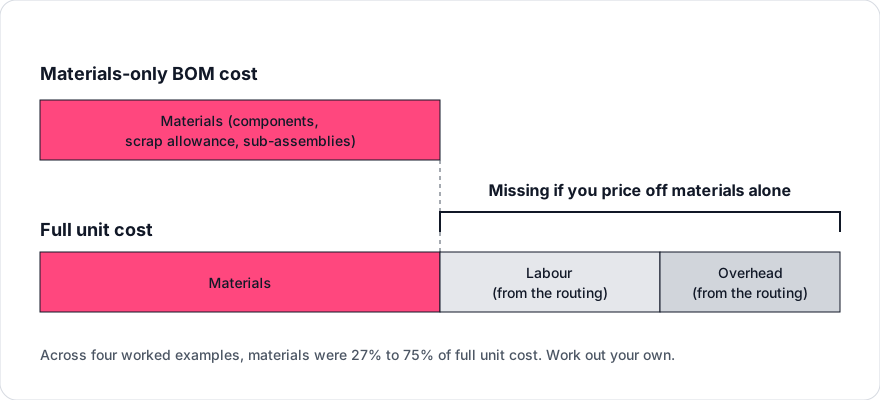
Method: in October 2026 four worked cost examples were compared. OpenBOM's example has materials of 157 and a total of 217, and Patron Accounting's example has materials of 640 and a total of 850. ErpDrive's cost sheet has materials of 47.54, scrap of 2.85 and a total of 84.37, and its machined bracket has materials of 46.53 and a total of 171.53. The shares and ratios are arithmetic from those figures. Components, bought-in assemblies and any scrap allowance were counted as materials, then divided by the stated total.
These are illustrative examples from vendors and accountants, not surveys. They show how wide the spread is, not a benchmark. A fabricator with expensive machine hours and a trader-assembler with bought-in parts will land at opposite ends.
- Example
- OpenBOM (US$)
- Materials
- 157
- Full cost
- 217
- Material share
- 72.4%
- Full cost ÷ materials
- 1.38
- Example
- Patron Accounting (₹)
- Materials
- 640
- Full cost
- 850
- Material share
- 75.3%
- Full cost ÷ materials
- 1.33
- Example
- ErpDrive cost sheet (₹, materials 47.54 plus scrap allowance 2.85)
- Materials
- 50.39
- Full cost
- 84.37
- Material share
- 59.7%
- Full cost ÷ materials
- 1.67
- Example
- ErpDrive machined bracket (₹, materials include 20% scrap)
- Materials
- 46.53
- Full cost
- 171.53
- Material share
- 27.1%
- Full cost ÷ materials
- 3.69
Which cost is your BOM cost?
Your BOM cost is one of five costs, and each answers a different question. Use the table to say which one a number is before it goes into a quote or a stock valuation.
Some enterprise resource planning (ERP) systems keep a costing BOM for estimates and a production BOM for planning and issuing materials. The product is the same, the purpose differs. The fourth row, landed cost, is the rate that belongs on each component line.
- Cost
- Material BOM cost
- Contains
- Components with scrap, at current rates
- Use it for
- First check on pricing; purchasing
- Cost
- Standard cost
- Contains
- Materials, labour and overhead at set rates
- Use it for
- Budgets, variance checks
- Cost
- Actual cost
- Contains
- What a production run really consumed
- Use it for
- Finding where cost leaked
- Cost
- Landed cost
- Contains
- Purchase price plus freight, duty and handling to your door
- Use it for
- The price you put on each component
- Cost
- Cost of goods sold (COGS)
- Contains
- The cost of what you sold in a period, by your valuation method
- Use it for
- Accounts and margins
What does a BOM costing sheet look like in rupees?
A per-unit sheet has one line per component, then labour, then overhead. The sheet below is an illustrative model for a small LED fitting. Every rate and quantity is an assumption, so replace them with your own.
Materials are 59.9% of this full cost (410.60 ÷ 685.60).
Scrap needs one rule. Under India's Cost Accounting Standard 6 on material cost, normal scrap is included in the material cost of good production, and abnormal scrap is left out and treated as a loss. Put your normal allowance in the BOM quantity and book spikes separately.
- Line
- Aluminium frame
- Calculation
- 1 × 1.02 × ₹180
- ₹ per unit
- 183.60
- Line
- LED driver
- Calculation
- 1 × 1.00 × ₹95
- ₹ per unit
- 95.00
- Line
- Diffuser sheet
- Calculation
- 0.5 m² × 1.10 × ₹240
- ₹ per unit
- 132.00
- Line
- Materials
- Calculation
- ₹ per unit
- 410.60
- Line
- Labour (assumed)
- Calculation
- 30 minutes ÷ 60 × ₹250 per hour
- ₹ per unit
- 125.00
- Line
- Overhead (assumed)
- Calculation
- 0.25 machine hours × ₹600 per hour
- ₹ per unit
- 150.00
- Line
- Full unit cost
- Calculation
- ₹ per unit
- 685.60
How do you check that a BOM cost is current?
Run these six tests on one product. Each has a pass and a fail.
- Price change: raise one component's price, then open the parent. Pass: the parent cost changes without re-keying. Fail: it shows the old cost.
- Scrap: compare each line's allowance with your recorded scrap. Pass: the allowance is within one percentage point of the scrap you recorded over the last three production runs. Fail: it differs by more, or is zero on cut or machined material.
- Units: check every unit of measure against the purchase unit. Pass: all match. Fail: metres against millimetres, or pieces against sets.
- Landed price: compare the BOM rate with the invoice plus freight and duty. Pass: freight and duty are included. Fail: the bare invoice rate.
- Sub-assemblies: pass if each is costed once and carried up as one line. Fail if its parts also appear in the parent.
- Rates: pass if labour and overhead rates were reviewed in the current financial year. Fail if they were not.
How Arka Inventory handles it
On the Advance and Enterprise plans, Arka Inventory lets you create bills of materials for standard products or specific orders, check material availability against the BOM, plan purchases and track consumption during production. The Enterprise plan adds landed cost, which allocates shipping, duties, taxes and fees to each unit. As of October 2026, the pricing page lists Advance at 499 a month billed yearly, with two licences included and 52 a month for each extra user; check the currency on the page.
A 15-day free trial with full access and no card is available, which is the time to run the price-change test from check 1 on your own products before relying on any cost figure.
Example
Take the LED fitting sheet above for an assumed batch of 200 units. The material total is ₹82,120, but a quote built on those materials alone would be about 40% short of the ₹685.60 full unit cost.
Frequently asked
Sources
- 1.Information used in BOM calculations with standard costs, Microsoft Learn, updated 1 September 2026, Microsoft Learn
- 2.CAS-6 (Revised 2017) Cost Accounting Standard on Material Cost, summary on TaxGuru, TaxGuru
- 3.CAS-6 (Revised 2017), Institute of Cost Accountants of India
- 4.BOM Cost Analysis: Formula, Example & Cost Rollup, OpenBOM
- 5.Bill of Materials (BOM) Costing: Meaning and Example, Patron Accounting
- 6.Production Costing for Indian Manufacturers, ErpDrive
- 7.BOM Cost Calculation, ErpDrive