


TL;DR
We recommend sales order software for inventory allocation that reserves eligible stock at a defined event, applies governed priorities, prevents conflicting commitments, and releases stock when demand changes. We compare the operational controls that matter, including partial fulfillment, warehouse sourcing, audit history, KPI dashboards, and a practical evaluation script for Salesforce-based teams.
Best Sales Order Software for Inventory Allocation
In the second quarter of 2026, U.S. retail e-commerce sales reached Census report estimates of $340.2 billion, raising the cost of promising stock that another order has already consumed.
The best sales order software for inventory allocation reserves eligible stock at a deliberate order event, applies consistent priorities, blocks conflicting commitments, and automatically releases stock when demand changes. For Salesforce-based teams, we pair stock commitment, real-time visibility, warehouse execution, and custom reporting so every promise can be traced.
This comparison explains the controls that make allocation accurate, how to test them under pressure, and how to report the results.
Which Sales Order Software for Inventory Allocation Is Best?
The best choice is not the platform with the longest feature list. It is the one that can show, at order-line level, what was reserved, why it was prioritized, where it will ship from, and what event releases the stock. For teams that operate in Salesforce, we built our allocation workflow around that operational evidence, not just order entry.
An ERP usually owns financial and supply consequences. An order-management layer owns intake, routing, and customer rules. An inventory system owns available stock and commitments. A warehouse system owns bin, lot, pick, and shipment execution. A reliable stack makes those responsibilities visible instead of allowing several systems to reserve the same unit.
| Platform Type | Reservation Trigger | Priority Controls | Partial And Backorder Handling | Warehouse Sourcing | Reporting Fit | Pricing Approach | Best Fit |
|---|---|---|---|---|---|---|---|
| Arka Inventory | Configured sales-order workflow | Policy and user-led decisions | Reviewable through order and inventory records | Multi-warehouse visibility | Custom dashboards and reports | Starts at $199/month, paid annually | Salesforce-based operations teams |
| Enterprise ERP Suites | Often configurable by order status | Date, promise, customer, or order rules | Usually configurable | Multi-location capable | Broad operational and financial reporting | Quote and licensing review | Finance-led, complex operations |
| Enterprise Supply Chain Suites | Reservation and fulfillment configuration | Deep shortage and sourcing policies | Advanced exception management | Network and warehouse logic | Enterprise analytics | Quote and implementation review | Large distribution networks |
| Warehouse-First Systems | Pick release or allocation wave | Picking and fulfillment rules | Warehouse exception workflows | Bin, lot, and zone logic | Execution-focused dashboards | Varies by deployment | Warehouse-led fulfillment teams |
| CRM Workflow Tools | Workflow status or approval event | Account and process rules | Often requires inventory-system coordination | Usually integration dependent | Sales and workflow reporting | Varies by licensing | Teams with simple stock requirements |
Our commit inventory capability is relevant when sales teams need a visible stock decision before promising delivery. We also keep inventory decisions connected to the live operational picture, rather than treating allocation as a one-time status update.
How Should Order Events and Priorities Control Commitments?
Reservation timing is a commercial policy, not a default setting. Reserving at order entry can protect a customer quickly, but it can also tie up stock before credit, approval, or payment has cleared. Reserving at confirmation, approval, payment success, scheduled release, or manual intervention gives teams different balances of protection and flexibility.
Priority rules matter most when supply is constrained. A fair policy may use FIFO by order date, promised date, customer tier, channel, warehouse, safety-stock protection, or a controlled manual override. The crucial part is that the policy is applied consistently and that exceptions are visible later.
A Reservation Is Not yet a Warehouse Lock
A soft reservation identifies intended demand. A hard allocation identifies the inventory, often down to warehouse, bin, lot, or serial level. Picking and shipment should tighten that commitment, because releasing stock after a pick has started creates avoidable warehouse rework.
Priority Rules Need a Decision Record
For every allocation, the system should retain the policy version, selected warehouse, order date, promise date, customer class, actor, and override reason. That record turns a shortage dispute from a search through messages into a reportable decision.
Safety Stock Must Remain Separate
Physical on-hand quantity is not automatically available quantity. A strong policy subtracts committed stock, quality holds, and protected safety stock before deciding whether a sales order can receive a promise. Our warehouse execution workflows help connect that decision to what the warehouse can actually fulfill.
What Happens When Stock Is Partial or Demand Changes?
Allocation accuracy is proven in messy orders, not clean ones. The system must distinguish between a partial allocation, a substitution, a kit waiting on a component, a split shipment, a backorder, and supply that is merely expected. Each state needs a clear next action and a record of what the customer was promised.
Returns also affect allocatable stock, particularly when the item cannot immediately return to available inventory. The NRF report estimates that 19.3% of online sales will be returned in 2025, making return status and inspection rules part of allocation accuracy.
Use these four scenarios during selection. They reveal whether the platform manages order state or only displays inventory totals.
-
Tier Conflict: With
[100 available], allocateto a standard order promised Friday andto a contracted order promised Thursday. Confirm whether policy, not manual speed, decides the shortfall. -
Safety Stock Guardrail: With
[80 on hand]and[25 safety stock], only[55 allocatable]should be available againstof demand. Confirm that the dashboard never presents allas promiseable. -
Cross-Warehouse Sourcing: With
in one warehouse andin another against a `` order, test whether the system chooses a split shipment, transfer, alternate source, or backorder with a visible reason. -
Kit And Inbound Supply: For `` kits, test one component with
[20 available]and another with[12 available]plus[8 due]. Confirm whether the remaining quantity is backordered, substituted under approval, or released only when complete.
Kits make this especially important because the saleable item can look available while a component is not. Our kitting controls give teams a practical way to see component demand alongside sales commitments.
How Do Dashboards Prove Allocation Accuracy?
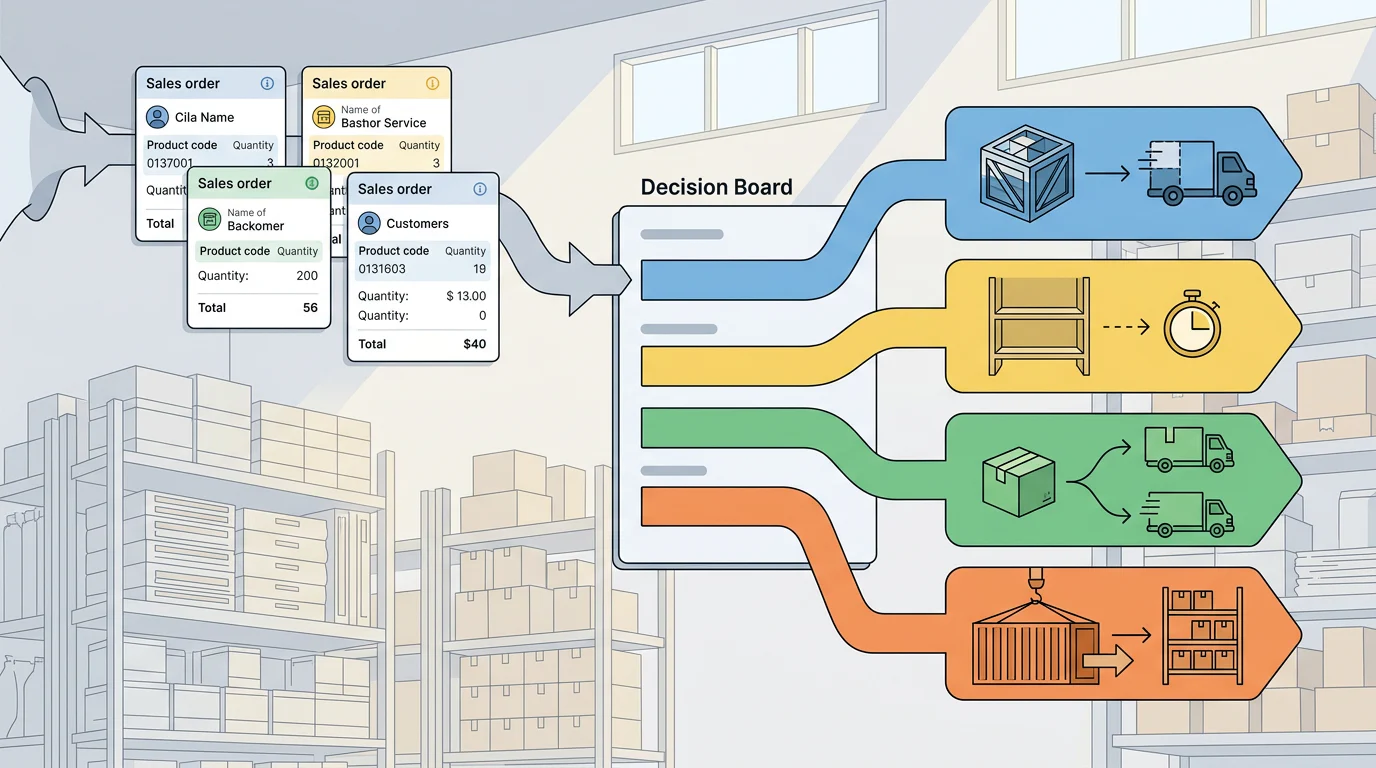
A dashboard should answer more than “how much stock is left?” It should show whether the system’s commitment became the warehouse outcome. That means reconciling requested, reserved, allocated, picked, shipped, cancelled, and returned quantities by order line.
The following measures make allocation performance visible across product, warehouse, channel, customer tier, and policy. They also expose when a process depends too heavily on manual intervention.
| KPI | Formula | What It Reveals |
|---|---|---|
| Allocation Accuracy | Correctly allocated lines ÷ audited allocated lines × 100 | Whether commitments match policy and fulfillment reality |
| Fill Rate | Shipped quantity ÷ ordered quantity × 100 | How much demand was fulfilled |
| Conflict Rate | Conflicting commitments ÷ allocation attempts × 100 | Whether stock was promised more than once |
| Manual Override Rate | Overridden allocations ÷ allocations × 100 | Whether policy is working without exceptions |
| Aging Reservation Rate | Open reservations beyond threshold ÷ open reservations × 100 | Whether stock is stranded by stale demand |
| Backorder Rate | Backordered quantity ÷ ordered quantity × 100 | Where supply or allocation policy falls short |
| Promise Reliability | On-time delivered orders ÷ delivered orders × 100 | Whether confirmed dates remain dependable |
The audit history behind these numbers should include the source system, actor, timestamp, prior quantity, new quantity, release reason, policy version, and warehouse. NIST guidance describes log management as generating, storing, accessing, and disposing of event data, a useful standard for allocation records that must explain operational issues.
Our custom reports let operations teams build those views around their own decision fields, rather than forcing every allocation exception into one generic report.
How Should Teams Evaluate Allocation Software?
A serious evaluation uses live order conditions, not a polished product tour. Give every platform the same definitions for eligible stock, reservation timing, priority, safety stock, cancellation, and backorder. Use inventory visibility to establish a baseline before testing whether reported availability matches the expected warehouse outcome.
- Map every order event from entry through return.
- Name the system responsible for each event.
- Define the single event that creates a reservation.
- Set eligible-stock and safety-stock rules.
- Test FIFO and customer-tier priority policies.
- Run the tier-conflict scenario.
- Run the safety-stock scenario.
- Run the cross-warehouse scenario.
- Run the kit-and-inbound scenario.
- Cancel, edit, fail payment, expire, pick, ship, and return an order, then audit every commitment and release.
The evaluation should end with an exported report, not a verbal assurance. Sales, operations, finance, and warehouse leaders should be able to agree on why an order received stock, why another did not, and how the outcome changed the promise date. Our Salesforce use cases help teams evaluate allocation inside the CRM workflows they already use.
How Arka Inventory Can Help
At Arka Inventory, we give Salesforce-based operations teams a place to turn allocation policy into visible, reviewable work. We connect sales orders to stock commitment, warehouse actions, purchase activity, and custom dashboards, so people who promise delivery can see the operational consequences of each order change. Our Enterprise plan includes sales orders, lot and serial tracking, landed cost, bin tracking, and dedicated onboarding. Our Basic plan starts at $199 per month when paid annually, while our Advance plan starts at $499 per month when paid annually. The right next step is not a generic demo. Bring one live shortage, one multi-warehouse order, and one cancelled order. We will help map the decision points, show the fields your reports need, and test the release behavior your team relies on across sales and operations before confidently committing to configuration or rollout. Explore Arka Inventory
FAQs on Sales Order Software for Inventory Allocation
What Makes Inventory Allocation Accurate?
Accurate allocation requires an explicit reservation event, an eligible stock calculation, a consistent priority policy, and a visible release record whenever demand changes, expires, or cancels.
Should Confirmed Orders Always Reserve Stock?
Not always. A confirmed order should reserve stock when the business accepts the delivery promise, then release it after cancellation, expiry, failed payment, or a qualifying edit.
What Should an Allocation Dashboard Track?
Track requested, reserved, allocated, picked, shipped, cancelled, and returned quantities by order line, then reconcile every state change to its source, actor, timestamp, and reason.
How Can Teams Test Allocation Before Buying?
Test shortages, partial kits, inbound receipts, split warehouse fulfillment, cancellations, failed payments, and returns, then inspect commitments, releases, audit history, and dashboards for every order line.