
Best Inventory Visibility Alternatives for Manufacturers
Compare inventory visibility alternatives for manufacturers by stock states, dashboards, reservations, traceability, production visibility, cost, and rollout.

Best Inventory Visibility Alternatives for Manufacturers
For covered food supply chains, the FDA says traceability records generally must be retained for two years. That standard illustrates a broader manufacturing reality: a stock figure is useful only when the team can explain where it came from, who needs it, and what will happen next.
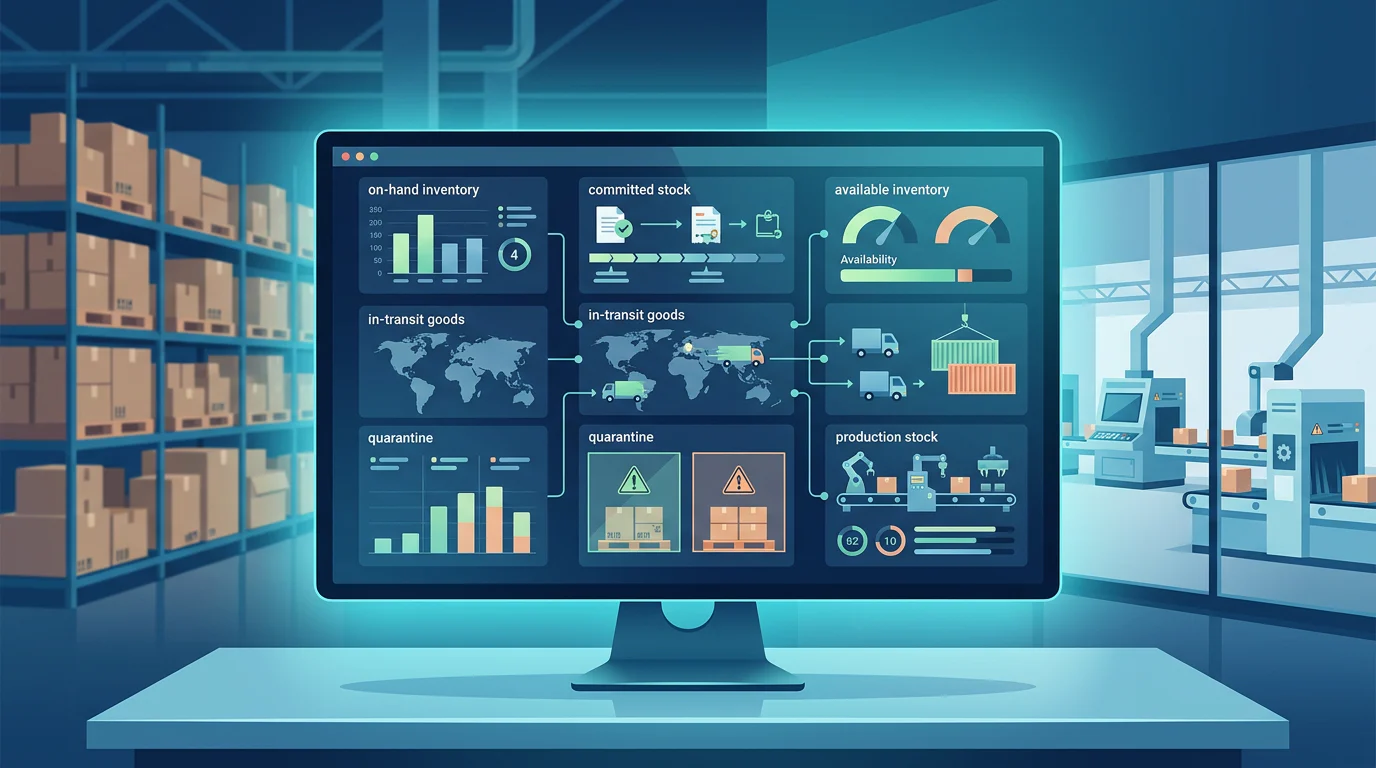
Inventory visibility alternatives for manufacturers earn a place on the shortlist only when they show on-hand, committed, available, in-transit, quarantined, and production stock from one operational record. We are a strong fit for Salesforce-based teams needing custom dashboards, stock commitments, lot and serial tracking, and warehouse workflows. We compare dashboard, reservation, traceability, production, and rollout requirements.
Why Manufacturers Replace Inventory Systems for Better Visibility
Manufacturers rarely replace an inventory system because one screen looks dated. They replace it because sales promises stock that production needs, warehouse teams cannot see an incoming transfer, or finance discovers that the physical count and the operational count are not telling the same story.
The central question is not whether a platform displays inventory. It is whether every team sees the right state of inventory for its job, with enough context to act without a spreadsheet sidecar. Our inventory visibility workflows bring location, demand, supply, and movement information into the same operating environment.
- On-hand stock: What is physically stored at a location or bin, including units already committed elsewhere.
- Available stock: What remains after open demand and existing commitments are considered.
- Committed stock: What has been promised to a customer or production requirement.
- In-transit stock: What has left one location but has not been received at another.
- Production stock: What is tied to raw materials, work in progress, or finished goods.
A useful replacement must also make disagreement visible. A buyer should be able to drill from a dashboard total into the order, transfer, lot, serial number, or work order responsible for that number. If the explanation stops at a total, the team is still reconciling.
Best Inventory Visibility Alternatives for Manufacturers
There is no universal winner because visibility depends on how inventory moves through your business. A team selling configured products from Salesforce needs a different operating model than a high-volume distributor, a regulated producer, or a multi-entity manufacturer.
We recommend ranking options against the workflows that create inventory changes, not a feature checklist alone. The matrix below gives manufacturers a practical way to compare the main solution patterns without confusing a module claim with a proven operational capability.
Compare the Operating Model Before the Feature List
| Alternative Pattern | Inventory-State Visibility | Dashboard Flexibility | Reservation Depth | Manufacturing Visibility | Cost And Overhead Signal | Best Fit |
|---|---|---|---|---|---|---|
| Arka Inventory | Location-level visibility, commitments, backorders, inventory on order, and production context | Custom Salesforce reporting and dashboard potential | Commit inventory against sales demand | BOM, production, kitting, and raw-material visibility | Starts at $199 per month when billed annually | Salesforce-based manufacturers |
| Manufacturing-First Platform | Often strong for materials and work orders | Validate custom object and field support | Validate order priority and ATP rules | Often a core strength | Add-ons may change the effective price | Production-led operations |
| Modular Business Suite | Depends on selected applications and configuration | Often flexible with administrative effort | Confirm cross-module reservation behavior | May require separate manufacturing modules | Scope and administration can expand together | Teams with technical configuration capacity |
| Enterprise ERP | Broad state coverage when configured | Strong reporting, but role and implementation dependent | Advanced allocation may be available | Broad production and multi-entity support | Quote-led pricing and formal rollout common | Complex, multi-entity operations |
| Wholesale Inventory Platform | Usually strong for orders, transfers, and fulfillment | Confirm dashboard customization limits | Test partial-order and backorder behavior | Often lighter for work in progress | Subscription may exclude advanced functions | Distribution-heavy manufacturers |
Look for the Seven Dashboard Tests
A dashboard should not be judged by chart count. It should answer whether a planner can identify a shortage, whether a sales rep can make a promise, and whether a warehouse manager can trace the movement behind an exception.
Our custom dashboards approach is most valuable when teams need inventory data alongside the Salesforce records they already use. Before selecting any platform, ask for a live demonstration of these tests:
- Configurable KPIs: Can users track availability, commitments, shortages, ageing, and transfer status without a vendor-built report?
- Custom data model: Can the organization report on its own fields, objects, statuses, and customer rules?
- Drill-down: Can a dashboard total open the transactions that created it?
- Alerts: Can low stock, backorders, expiry exposure, or transfer delays trigger a useful action?
- Permissions: Can sales, warehouse, production, and finance see the right data without exposing everything?
- Exports: Can operations export an auditable detail set when a customer, auditor, or manager asks?
- Refresh behavior: Does the number change from a native transaction, an integration sync, or a scheduled import?
Which Features Decide Inventory Visibility?
Reservations, traceability, and production visibility are where apparently similar systems separate. A platform can display a quantity accurately and still fail the business if it cannot explain why the quantity is unavailable, which lot must ship, or whether materials can support the next work order.
Reservation Rules Need to Match the Promise
Reservation is not simply a reduction in stock. It is a business rule that determines who receives inventory first, when a commitment occurs, whether partial quantities can ship, and when the commitment is released.
Our stock commitment capability helps teams reserve inventory against demand while keeping availability visible to the people creating opportunities, quotes, and orders. During evaluation, test a high-priority order, a partial shipment, a cancellation, and a stock transfer against the same SKU.
| Reservation Test | Passing Result | Red Flag | Business Effect |
|---|---|---|---|
| Sales-order trigger | Commitment timing is explicit and visible | Teams guess whether stock is held | Promises can exceed supply |
| Priority rule | Priority is documented and adjustable | First order wins by accident | Strategic customers lose allocation |
| Partial stock | Available units can ship while the balance stays visible | Entire order becomes opaque | Backorders are harder to manage |
| Release event | Cancellation, amendment, and fulfillment release stock predictably | Held stock remains stranded | Availability is understated |
| ATP impact | Available-to-promise changes with demand and supply | On-hand is treated as sellable | Sales sees a misleading number |
Traceability Must Survive Real Operations
Lot and serial tracking is only valuable when it follows the item through receipt, storage, movement, production, shipment, return, adjustment, and recall. We built lot and serial tracking to support batch, expiry, and serial workflows without forcing teams to reconstruct history manually.
A credible demonstration should start with a received lot, consume it into a finished good, move that finished good between locations, ship it, and then identify every affected transaction. Buyers should also test expiry controls, adjustments, audit history, recall lookup, and the export format required by their quality process.
Regulated food manufacturers have an added reason to test this path now. FDA says it does not intend to enforce the Food Traceability Rule before July 20, 2028.
Readiness still matters before that date because a traceability process must work under pressure. FDA guidance says covered firms may need to provide requested records within 24 hours.
Production Visibility Begins with Material Availability
Production visibility should connect raw materials, BOM requirements, buildable quantity, work orders, work in progress, and finished goods. If an option shows finished stock but cannot show the component shortage preventing the next build, it is not giving production a dependable planning view.
Our manufacturing inventory workflows help bring material availability and production context into the same decision path as sales and purchasing. For subcontracting, test whether supplied materials, outside processing, expected receipt, and finished-good completion remain traceable through the same record chain.
How to Evaluate Cost, Integrations, and Rollout Effort
Subscription price is only one part of the decision. The operational cost includes new integrations, required add-ons, custom reporting, data cleanup, process redesign, permission setup, training, and the time your team spends maintaining exceptions.
A native Salesforce workflow can reduce duplicate data handling for teams that already run sales, service, and operations there. Our Salesforce use cases show where inventory context can support those customer-facing workflows, while the evaluation should still document every external accounting, ecommerce, 3PL, and warehouse connection.
Start with a representative operating scenario, not a polished demo. Use one active SKU, one lot-controlled item, one serial-controlled item, an open sales order, a partial backorder, an inter-location transfer, and a production order. Then score the result using the rubric below.
| Evaluation Criterion | Weight | What To Verify |
|---|---|---|
| Inventory-state accuracy | 25% | On-hand, available, committed, in-transit, and exception statuses agree |
| Reservation And ATP Logic | 20% | Triggers, priority, partial stock, releases, and backorders work as required |
| Traceability Depth | 15% | Lots, serials, expiry, genealogy, recalls, adjustments, and audit trail are usable |
| Manufacturing Visibility | 15% | BOM availability, work orders, WIP, finished goods, and subcontracting are visible |
| Dashboard And Permissions | 10% | KPIs, drill-downs, custom fields, alerts, exports, and roles fit the team |
| Integration Architecture | 10% | Sync direction, refresh timing, ownership, and failure handling are documented |
| Cost And Administrative Overhead | 5% | Pricing, onboarding, add-ons, implementation work, and ongoing administration are transparent |
Our published plans begin at $199 per month when billed annually, while advanced production and traceability requirements can change the right plan and rollout path. Review pricing alongside your workflow test, not before it.

Why Arka Inventory Fits Salesforce-Based Manufacturers
At Arka Inventory, we built our platform for teams that already operate in Salesforce and need inventory decisions to appear where customer, service, and sales work happens. We connect location-level stock, purchase activity, sales orders, warehouse actions, lots, serials, and production information so teams can work from shared operational context. That can reduce handoffs between CRM, warehouse, and planning conversations while keeping each team focused on the record it needs. Our best next step is a workflow-led demo, using a representative SKU, an open order, a transfer, and a production scenario. We will show how those events affect availability, commitments, and dashboard reporting, then help you identify configuration requirements before rollout. Bring the people who promise, buy, pick, build, and reconcile inventory, because a useful evaluation exposes their questions before migration starts and turns assumptions into testable workflow decisions. Explore Arka Inventory.
FAQs on Inventory Visibility Alternatives for Manufacturers
Manufacturers should use these questions to test real workflows, not just feature claims. Each answer points back to the visibility requirements that determine whether a system can support dependable operational decisions.
Which Inventory Visibility Alternative Offers Custom Manufacturing Dashboards?
For Salesforce-based manufacturers, we fit teams needing inventory data, configurable dashboards, drill-downs, role-based permissions, and workflow-specific fields within their CRM, alongside warehouse and production operations.
Which Inventory Visibility Alternative Tracks Lots and Serial Numbers?
We track lots, serial numbers, batch expiry dates, and their transaction history. Buyers should still test their exact recall, adjustment, genealogy, and export workflow before purchase.
Which Inventory Visibility Alternative Supports Inventory Reservations for Sales Orders?
We support inventory commitments against orders and visibility into backordered supply. A buyer should test trigger timing, partial allocation, priority, release events, and available-to-promise effects.
Which Inventory Visibility Alternative Provides Real-Time Inventory Visibility?
We update inventory information as operational transactions occur in Salesforce. Buyers should verify each integration's sync behavior, transfer timing, offline workflow, and report-refresh schedule during a demo.