Purchase Order Process: Steps, GST-Ready Sample PO and Pay-or-Hold Rule
The purchase order process runs from requisition and approval to order, receipt, invoice match and payment. In India, pay only for goods received, within 45 days for micro and small suppliers.

By Praveen Nune, Co-Founder & CEO · Updated 10 Oct 2026
Key takeaways
- 01The purchase order process has seven steps: requisition, approval, PO, PO acceptance by the supplier, goods receipt, invoice match and payment. Each step must leave a record before the next begins.
- 02A complete PO carries both GSTINs, an HSN or SAC code on each line, one GST type, the supplier's Udyam category, and a payment term counted from acceptance of the goods.
- 03For micro and small suppliers, payment is due within the agreed period, capped at 45 days, or 15 days with no written agreement. Late payment carries interest at three times the RBI bank rate.
- 04Hold any invoice that bills more than you received or at a rate above the PO, and settle the difference in writing.
In this article
- 1What are the steps in a purchase order process?
- 2What should a GST-ready sample purchase order include?
- 3How does a purchase order differ from a delivery challan, a GRN and an invoice?
- 4Should you pay an invoice that does not match the purchase order?
- 5How long can you take to pay a micro or small supplier after goods acceptance?
- 6Why does the goods receipt note matter for GST input tax credit?
- 7When does a spreadsheet stop being enough, and how do we run purchase orders in Arka Inventory?
- 8Frequently asked questions
Companies that file the half-yearly MSME-1 return, which discloses dues to micro and small suppliers, reported about ₹22,730 crore outstanding for more than 45 days in the October 2024 to March 2025 period, according to the Ministry of Corporate Affairs' reply in the Lok Sabha (Unstarred Question 177, 21 July 2025). Each of those rupees began as a purchase order, and the payment date was set, or left unset, on that document.
A purchase order (PO) is the buyer's written order to a supplier: what you want, how many, at what price, delivered where and paid when. Everything after it either confirms that document or contradicts it. The contradiction usually surfaces when the invoice arrives.
This page gives the seven steps of the purchase order process, a filled-in GST-ready sample PO you can copy, and a rule for deciding whether to pay an invoice or hold it. It also shows how the 45-day payment limit and your GST credit depend on the records you keep at each step.
What are the steps in a purchase order process?
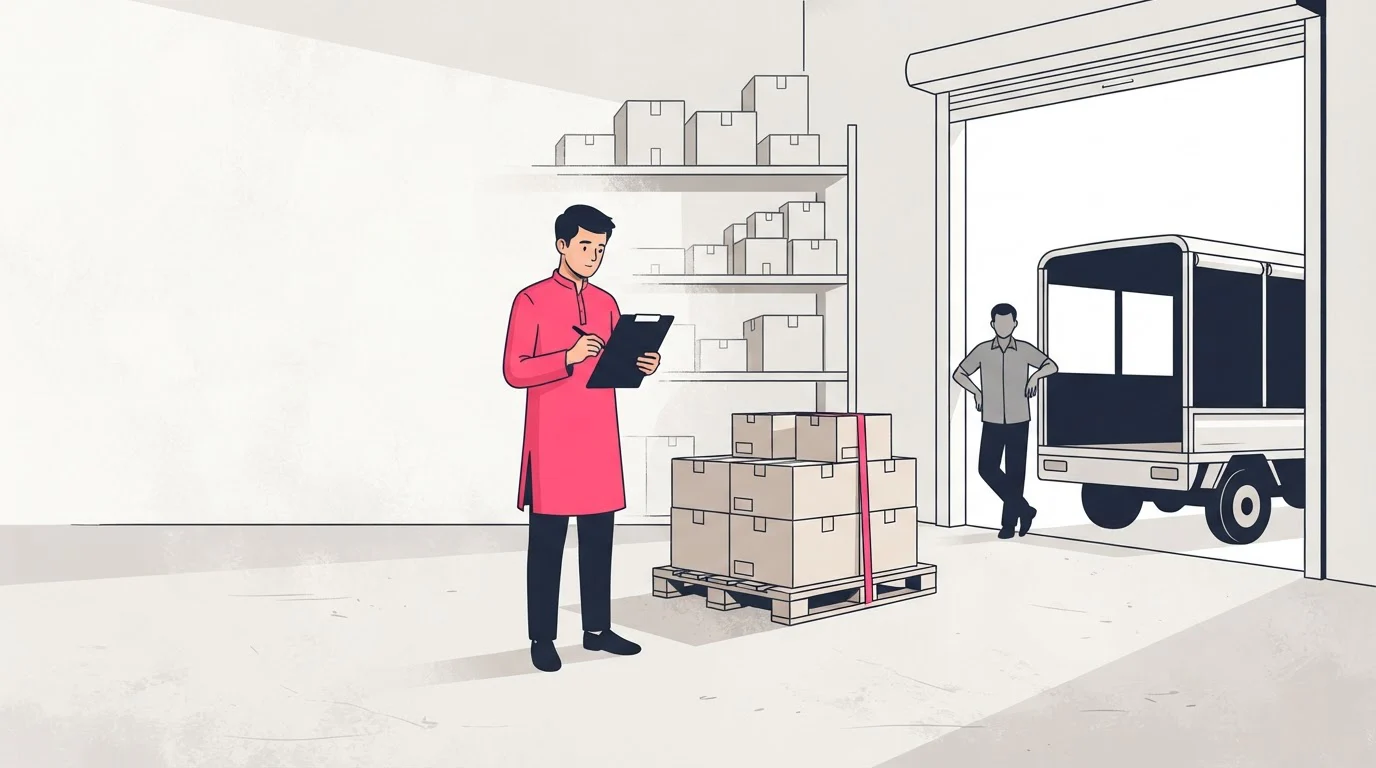
The purchase order process has seven steps: requisition, approval, PO issue, PO acceptance, goods receipt, invoice match and payment. Each step creates one record, and the next step starts only when that record exists. The flow is: Requisition → Approval → PO → PO acceptance → Goods receipt note → Invoice match → Payment.
| Step | Who | Record it creates | Move on only when |
|---|---|---|---|
| 1. Requisition | Stores, production or sales | Request with item, quantity, need-by date | Item and quantity are written down, not asked for verbally |
| 2. Approval | Budget owner | Signed or system approval | The approver is not the requester |
| 3. PO issue | Purchase team | PO with a unique number | Every field in the next section is filled |
| 4. PO acceptance | Supplier | Written confirmation of price, quantity, date | You hold the confirmation (email counts) |
| 5. Goods receipt and goods acceptance | Stores | Goods receipt note (GRN), the buyer's record of what arrived and was accepted | Quantity counted, damage noted, PO number quoted |
| 6. Invoice match | Accounts | Matched or held invoice | PO, GRN and invoice agree (see below) |
| 7. Payment | Accounts | Payment entry, PO closed | Payment falls inside the PO's payment term |
Two acceptances matter. PO acceptance is the supplier agreeing to your order (step 4). Goods acceptance is you accepting what was delivered (step 5). The legal payment clock runs from goods acceptance, not from PO acceptance.
What should a GST-ready sample purchase order include?
A GST-ready PO carries the buyer's and supplier's Goods and Services Tax Identification Numbers (GSTIN), an HSN or SAC code on each line, the GST rate, a payment term in days, and the supplier's acceptance. HSN (Harmonised System of Nomenclature) classifies goods; SAC (Services Accounting Code) classifies services.
Our recommendation is to carry the HSN or SAC on the PO so it can be matched to the invoice, where the code is mandatory: tax invoices need 4 digits up to ₹5 crore turnover and 6 digits above (CBIC Notification 78/2020-Central Tax, PIB).
Udyam registration is the government's registration for micro, small and medium enterprises (MSMEs). From 1 April 2025, an enterprise is micro with investment in plant and machinery or equipment up to ₹2.5 crore and turnover up to ₹10 crore. It is small with investment up to ₹25 crore and turnover up to ₹100 crore (Ministry of MSME notification S.O. 1364(E)).
| Field | Enter | Pass if |
|---|---|---|
| PO number | Sequential with financial year, e.g. PO/2026-27/0001 | The number appears once in your PO register. Fail if it repeats |
| Buyer | Legal name, address, GSTIN | The GST portal's Search Taxpayer tool returns your legal name for that GSTIN |
| Supplier | Legal name, address, GSTIN | Search Taxpayer shows the GSTIN as active and the name matches the supplier's invoice. Fail if cancelled or different |
| Supplier size | Udyam number and category (micro, small or medium) | The category from the supplier's Udyam certificate is on the PO. Fail if blank, because you cannot tell whether the 45-day limit applies |
| Place of supply | State of supply and ship-to address | The place of supply is the supplier's state with CGST plus SGST (Central and State GST) lines, or a different state with one IGST (Integrated GST) line. Fail if both types appear |
| Line items | Description, HSN or SAC, unit, quantity, rate | Every line has all five |
| GST | Rate and amount per line | Recomputed line totals plus GST equal the PO total |
| Other charges | Freight, packing, insurance | Every charge is on the PO. Fail if one first appears on the invoice |
| Delivery date | Calendar date per delivery | A date, not "ASAP" |
| Payment term | Days from acceptance of the goods (or deemed acceptance) | 45 days or fewer for a micro or small supplier. Fail if longer or blank |
| PO acceptance | Supplier's signed copy or confirming email | You hold it, dated before dispatch |
| Short-delivery clause | Buyer pays only for goods received and accepted | The clause is printed on the PO |
A filled-in PO using these fields (names, GSTINs and Udyam number are dummy values; use the HSN and GST rate that apply to your goods):
PURCHASE ORDER
PO number: PO/2026-27/0001          PO date: 12 October 2026
Buyer:    Example Fabricators Pvt Ltd, Peenya, Bengaluru, Karnataka
          GSTIN 29AAAAA0000A1Z5
Supplier: Sample Fasteners LLP, Bengaluru, Karnataka
          GSTIN 29BBBBB1111B1Z5   Udyam UDYAM-KR-00-0000000, category: small
Place of supply: Karnataka (same state: CGST + SGST)

Line  Description                  HSN   Unit  Qty  Rate     Amount
1     Hex bolt M8 x 40 mm, zinc    7318  nos   500  ₹84.00   ₹42,000.00

Taxable value ₹42,000.00 | CGST 9% ₹3,780.00 | SGST 9% ₹3,780.00
PO total ₹49,560.00. Other charges: none (freight included in rate)
Delivery: 26 October 2026, buyer's Peenya stores
Payment term: 45 days from acceptance of the goods (or deemed acceptance)
Terms: Buyer pays only for goods received and accepted, at the PO rate.
       Quote the PO number on the delivery challan and the invoice.
PO acceptance: Supplier name / signature or email reference / date
How does a purchase order differ from a delivery challan, a GRN and an invoice?
A purchase order is the buyer's order. A delivery challan is the supplier's movement document, which lists goods sent and charges no GST. The GRN is the buyer's record of what arrived. A tax invoice is the supplier's demand for payment, with GST.
| Document | Issued by | Answers |
|---|---|---|
| Purchase order | Buyer | What did we agree to buy, at what price and terms? |
| Delivery challan | Supplier | What was sent with this vehicle? |
| GRN | Buyer | What did we actually receive and accept? |
| Tax invoice | Supplier | What are we being asked to pay? |
Payment is safe only when the invoice agrees with the PO on price and with the GRN on quantity.
Should you pay an invoice that does not match the purchase order?
No. Hold the invoice when its quantity exceeds the GRN quantity or its rate differs from the PO rate, and pay the undisputed amount. Matching the PO, the GRN and the invoice before paying is a three-way match. A credit note is the supplier's document that reduces an earlier invoice.
A worked example (constructed to show the method), using the sample PO above:
- PO: 500 units at ₹84.00 = ₹42,000, plus 18% GST of ₹7,560 = ₹49,560.
- GRN: 480 units received.
- Invoice: 500 units at ₹86.50 = ₹43,250, plus GST of ₹7,785 = ₹51,035.
- Undisputed amount: 480 × ₹84.00 = ₹40,320, plus GST of ₹7,257.60 = ₹47,577.60.
- Excess billed: ₹51,035 − ₹47,577.60 = ₹3,457.40, or 7.3% of the undisputed amount.
The excess has two causes. The 20 units not delivered account for ₹1,982.40 (20 × ₹84.00 = ₹1,680, plus GST of ₹302.40). The ₹2.50 price rise on 500 units accounts for ₹1,475 (₹1,250 plus GST of ₹225). Together they make ₹3,457.40.
Our recommended rule, which you can adapt to your own risk:
| Check | Pass | If it fails |
|---|---|---|
| Invoice quantity against GRN quantity | Invoice quantity is no more than GRN quantity | Hold. Ask for a credit note, or wait for the balance delivery |
| Invoice rate against PO rate | Equal | Hold. Pay the new rate only if you agree it in writing and amend the PO. Otherwise pay the undisputed amount at the PO rate and settle the difference by credit note |
| GSTIN, HSN and GST rate against PO | All three match | Hold. Ask for a corrected invoice |
| Extra charges (freight, packing) | Already on the PO | Raise an amended PO before paying |
| Due date | Inside the PO payment term | Schedule payment now |
In the example, pay ₹47,577.60 before the due date and settle the ₹3,457.40 by credit note. For micro and small suppliers, interest under section 16 of the MSMED Act runs on any held amount later found due, so resolve disputes inside the payment term.
How long can you take to pay a micro or small supplier after goods acceptance?
Pay within the period agreed in writing, which can never exceed 45 days from the day of acceptance or deemed acceptance of the goods. With no written agreement, the limit is 15 days (MSMED Act, 2006, section 15). Goods are deemed accepted if you do not object in writing within 15 days of delivery.
Section 43B(h) of the Income Tax Act applies from assessment year 2024-25 (financial year 2023-24 onward). Amounts owed to micro and small suppliers are deductible in the year of the expense only if paid within the 15 or 45 day limit. Otherwise the deduction is deferred to the year you actually pay (Income Tax Department, Finance Act 2023 highlights). Medium enterprises are outside this rule.
Late payment attracts compound interest with monthly rests at three times the bank rate (MSMED Act, section 16). The bank rate was set at 5.75% from 7 October 2026 (RBI Monetary Policy Statement, 5 to 7 October 2026), so as of October 2026 the interest rate is 17.25% a year. Use the bank rate in force when you pay.
Our illustration for ₹1,00,000 overdue at 17.25% a year, compounded monthly (17.25% ÷ 12 = 1.4375% a month, each month taken as 30 days):
| Overdue for | Interest |
|---|---|
| 1 month | ₹1,438 |
| 2 months | ₹2,896 |
| 3 months | ₹4,375 |
Three habits follow:
- Record the supplier's Udyam category on every PO.
- State the payment term in days from goods acceptance. In our view, a PO the supplier accepts in writing is the simplest written agreement; confirm this with your chartered accountant.
- Object to a bad delivery in writing within 15 days.
Why does the goods receipt note matter for GST input tax credit?
The goods receipt note proves you received the goods, which is a condition for claiming input tax credit (ITC) under section 16(2)(b) of the Central Goods and Services Tax (CGST) Act, 2017. ITC is the GST you paid on purchases, which you set against the GST you owe on sales. When goods arrive in instalments, credit is available on receipt of the last lot.

Section 16(2) also requires a valid tax invoice, the invoice appearing in your GSTR-2B (the auto-drafted ITC statement the GST portal prepares from suppliers' returns), the supplier having paid the tax to the government, and your own return being filed. If you do not pay the supplier within 180 days of the invoice date, the credit must be added back to your tax liability with interest (CBIC, CGST Act section 16).
Record every partial delivery against its PO line on the day it arrives, not at month end.
When does a spreadsheet stop being enough, and how do we run purchase orders in Arka Inventory?
A spreadsheet works while one person raises few POs for few suppliers. It stops working when POs, receipts and stock sit in different files, because nobody can see which POs are still open. We recommend software once more than one person receives goods or you buy for more than one warehouse.
Arka Inventory is cloud software built natively on Salesforce. This is how we run the process:
- Plan the purchase. You plan purchases and schedule purchase requisitions or POs from sales, stock levels and forecasts (forecasting and purchase automation). Set the trigger quantity with the reorder point formula.
- Receive against the PO. At receipt, you choose the supplier and see its outstanding POs, then select the products and adjust quantities to what arrived. Price fills in from the supplier's cost when we hold it (material inbound guide). Receiving is barcode-based, with pallet labels and bin putaway; our guide to managing warehouse inventory covers the routine around it.
- Cost it properly. Freight, duties, taxes and fees go into landed cost, so each unit carries its true cost. The landed cost calculation for imports into India gives the formula and a sheet.
- Get alerted. Inventory alerts tell you when stock arrives for backordered items and when items fall below minimum levels.
- Hand over to accounts. Our Tally integration passes invoices, bills and transaction details from Arka to Tally. We also integrate with QuickBooks Online.
As of October 2026, purchase orders are included in every plan. Basic costs $199 a month billed yearly with one user licence (extra users $42 a month), and Advance costs $499 a month billed yearly with two (extra users $52). Enterprise pricing is tailored to your team (pricing). For a wider view of what buyers pay, see inventory management software cost. You can try everything free for 15 days with no credit card, and standard setup guidance is included. Onboarding typically takes a minimum of two weeks, depending on your data.
To see your own purchase flow in the product, book a demo.
See your purchase order flow in Arka Inventory
Frequently asked questions
Sources
- 1.Income Tax Department: Highlights of Finance Act 2023 (section 43B(h))
- 2.India Code: Micro, Small and Medium Enterprises Development Act, 2006 (sections 15 and 16)
- 3.RBI: Monetary Policy Statement, 2026-27, Resolution of the Monetary Policy Committee, 5 to 7 October 2026
- 4.Ministry of MSME: Notification S.O. 1364(E), 21 March 2025 (revised classification)
- 5.CBIC: CGST Act, 2017, section 16
- 6.PIB: HSN code and SAC on invoices, CBIC Notification 78/2020-Central Tax
- 7.GST portal: Search Taxpayer
- 8.Ministry of Corporate Affairs reply, Lok Sabha Unstarred Question 177, 21 July 2025 (MSME-1 dues), as reproduced by TaxGuru
- 9.Arka Inventory: Pricing
- 10.Arka Inventory: Forecasting and Purchase Automation
- 11.Arka Inventory: Material inbound guide
- 12.Arka Inventory: Landed Cost
- 13.Arka Inventory: Inventory Alerts
- 14.Arka Inventory: Tally integration