Order Picking Methods: Choose by Lines per Trip, Then Test
Choose order picking methods by items per trip: batch picking adds orders to each trip, discrete picking suits orders that fill a cart, and a timed 20-order test confirms the choice.

By Praveen Nune, Co-Founder & CEO · Updated 14 Oct 2026
Key takeaways
- Choose an order picking method by pick lines per trip. In our model the walk flattens at about 2 to 4 pick lines per aisle (20 to 40 lines across 10 aisles), so multiply by your own aisle count.
- Batch picking (several orders collected on one trip) cuts walking most. For five-line orders in our model, batches of 4 cut walking per order by 55% and batches of 8 by about three quarters, before sorting time.
- Zone picking (each picker stays in one area) is meant to cut elapsed time, which our model does not measure. In our model, five zones cut total walking on five-line orders by about a quarter.
- Test before you switch. Deal 40 orders from one shift into two matched sets of 20, pick one set singly and one in batches, and adopt batching only if time per order falls by at least 15% with no extra mispicks.
In this article
- 1What are the main order picking methods, and what separates them?
- 2How far does a picker walk as a trip gets longer?
- 3How much walking does batch picking save per order?
- 4Does zone picking reduce walking, and where does wave picking fit?
- 5What is the saved walking worth in rupees?
- 6Which picking method should you start with, and how do you test it?
- 7How do we support picking at Arka Inventory?
- 8Frequently asked questions
A picker's walk stops growing once a trip carries enough items. After that point, every extra line (one item and quantity on an order) on the same trip adds almost no walking. The cheapest line to pick is the one that shares a trip with many others, and each picking method is a different way of arranging that sharing.
Picking is among the largest labour costs in a warehouse, and walking is often the biggest part of it. Choosing a method by its name, or by what suits a much bigger warehouse, is an easy way to pay for walking you do not need.
This page shows how far a picker walks as a trip lengthens, what batching is worth in rupees, which method to start with, and a 20-order test to run on your own floor before you change anything. The numbers come from a walking model we built, and the page gives its rules so you can rebuild it with your own aisle count.
What are the main order picking methods, and what separates them?
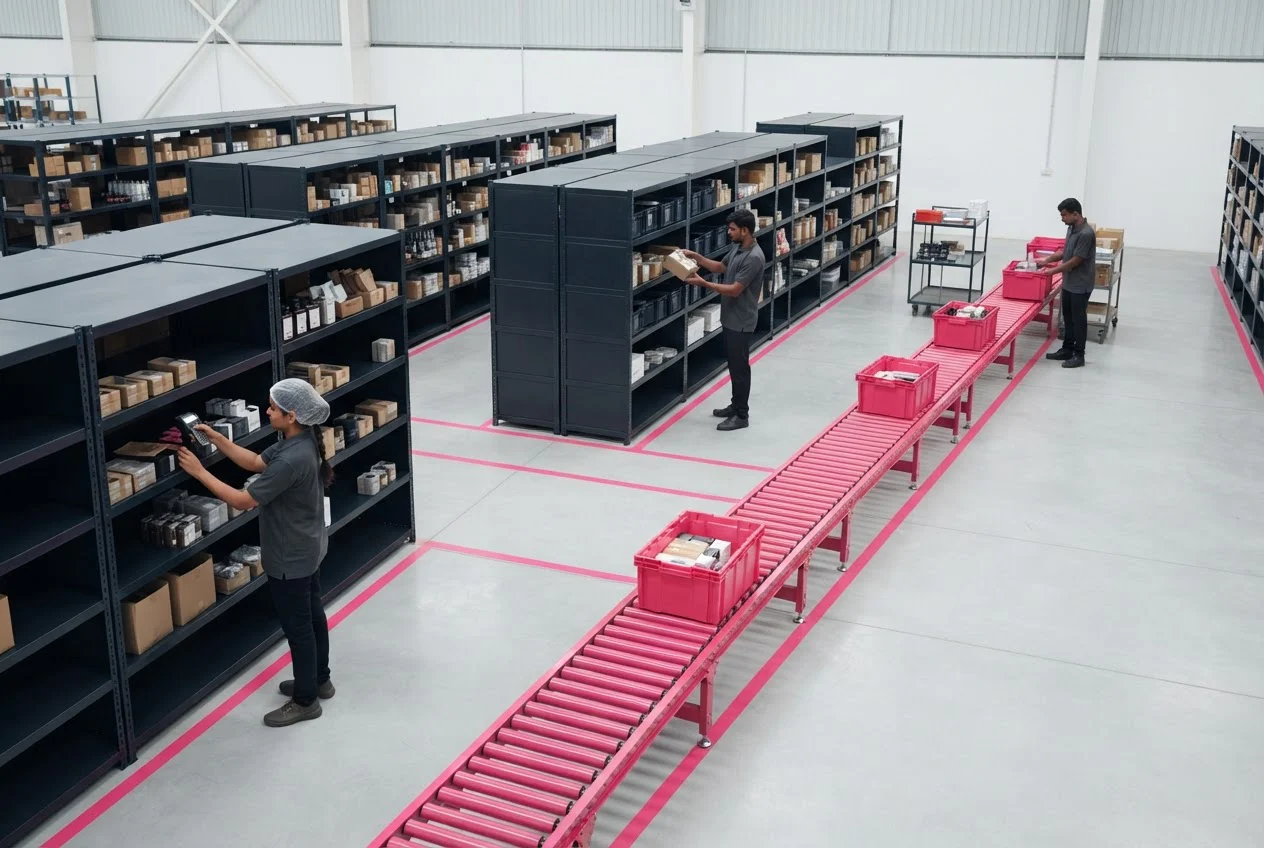
Four methods cover most warehouses. Discrete picking collects one order per trip. Batch picking collects several orders per trip. Zone picking keeps each picker in one area while orders pass between pickers. Wave picking releases orders to the floor at set times. All four decide how many pick lines share a trip.
A pick line is one item and quantity on an order. A trip runs from the packing area through the aisles and back.
Picking is a large share of cost. A 2006 literature review from Erasmus University Rotterdam, citing earlier estimates, puts order picking at up to 55% of warehouse operating expense.
When orders are large, picking each on its own works. When orders are small, grouping a set of them into one trip cuts travel. Orders can be grouped by the proximity of their pick locations or by time window, meaning all orders that arrive in the same interval (De Koster, Le-Duc and Roodbergen).
How far does a picker walk as a trip gets longer?
Walking per trip climbs steeply for the first 20 pick lines, then flattens at about 254 m, the full sweep of every aisle in our 10-aisle model. The flattening follows lines per aisle: at 20 lines about 88% of aisles hold a pick, and at 40 lines about 99% do.
| Pick lines on the trip | Metres walked per trip |
|---|---|
| 1 | 47 |
| 2 | 76 |
| 4 | 115 |
| 8 | 165 |
| 12 | 197 |
| 20 | 232 |
| 30 | 248 |
| 40 | 253 |
| 60 | 254 |
The first line costs 47 m, but lines 21 to 40 add only 21 m in total. In our model the walk flattens at about 2 to 4 pick lines per aisle. A 30-aisle warehouse needs roughly three times as many lines per trip to reach the same point.
Anyone can rebuild this in a spreadsheet or short script from these rules. Real racking differs, and picks cluster in fast-moving aisles, so treat the lines-per-aisle figure as a starting point to test, not a law.
How much walking does batch picking save per order?
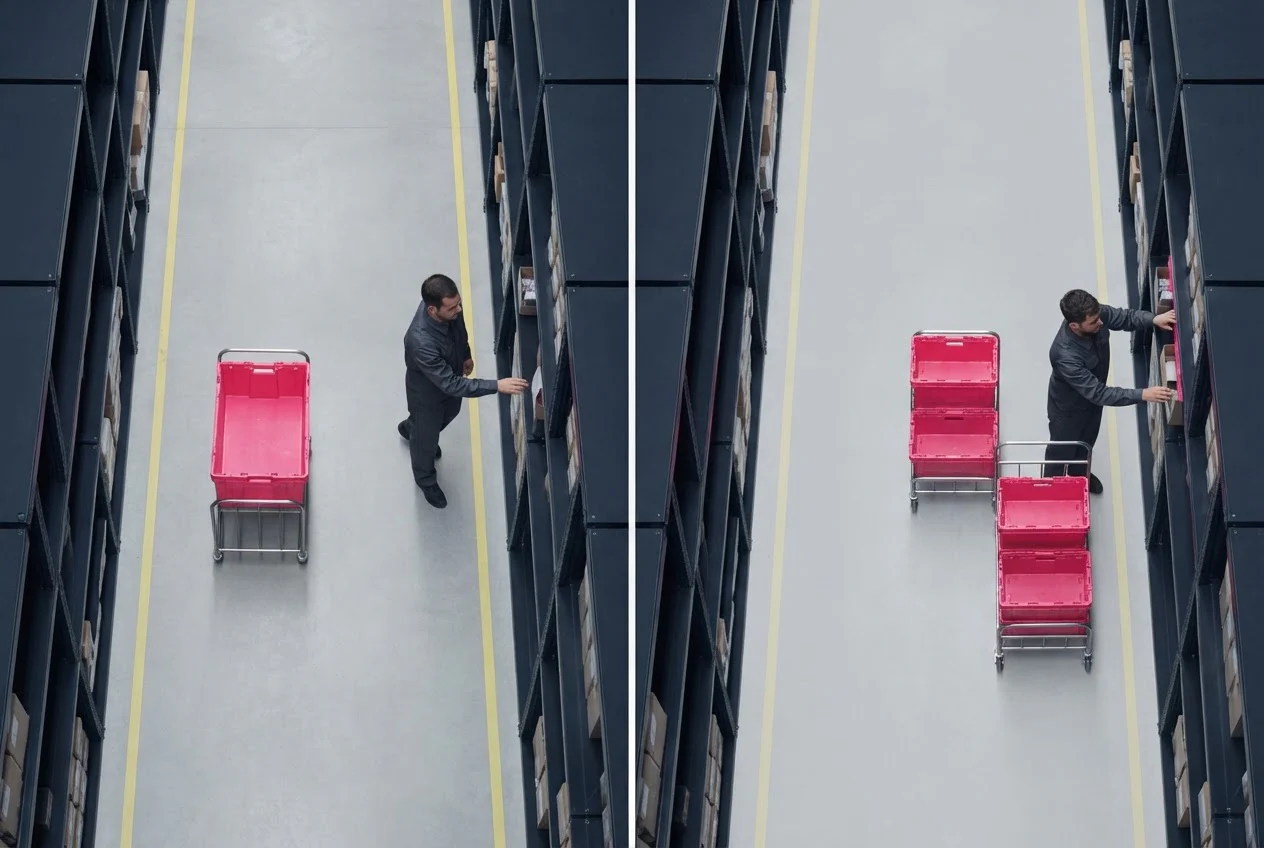
Batch picking saves most when orders are short. In our model, a five-line order walks 129 m when picked alone, 58 m in a batch of 4 and 32 m in a batch of 8. That is 55% and about three quarters less.
| Lines per order | Picked alone (m per order) | Batch of 2 | Batch of 4 | Batch of 8 |
|---|---|---|---|---|
| 1 | 47 | 38 | 29 | 21 |
| 2 | 76 | 57 | 41 | 27 |
| 5 | 129 | 91 | 58 | 32 |
| 10 | 183 | 116 | 63 | 32 |
| 20 | 232 | 126 | 63 | 32 |
Once a trip holds about 4 lines per aisle (40 lines here), walking per order is roughly the full sweep of 254 m divided by the orders in the batch. Five-line orders reach that point at a batch of 8. A batch of 12 walks 21 m per order, only 11 m better, while adding sorting work and waiting.
Our model groups orders at random. We expect grouping by shared locations to do better, so treat these figures as a floor (our inference).
Batching has two costs the walking figures leave out. The first is sorting items into the right order, either at the end or at each pick if the cart carries one tote (the container holding one order) per order. The second is waiting. At 25 orders an hour, orders arrive about every 2.4 minutes (60 ÷ 25), so the first order in a batch of 4 waits about 7 minutes (3 × 2.4) for the fourth.
Our recommendation: size batches at about (2 to 4) × your aisle count ÷ lines per order, capped by the tote slots on your cart. For 5-line orders in 10 aisles, that is 4 to 8 orders. Discrete picking is the right choice when one order fills the cart or pallet, or when orders arrive too slowly to group without delaying dispatch.
Does zone picking reduce walking, and where does wave picking fit?
Zone picking is meant to cut elapsed time, and our model measures only walking. In our model, five-line orders walk 129 m in total with one zone, 118 m with two zones and 98 m with five, about a quarter less. At 20 lines the totals are 232, 229 and 210 m.
In our reasoning, the elapsed-time gain comes from pickers working in parallel and learning their own area, and zones can also be assigned by handling needs such as high-value or temperature-controlled stock. The cost is handing orders between zones and keeping every zone equally busy, which our model leaves out. A 1988 simulation by Mellema and Smith, summarised in the De Koster review, suggested that combining batching and zoning raises output per picker-hour. That is not a result from our model.
Wave picking answers a different question: when, not where. It releases orders at set times, for example before a carrier collection. Batch inside each wave.
Our recommendation: choose zone picking when the aisles are too many for one picker to sweep within your dispatch window. Otherwise batch.
What is the saved walking worth in rupees?
For 200 five-line orders a day, batches of 4 save about 4 hours of walking. That is worth roughly ₹265 to ₹420 a day at the assumed Tier 1 metro pay and ₹210 to ₹300 at Tier 2 pay, before sorting time.
The cash is small at this scale. The value is capacity: 3.9 hours is about half a picker's day. At 1,000 orders a day the same batching frees nearly 20 hours, worth about ₹1,300 to ₹2,100 a day at the metro proxy. Swap in your own wage and walking speed.
Which picking method should you start with, and how do you test it?
Start with batch picking for short orders at enough volume to group them, and discrete picking otherwise. Then prove it on your own floor. These starting points are our recommendations.
| Your floor | Start with | Why |
|---|---|---|
| Short orders arriving at about 25 an hour or more, so the first order in a batch of 4 waits about 7 minutes or less | Batch picking, sized by the formula above | The trip reaches about 2 to 4 lines per aisle |
| A few orders an hour, or orders that must leave within minutes | Discrete picking | Waiting to group costs more than the walking saved |
| One order fills a cart or pallet | Discrete picking | The trip is already full |
| Aisles too many for one picker to sweep within your dispatch window, or zones with different handling | Zone picking, batching within each zone | Pickers work in parallel |
| Carriers collect at fixed times | Wave picking, batching inside each wave | Orders are released ahead of each cut-off |
- Build two matched setsTake 40 orders from one shift's list. Deal them alternately into set A and set B, ordered by line count, so both sets have a similar mix.
- Pick both sets in the same shiftPick set A one order per trip. Pick set B in batches of 4, grouped by shared aisles. Run both in the same shift, alternating trips, so day-to-day variation does not decide the result.
- Record minutes and mispicksRecord total picker minutes for each set, including sorting into totes, and divide by 20. Count mispicks (wrong item or quantity) in each set.
- Apply the pass or fail rulePass: minutes per order for set B are at least 15% lower than set A and mispicks do not rise. Fail: either condition is missed, usually because sorting time ate the walking saved. Try batches of 2.
- Repeat on a second shiftRepeat on a second shift, since 20 orders is a small sample. The 15% threshold is our rule of thumb: smaller gains tend to disappear in shift-to-shift variation.
- Test zone picking separatelyTo test zone picking, pick set B zone by zone and record elapsed minutes from order release to order complete in its tote, handovers included. Pass: elapsed minutes fall by at least 15% against set A with no rise in mispicks.
Before testing, number bins along the walking route so a ticket sorted by bin is the route. Place fast sellers nearest the packing area, using ABC analysis, which ranks stock by how much it sells. Treat every bin a picker empties as a free check: confirm it is empty, and count it if it is not, as part of a cycle counting routine.
How do we support picking at Arka Inventory?
Our warehouse management feature generates pick tickets that list the items to pick and the warehouse bin location to pick each from, so pickers do not search for stock.
For lot or batch-tracked products, we direct picks to the lots that expire first, known as first-expired, first-out (FEFO); see batch expiry software for FEFO operations. For other items you can use first-in-first-out (FIFO) picking. We support barcode-based receiving, palletising, pallet labels and putaway into bins, and pick tickets with packing slips for shipments, across multiple warehouses.
Today our pick tickets list the items and bins to pick for each shipment. If you want orders grouped into batches, zones or waves, we can build that workflow to your rules.
As of October 2026, our Basic plan is $199 a month billed yearly with 1 user licence (extra users $42 a month), and our Advance plan is $499 a month billed yearly with 2 user licences (extra users $52 a month), as listed on our pricing page. Enterprise pricing is flexible. Our 15-day free trial gives full access with no credit card. Onboarding typically takes a minimum of two weeks, depending on data readiness. For wider selection criteria, see our warehouse management software buyer's checklist.