
Glossary
Warehouse Slotting
Warehouse slotting assigns each product to a storage location so the items picked most often are quickest to reach. Rank products by pick lines and group them in classes.

By Praveen Nune, Co-Founder & CEO · Updated 23 Oct 2026
On this page
- 01Definition
- 02Quick facts
- 03What is warehouse slotting?
- 04Should you slot by sales value, units or pick lines?
- 05Ranking by lines, units or sales value
- 06How do you run a slotting check on your own order data?
- 07How long does a slotting plan stay right?
- 08What is slotting confused with, and which terms are related?
- 09How Arka Inventory handles it
- 10Example
- 11Related terms
- 12Frequently asked
What is warehouse slotting?
Warehouse slotting is deciding which storage location each SKU (stock keeping unit, a distinct product) gets, so that picking travel and handling fall.
Key takeaways
- Rank SKUs by pick lines, the number of orders that include the SKU, to set classes A, B and C. Then order inside each class by cube-per-order index (COI, the space a SKU needs divided by its picks), and put the lowest COI closest to dispatch, the area where orders are packed and leave the warehouse.
- Rank by pick lines because a picker's walk is set by trips rather than units or value (inference). In the dataset analysed, the top fifth of SKUs covers 64.3% of pick lines when ranked by lines, against 59.1% by units and 60.1% by sales value.
- In this dataset, a plan built on December to May orders cut modelled travel by 12 to 14% on June to December orders, against 34 to 45% on the orders it was built from. Part of that drop is overfitting and the autumn peak.
- Use three classes to start, re-rank every quarter, and prove the change with a before-and-after timing.
Quick facts
- Ranking measure
- Pick lines (distinct orders per SKU)
- Starting classes
- Three: A for the first 20% of SKUs, B for the next 30%, C for the rest
- Re-ranking
- At least every quarter
- What to check
- Class A should hold more than half of all pick lines
Ranking products by how much they sell is the usual way to choose pick locations, and it quietly puts the wrong items up front. A drum that sells many units may be pulled a handful of times a month, while a small box is pulled every day. Pickers pay for trips, not units.
Warehouse slotting follows trips, not units: the location plan should follow how often a product is pulled, and how much space it occupies while it waits. A bulky product on a few orders takes prime space without saving many steps, while a compact product on most orders saves steps on nearly every trip.
The usual rules were tested on a public set of 20,538 real wholesale orders covering one year. Below is a one-sheet check you can run on your own invoices before you move a single carton. The result is a layout you can defend, and a date to test it again.
What is warehouse slotting?
Travel matters because it is the biggest share of a picker's day: about 50% in the review by de Koster and colleagues, and 55% in Bartholdi and Hackman's textbook. Order picking itself is estimated at up to about 55% of warehouse operating expense in both sources.
A good plan puts busy items near dispatch and at waist height (the "golden zone", where picking is easiest). It keeps heavy items low and avoids packing every busy item into one aisle, which creates congestion.
Should you slot by sales value, units or pick lines?
Slot by pick lines. A pick line is one SKU on one order, and it is what makes a picker walk. The cube-per-order index (COI) formalises this: a SKU's required space divided by its picks per period, with the lowest COI placed closest to dispatch (de Koster et al., 2007).
Sales value answers a different question, which items need tight stock control. The ABC analysis guide covers that ranking.
Here is a real example. The public UCI Online Retail dataset holds a UK gift wholesaler's orders from 1 December 2010 to 9 December 2011. After removing cancellations, non-positive quantities and non-product codes, it held 20,538 orders, 3,919 SKUs and 518,385 distinct pick lines. Distinct orders were counted per SKU and ranked.
The rule of thumb that 20% of products make 80% of activity did not hold here, so measure yours. It is one seasonal wholesaler with long orders (median 15 lines), not an Indian benchmark.
- SKU class (by lines)
- A: top 20%
- SKUs
- 784
- Share of pick lines
- 64.3%
- SKU class (by lines)
- B: next 30%
- SKUs
- 1,176
- Share of pick lines
- 27.6%
- SKU class (by lines)
- C: bottom 50%
- SKUs
- 1,959
- Share of pick lines
- 8.1%
Ranking by lines, units or sales value
Ranking the same SKUs three ways, with the same filters, gives different top fifths. This table shows the share of all pick lines covered by the top 20% of SKUs (784 SKUs) under each ranking.
This comparison cannot prove that lines are the better measure, because a ranking by lines will always cover the most lines. Lines are recommended because the walk is set by how many trips visit a location, not by how many units leave it (inference). The travel model below tests the line ranking only.
- Ranking measure
- Pick lines (distinct orders per SKU)
- Share of pick lines covered
- 64.3%
- Ranking measure
- Units (total quantity sold)
- Share of pick lines covered
- 59.1%
- Ranking measure
- Sales value (quantity times unit price)
- Share of pick lines covered
- 60.1%
How do you run a slotting check on your own order data?
Run six steps in a spreadsheet; each has a pass or fail.
Classes A, B and C by distance from dispatch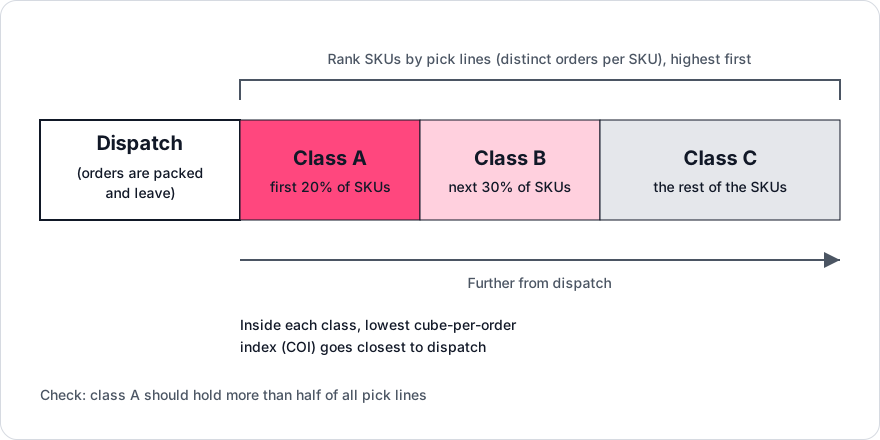
- Collect order lines. One row per SKU per order, covering a full year if demand is seasonal. Pass: every row has a SKU and an order number.
- Count and rank. Count distinct orders per SKU and sort high to low. Pass: the ranked counts sum to the total pick lines.
- Cut into classes. Start with three: A for the first 20% of SKUs, B for the next 30%, C for the rest. Research on manual picking finds a full ranking gives the shortest travel but suggests two to four classes in practice. Three classes are recommended because they are simpler to maintain (inference). Pass: class A holds more than half of all pick lines. If it holds less, demand is flat and slotting will gain little (inference).
- Order by COI inside each class. Divide each SKU's required space by its picks and place the lowest COI nearest dispatch. Pass: no SKU is placed ahead of a lower-COI SKU in the same class.
- Apply overrides. Heavy items low, busiest items at waist height, hazardous goods segregated, expiring lots reachable first, and no aisle holding every A item. Pass: no heavy SKU sits above waist height and no aisle holds more than half of the A SKUs.
- Time it. Time at least 50 orders before and after the move (suggested), using the method in the order picking methods guide. A mispick is the wrong item or quantity picked. Pass: the average time per order falls and the mispick rate does not rise.
How long does a slotting plan stay right?
Re-rank at least every quarter, and sooner after a launch or season change (recommended). In this dataset, of the 675 SKUs in the first six months' top fifth, 438 (64.9%) were in the top fifth in the following six months.
The model used one aisle, one slot per SKU numbered by distance from dispatch, and one trip per order to its farthest slot and back. Random placement scores 1.00 (average of ten random layouts).
The same-period column slots and tests on the whole year. The later-period column slots on orders to 31 May 2011 and tests on 1 June to 9 December 2011. SKUs unseen in the first period were placed last. Part of the gap between the columns is overfitting (the plan is fitted to the orders it is tested on) and the autumn peak, which falls in the later window.
Also, 16.2% of later pick lines were for SKUs absent from the first period. The model is a distance proxy, not a route simulation, and it tests ranking by lines only, not COI. Move only SKUs that changed class. Bin records must also be right, so pair slotting with cycle counting, which means counting a small part of stock every day or week to correct bin records.
- Layout
- Full ranking by lines
- Same-period test
- 0.55
- Later-period test
- 0.86
- Layout
- Three classes (20/30/50)
- Same-period test
- 0.66
- Later-period test
- 0.88
What is slotting confused with, and which terms are related?
Slotting is a plan; putaway is the act of storing received stock, which should follow the plan. Retail "slotting fees" are one-time payments a supplier makes to a retailer for initial shelf placement or warehouse access, a different meaning. Some texts use slotting for case orientation and shelf placement.
Related terms: pick face (the location items are picked from), golden zone, re-slotting (moving SKUs after re-ranking), replenishment (refilling pick locations from bulk storage), COI and ABC analysis.
How Arka Inventory handles it
A slotting plan is only as good as the bin and pick records behind it. In our warehouse management feature you receive stock by barcode, put pallets away into bins and generate pick tickets that suggest the bin to pick from. Lot-enabled products are picked expiring-first, and other items can follow first-in, first-out. Pallet labels and multiple warehouses are supported, and custom reports and dashboards let you build your own views. We supply the bin and pick records; the ranking itself happens in your spreadsheet, using the sheet above.
Our 15-day free trial gives full access with no credit card.
Example
Illustrative example, invented numbers: a tile carton takes 0.6 m³ and has 600 picks a quarter (COI 0.001); a small box takes 0.05 m³ and has 250 picks (0.0002); a drum takes 1.2 m³ and has 20 picks (0.06). The box goes nearest dispatch, then tiles, then the drum, even though the tiles have the most picks.
Frequently asked
Sources
- 1.Design and control of warehouse order picking: a literature review, de Koster, Le-Duc and Roodbergen, European Journal of Operational Research, 2007
- 2.Warehouse & Distribution Science, release 0.96, Bartholdi and Hackman, Georgia Tech
- 3.Online Retail dataset, UCI Machine Learning Repository, CC BY 4.0, DOI 10.24432/C5BW33
- 4.FTC releases grocery industry slotting allowance report, US Federal Trade Commission, November 2003