
Glossary
Vendor Managed Inventory (VMI)
Vendor managed inventory is an arrangement where a supplier decides when and how much to replenish a buyer's stock, using stock data the buyer shares, within agreed minimum and maximum levels.

By Praveen Nune, Co-Founder & CEO · Updated 23 Oct 2026
On this page
- 01Definition
- 02Quick facts
- 03What a VMI arrangement asks of a buyer
- 04What is vendor managed inventory and who decides what?
- 05How do minimum and maximum levels work in a VMI example?
- 06Who owns the stock, and when does GST apply?
- 07Which six checks should a buyer pass before a supplier manages stock?
- 08What terms are related to vendor managed inventory?
- 09How Arka Inventory handles it
- 10Example
- 11Related terms
- 12Frequently asked
What is vendor managed inventory?
Vendor managed inventory (VMI) is a replenishment model in which the supplier, not the buyer, decides the order size.
Key takeaways
- Trigger deliveries on available plus expected stock, not on-hand stock alone, or the supplier will over-ship.
- VMI does not fix who owns the stock: under a standard purchase you own it from delivery, and under consignment the supplier owns it until you use or sell it.
- Run each of the six checks before the first delivery; each has a clear pass and a clear fail, so you know where you stand.
Quick facts
- Who shares the data
- The buyer
- Data shared
- Sales records, stock withdrawals, production schedules, inventory levels, goods in transit, back orders, incoming orders and returns
- Update frequency
- Usually weekly
- Who sets the limits
- Either the buyer or the supplier, depending on how the enterprise system is set up
- Who owns the stock
- Set in the agreement: the buyer from delivery under a standard purchase, the supplier until use or sale under consignment
What a VMI arrangement asks of a buyer
A supplier who runs your replenishment depends on one thing it cannot check: your own stock figures. Under vendor managed inventory (VMI), the buyer supplies the counts, the consumption (units used) and the limits. When a VMI arrangement goes wrong, the cause is usually a number that was shared late, was wrong, or had no rule behind it.
That makes VMI a buyer-side discipline before it is a supplier service. Large retailers such as Walmart and Procter & Gamble made it well known, but the same logic applies to a factory buying cartons or a distributor buying packaging. Who owns the stock and who bears the risk also change with the model, so those are settled in writing too.
This page defines the term, works through a minimum and maximum example, and gives a six-test checklist to pass before the first delivery. Each test has a clear pass and a clear fail, so you know where you stand.
What is vendor managed inventory and who decides what?
The buyer shares inventory data and the supplier replenishes against it.
The data shared typically covers sales records, stock withdrawals, production schedules, inventory levels, goods in transit, back orders, incoming orders and returns, usually updated weekly. Who sets the limits is a separate choice: enterprise systems let the buyer fix the minimum and maximum, or let the supplier manage them (Oracle's VMI documentation, release 25c). The buyer keeping the limits is the recommended choice.
How do minimum and maximum levels work in a VMI example?
The minimum is the stock that covers demand during the supplier's lead time plus safety stock. The maximum adds demand over one review period. Lead time is the days from order to receipt, safety stock is extra stock held against uncertainty, and the review period is the days between stock checks.
Minimum and maximum levels built from their inputs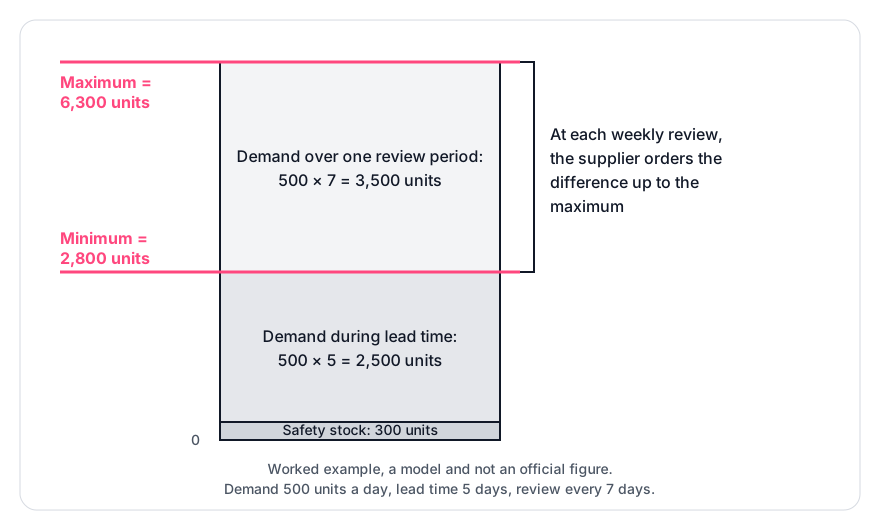
The worked example is a model and not an official figure. At each weekly review, the supplier orders up to the maximum, which acts as an order-up-to level. If reviews are continuous or daily, the minimum serves as the reorder trigger.
For the inputs, see the guides to the reorder point formula and safety stock calculation.
Who owns the stock, and when does GST apply?
VMI does not fix who owns the stock. Under a standard purchase the buyer owns it from delivery; under consignment the supplier owns it until the buyer uses or sells it. VMI is about who decides replenishment and consignment is about who owns the stock, so an arrangement can be either or both. Write the model into the agreement, with who bears losses from shrinkage (stock lost to theft, damage or error) and expiry, and whose count wins in a dispute.
For GST (Goods and Services Tax), one rule matters if your stock moves as sale or return. Under section 31(7) of the Central Goods and Services Tax (CGST) Act, 2017, as of October 2026, goods sent on approval for sale or return are invoiced at or before supply, or six months from removal, whichever is earlier. Whether your arrangement is sale or return is a question for your tax adviser.
Which six checks should a buyer pass before a supplier manages stock?
Six checks decide whether a VMI arrangement is ready: scope, levels, trigger, cadence, ownership and proof. Run each before the first delivery. They are recommendations, built on the formulas above.
Is the scope small and steady enough?
Pass: 2 to 3 items at one site, each with daily demand that varies by less than 20% over 12 weeks (a recommended threshold for "steady"). Fail: the whole catalogue from day one, or any item outside that variation.
Are the minimum and maximum written down with their inputs?
Pass: each item has a written minimum and maximum, with demand, lead time, safety stock and review period behind them. Fail: round numbers nobody can explain.
Does the trigger use available plus expected stock?
Pass: the agreement bases orders on stock on hand, less reserved, plus on order. Fail: the trigger is on-hand stock only.
Is there a named review day and owner?
Pass: a fixed day, weekly to start, and a named owner on each side. Fail: "regular reviews".
Are ownership, losses and disputed counts written down?
Pass: the agreement says who owns the stock, who bears shrinkage, damage and expiry, and whose count wins. Fail: it is silent on any of the four.
Does the stock report match a physical count?
Pass: a dated stock report by warehouse matches a count of 5 items, each within 2% (a recommended sample and tolerance), and each receipt is checked against its order. Fail: the report is never reconciled. Guides to cycle counting and the goods receipt note show how.
How Arka Inventory handles it
A dated stock report by warehouse is the shared figure in VMI. Arka Inventory is cloud software built natively on Salesforce, and it shows stock across multiple warehouses, inventory on order and lead-time insights in one view.
With custom reports and dashboards you build the view you agree with your supplier, and our inventory dashboard guide shows what to include. Our inventory alerts flag items approaching or below minimum stock levels. Our Commit Inventory feature handles the reservations behind the "less reserved" part of test 3. You can export your data at any time, in the format you choose or through our API, and send it on the agreed day.
Example
Demand is 500 units a day, lead time is 5 days, safety stock is 300 units and the review is every 7 days. The minimum is 500 × 5 + 300 = 2,800 units and the maximum is 2,800 + 500 × 7 = 6,300 units. At each weekly review, the supplier orders the difference between 6,300 (an order-up-to level) and stock on hand, less reserved, plus on order. If reviews are continuous or daily, use 2,800 as the reorder trigger.