
Glossary
Types of Inventory in India
Types of inventory in India fall into seven Schedule III heads of the Companies Act, 2013: raw materials, work-in-progress, finished goods, stock-in-trade, stores and spares, loose tools, and others.

By Praveen Nune, Co-Founder & CEO · Updated 23 Oct 2026
Also called Inventory heads or Schedule III inventory classification
On this page
- 01Definition
- 02Quick facts
- 03What are the types of inventory in India?
- 04What are the other types of inventory by function, such as cycle stock and safety stock?
- 05Which of the seven inventory heads does each item belong in?
- 06What do inventory types look like in real company accounts?
- 07How should packing material, consumables, spares and goods in transit be classified?
- 08How Arka Inventory handles it
- 09Example
- 10Related terms
- 11Frequently asked
What are the types of inventory in India?
Types of inventory in India are the seven heads under which Schedule III of the Companies Act, 2013 requires companies to classify the stock they hold.
Key takeaways
- Generic lists usually omit stock-in-trade, loose tools and others, so check your list against all seven heads.
- Packing material, consumables and goods in transit are the items most easily misfiled.
- Goods in transit are not a separate head, though DMart shows the line separately by its own choice.
- Run three checks: one head per item, transit flagged, and the heads reconciling to closing stock.
Quick facts
- Legal basis
- Schedule III to the Companies Act, 2013
- Number of heads
- Seven
- Valuation rule
- Lower of cost and net realisable value (Ind AS 2, para 9)
- Who must use it
- Companies; proprietorships and partnerships may use the same heads but are not required to
- What buyers check
- One head per item, and heads that add up to closing stock
Asian Paints reports six inventory lines in its standalone accounts for the year ended 31 March 2026: raw materials, packing materials, work-in-progress, finished goods, stock-in-trade, and stores, spares and consumables. Avenue Supermarts, which runs DMart, reports two: stock-in-trade and goods in transit.
A four-item list (raw materials, work-in-progress, finished goods, maintenance supplies) suits a textbook factory. It does not suit a trader, a manufacturer that also resells, or any company that must present inventory as the Companies Act, 2013 requires.
This page sets out the seven heads, a table to sort your own stock into them, and the real splits at three listed companies. Name each item once, correctly, before you set up a system to track it.
What are the types of inventory in India?
India's Companies Act, 2013 (Schedule III) sorts inventories into seven heads: raw materials; work-in-progress; finished goods; stock-in-trade (goods acquired for trading); stores and spares; loose tools; and others, with the nature specified. The source is Schedule III, Division I, Note O (non-Ind AS companies) and Division II, Part B, Current Assets, I (Ind AS companies).
The seven Schedule III inventory heads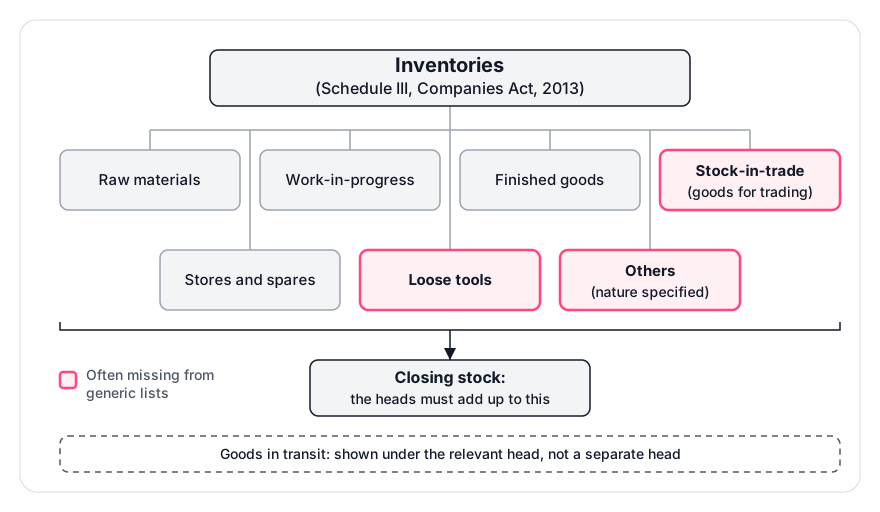
Inventory is any asset a business holds for sale, is producing for sale, or will consume in production or services (Ind AS 2, Inventories, para 6). Ind AS means Indian Accounting Standards.
Ind AS 2 para 8 includes "materials and supplies awaiting use in the production process". Para 9 values inventory at the lower of cost and net realisable value, which is the estimated selling price less the costs of completion and sale.
The common maintenance, repair and operations (MRO) category corresponds roughly to stores and spares plus loose tools.
What are the other types of inventory by function, such as cycle stock and safety stock?
By function, inventory is cycle stock, safety stock, anticipation stock, pipeline stock and decoupling stock. These describe why you hold the stock. They sit inside the Schedule III heads rather than replacing them.
- Cycle stock: stock used to meet normal demand between replenishments.
- Safety stock: extra stock held to handle uncertainty in demand or supply.
- Anticipation stock: stock built ahead of expected demand, such as festival-season merchandise.
- Pipeline (transit) stock: goods moving between locations or stages.
- Decoupling stock: stock held between two stages so one can continue if the other slows.
Which of the seven inventory heads does each item belong in?
Ask what the item is for, and give each item exactly one head. Sort by purpose, not by price or storage place: the same steel sheet is a raw material in a factory and stock-in-trade in a dealer's yard.
Three checks show whether the sorting holds:
- One head per item. Give 10 sample items to two people and have each assign a head from the table. Pass if all 10 match. Fail on any mismatch, and add a written rule for that item.
- Transit flagged. Pass if goods you own that are still on the road show under their head, marked in transit.
- Total reconciles. Pass if the heads add up to the closing stock value in your books.
- Question about the item
- Bought to make something you sell?
- Head
- Raw materials
- Example
- Steel sheet, resin
- Question about the item
- Started in production, not finished?
- Head
- Work-in-progress
- Example
- Assembled units awaiting testing
- Question about the item
- Made by you and ready to sell?
- Head
- Finished goods
- Example
- Packed product
- Question about the item
- Bought ready-made to resell as it is?
- Head
- Stock-in-trade
- Example
- Trading goods
- Question about the item
- Used up in production or upkeep, not part of the product?
- Head
- Stores and spares
- Example
- Lubricants, machine spares
- Question about the item
- A small tool issued to staff?
- Head
- Loose tools
- Example
- Hand tools
- Question about the item
- None of these?
- Head
- Others (specify nature)
- Example
- A separate line, named by nature
What do inventory types look like in real company accounts?
The split depends on the business model, not a standard list. For the year ended 31 March 2026, Asian Paints reported six lines, Bajaj Auto (standalone) five, and Avenue Supermarts one stock line plus goods in transit.
- Asian Paints holds trading goods beside its own output. Stock-in-trade was 24.9% of its stock (₹1,201.57 crore), up from 15.6% of ₹5,848.23 crore a year earlier.
- Supplies are small by value. Packing materials plus stores, spares and consumables were 3.5% at Asian Paints. Stores, spares, packing and loose tools were 1.6% at Bajaj Auto. Count them anyway, because a missing spare can stop a line.
Each percentage is the line divided by the total stated in the filed note, with transit amounts added across lines for Asian Paints. These are three large listed companies, so read them as patterns, not benchmarks for a small firm.
- Company
- Asian Paints
- Largest line
- Raw materials, 40.8% (₹1,966.75 crore of ₹4,824.74 crore)
- Goods in transit
- 10.3% (₹497.67 crore)
- Company
- Bajaj Auto
- Largest line
- Raw materials and components, 53.1% (₹1,250.57 crore of ₹2,353.70 crore)
- Goods in transit
- 7.6% (₹179.2 crore, raw materials only)
- Company
- Avenue Supermarts
- Largest line
- Stock-in-trade, 99.1% (₹5,577.00 crore of ₹5,630.44 crore)
- Goods in transit
- 0.9% (₹53.44 crore, a separate line by DMart's own choice)
How should packing material, consumables, spares and goods in transit be classified?
Packing material, consumables and ordinary spares are inventory when you hold them. Goods in transit are not a separate head. Schedule III, Note O(ii), requires them to be disclosed under the relevant sub-head, for example raw materials in transit under raw materials. Only large spares tied to one machine need a closer look.
- Packing material. Asian Paints carries it as its own inventory line. Bajaj Auto groups it with stores and spares. Both treat it as inventory, not as an expense booked on purchase.
- Consumables. Oil and grease are consumables, which Asian Paints reports within stores, spares and consumables.
- Spares. Under Ind AS, a spare is property, plant and equipment only if it meets that definition; otherwise it is inventory. Confirm large, machine-specific spares with your accountant.
- Stock-in-trade versus finished goods. Stock-in-trade is bought to trade. Finished goods are what you made.
- Transit. Asian Paints shows in-transit sub-lines under raw materials, stock-in-trade, and stores and spares.
How Arka Inventory handles it
Arka Inventory tracks stock quantities and movements in one cloud system built natively on Salesforce. The Schedule III head is assigned in your accounts (Tally or QuickBooks Online), and it integrates with both.
As of October 2026, Arka Inventory costs $199 a month (Basic, 1 user) or $499 a month (Advance, 2 users), paid yearly, with Enterprise on flexible pricing, as listed on its pricing page. A 15-day free trial gives full access with no credit card.
- Raw materials: Inventory Visibility shows stock across warehouses, inventory on order, expected lead times and raw material availability.
- Work-in-progress, finished goods and kits: standard or order-based bills of material (the list of materials a product needs), material availability checks, consumption tracking, production and kitting, on the Advance plan.
- Traceability: lot and serial-number tracking is on the Enterprise plan.
- Stores and trading stock: low-stock alerts, multiple warehouses, purchase orders and transfers start on the Basic plan.
- Loose tools and others: tracked as stock items by quantity and movement, like any other item; you name the head in your accounts.
Example
Avenue Supermarts, which runs DMart, reports stock-in-trade of ₹5,577.00 crore and goods in transit of ₹53.44 crore for the year ended 31 March 2026. Added together, the two lines give the ₹5,630.44 crore total in its filed note, which is the reconciliation a company should be able to make between its heads and closing stock.
Frequently asked
Sources
- 1.Ind AS 2, Inventories (ICAI)
- 2.Schedule III to the Companies Act, 2013, Division I and Division II (ICAI copy)
- 3.Asian Paints Integrated Annual Report 2025-26, standalone Note 9
- 4.Bajaj Auto Annual Report 2025-26, standalone Note 9
- 5.Avenue Supermarts standalone accounts, FY2025-26, filed with BSE on 23 July 2026
- 6.Taxmann: Ind AS 16 and spare parts
- 7.KPMG India: Accounting for major spares
- 8.Arka Inventory pricing