
Glossary
Pallet Label
A pallet label identifies one pallet for whoever scans it next. The GS1 version carries an 18-digit Serial Shipping Container Code (SSCC) in a GS1-128 barcode; carrier labels follow different rules.

By Praveen Nune, Co-Founder & CEO · Updated 23 Oct 2026
Also called GS1 logistics label or SSCC label
On this page
- 01Definition
- 02Quick facts
- 03Pallet labels and what they are confused with
- 04Which pallet label do you need: carrier, GS1, marketplace or internal?
- 05What goes on a GS1 pallet label, and where?
- 06How is an SSCC built, and can you check one yourself?
- 07How do you test that your pallet labels match your stock?
- 08How Arka Inventory handles it
- 09Example
- 10Related terms
- 11Frequently asked
What is a pallet label?
A pallet label is a label fixed to one pallet so that anyone scanning or reading it knows exactly which pallet it is.
Key takeaways
- On a GS1 pallet label the SSCC is the only element always required; a GTIN is also required when the receiver gets no electronic despatch advice.
- Pick the label by its reader, since carrier, retail buyer, marketplace and your own team need different content.
- Put two identical labels on adjacent sides; for pallets over 400 mm, the barcode sits 400 to 800 mm above the base and 50 mm from vertical edges.
- Test ten pallets: scan, printed number, check digit, quantity and lot must all match your stock record.
Quick facts
- Also known as
- GS1 logistics label (GS1 version)
- Barcode type
- GS1-128 carrying an 18-digit SSCC
- Always required element
- SSCC
- Label size
- A6 (105 × 148 mm) for SSCC only; A5 (148 × 210 mm) for more data
- Text height
- Main text at least 7 mm; barcode text at least 3 mm
Pallet labels and what they are confused with
Ask three people in a warehouse for a pallet label and you can get three different things. One hands you a carrier's address label. Another hands you a label built to GS1 rules, GS1 being the global standards body for barcodes, with a scannable pallet number. The third hands you an internal tag recording where the pallet came from.
The mix-up persists because each reader checks something different. A carrier looks for an address. A retail distribution centre scans the pallet number and compares it with the electronic delivery notice, so a printed number that differs from the one in the notice fails that check. Your own receiving team compares the label with the stock record.
Four different labels share the name: a carrier address label, a GS1 logistics label, a marketplace receiving label and an internal pallet tag. A fifth mark, the ISPM 15 (International Standard for Phytosanitary Measures No. 15) stamp on wooden pallets, certifies wood treatment and carries no stock data.
The commonest confusion is between product and pallet. A Global Trade Item Number (GTIN) identifies a product. An SSCC identifies one pallet. A pallet may hold several products but carries one SSCC. GS1 makes the SSCC the element always required in its pallet label. The GTIN is needed only if the recipient has not been sent an electronic despatch advice, also called an advance ship notice (ASN), as the GS1 rules and recommendations set out.
Which pallet label do you need: carrier, GS1, marketplace or internal?
Use a carrier label for couriers, a GS1 logistics label for retail receiving, the marketplace's own label for marketplace inbound, and an internal pallet tag for your own team. Where a buyer's own guide conflicts with the table, follow the buyer.
Amazon's FBA (Fulfilment by Amazon) rules require a unique box ID on each box and a pallet label on each pallet, as an Amazon representative replied on the seller forum (Amazon seller forum). Confirm the rule for your own marketplace and country before you print.
Retailers add their own rules. Wakefern, a US grocery cooperative, requires a GS1-128 or Data Matrix (a square two-dimensional barcode) SSCC, "Mixed Pallet" on pallets with several lot codes, and a barcode that matches the pallet contents and destination in the ASN (Wakefern supplier rules).
- Label
- Carrier label
- Reader
- Courier and hub staff
- What it carries
- Sender and recipient addresses, service type, content description, tracking number, barcode. Front and back of the load, not on top, about 30 cm from the ground (Eurosender)
- Who sets the rule
- The carrier
- Label
- GS1 logistics label
- Reader
- Retailer receiving
- What it carries
- SSCC in a GS1-128 barcode, plus optional data
- Who sets the rule
- GS1 standard and the buyer's guide
- Label
- Marketplace label
- Reader
- Marketplace receiving
- What it carries
- For Amazon FBA, a unique box ID on each box and a pallet label on each pallet (Amazon seller forum)
- Who sets the rule
- The marketplace
- Label
- Internal pallet tag
- Reader
- Your receiving and picking team
- What it carries
- Your pallet number, linked to the stock record
- Who sets the rule
- You
What goes on a GS1 pallet label, and where?
A GS1 pallet label has three sections: optional information at the top, plain-text descriptions in the middle, and the barcodes at the bottom. Main text should be at least 7 mm high and barcode text at least 3 mm. The information in the barcode is also printed in plain text, because barcodes sometimes fail to scan (GS1 Sweden).
The three sections of a GS1 pallet label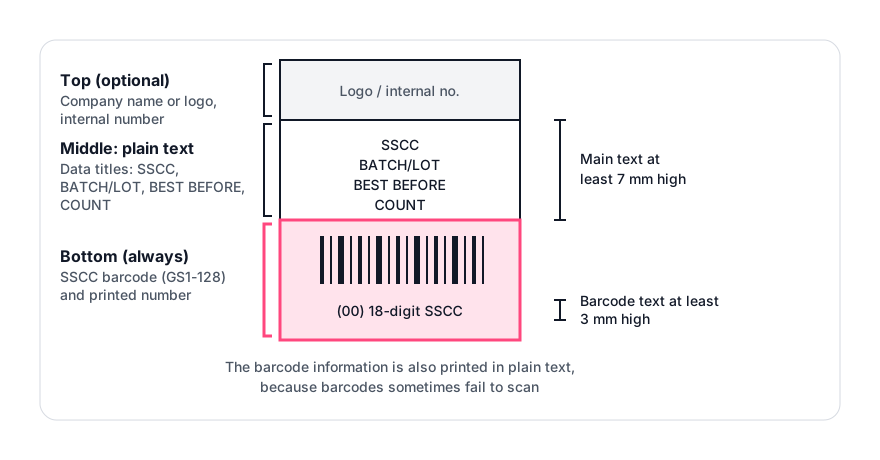
TOP (optional):   company name or logo, internal number
MIDDLE (text):    SSCC / BATCH/LOT / BEST BEFORE / COUNT (data titles)
BOTTOM (always):  SSCC barcode (GS1-128) and printed number
For placement, GS1 Ireland advises two identical labels, one on a short side and one on the adjacent right-hand side, upright. On pallets over 400 mm the barcode sits between 400 and 800 mm from the base. On lower pallets, place it as high as possible. Keep the barcode, including its quiet zone (the blank margin around it), at least 50 mm from any vertical edge. Carrier labels follow the carrier's placement rule, not the GS1 one, and a retailer's guide can override both: Wakefern, for example, wants its label inside the shrink-wrap, attached to one case.
How is an SSCC built, and can you check one yourself?
An SSCC has 18 digits: an extension digit, your GS1 company prefix (which identifies your organisation), a serial reference you assign, and a check digit (SSCC structure).
The worked example below uses a made-up prefix, 8901234, which is not allocated to any company.
- Write the 17 data digits: extension 0, prefix 8901234, serial 000000001, giving
08901234000000001. - Starting from the right, multiply the first digit by 3, the next by 1, and so on, then add: 3 + 4 + 9 + 2 + 3 + 27 + 8 = 56.
- The check digit is the amount that takes 56 to the next multiple of 10: 4.
- The SSCC is
089012340000000014.
This uses the GS1 check-digit method (round the sum up to the next multiple of 10); the GS1 check digit calculator gives the same result for any number you enter.
With a 7-digit prefix, 9 digits remain for the serial reference (16 minus 7), which is 10⁹ serials per extension digit. Prefix lengths vary, so a longer prefix leaves fewer serials. As of October 2026, GS1 India calculates registration fees from annual turnover, the number of barcodes (100, 1,000, 10,000 or 1,00,000) and the subscription period. As of 1 October 2026, GS1 India's revised barcode registration fee structure applies; see its fee schedule. For labelling rules specific to your Indian buyer, check that buyer's supplier guide.
How do you test that your pallet labels match your stock?
Pull ten pallets from the dock and run these tests. Ten out of ten passing on every test is a pass; any failure means fix the process before the next dispatch.
- Scan each label with the scanner your receiving team uses. Pass: every SSCC reads first time. Fail: any retry.
- Compare the scanned number with the printed text. Pass: identical.
- Recompute the check digit as above. Pass: it matches.
- Look for duplicates among the ten and in your records. Pass: none.
- Compare quantity, lot and expiry on the label with the stock record. Pass: all match. For lot and batch rules see lot number vs batch number.
- Measure the barcode height, the edge distance and the two label positions against the rules above.
- Split one pallet. Pass: each resulting pallet gets a new number and the old one is retired.
Schedule the same test with cycle counting, and match labels to receipts on your goods receipt note.
How Arka Inventory handles it
We support barcode-based receiving, printing pallet labels, bin putaway and picking. Picking suggests the items and the bin location to pick from. For lot-tracked goods we pick lots that expire first, and otherwise first-in-first-out (FIFO). See warehouse management.
As of October 2026, barcoding is included in all plans; bin tracking and lot and serial tracking are on the Enterprise plan. Details are on our pricing page. If your buyer specifies a GS1 SSCC layout, confirm our label output with us before you rely on it. We offer a 15-day free trial with full access and no credit card. To see our label output first, book a demo with our sales team.
Example
With the same made-up prefix 8901234, the next serial after 000000001, which is 000000002, gives check digit 1, so the second pallet's SSCC is 089012340000000021. The GS1 check digit calculator gives the same result for any number you enter.
Frequently asked
Sources
- 1.GS1 Sweden, Pallet label
- 2.GS1 Sweden, Rules and recommendations for labelling the pallet
- 3.GS1 Ireland, Where should pallet labels be placed?
- 4.GS1, Check digit calculator
- 5.GS1 India, Register for barcodes
- 6.GS1 India, Barcode registration fee schedule
- 7.Serial shipping container code (Wikipedia)
- 8.Wakefern, Pallet label requirements
- 9.Amazon seller forum, Shipping single SKU pallet
- 10.Eurosender, Pallet labelling