
Glossary
Blanket Purchase Order (Blanket PO)
A blanket purchase order is one order that fixes price, validity and a spending cap with a supplier, while separate releases draw deliveries against it. Track each release's balance and payment date.

By Praveen Nune, Co-Founder & CEO · Updated 23 Oct 2026
Also called blanket PO
On this page
- 01Definition
- 02What is a blanket purchase order, and what are its key points?
- 03How a blanket purchase order works: a worked release ledger
- 04Ledger columns and the checks before approving and paying
- 05Why the payment rule for micro and small suppliers makes each release its own deadline
- 06How the 45-day clock is counted and who it covers
- 07Blanket purchase order vs standard PO and contract
- 08Should you use a blanket purchase order? Six tests
- 09How Arka Inventory handles it
- 10Example
- 11Related terms
- 12Frequently asked
What is a blanket purchase order?
A blanket purchase order is one purchase order placed with a supplier to cover repeated deliveries over a set period, often at pre-agreed prices.
Key takeaways
- Keep a release ledger and approve no release whose value exceeds the remaining balance or whose date falls outside the validity period.
- Hold any goods that arrive without a release number, since the release is the instruction to ship.
- For micro and small suppliers, each release carries its own payment clock, counted from the day you accept the goods.
- Put a payment term of 45 days or less in the blanket PO and get the supplier's written acceptance of it.
- You owe a minimum quantity only when the signed terms name one, so read them first.
The definition takes a sentence. The trouble starts after the first release. The spending cap is crossed because nobody kept a running balance. An invoice arrives without a release number. A payment slips past the 15-day default, or the agreed period of up to 45 days, that Indian law sets for micro and small suppliers.
This page gives you the meaning, a worked release ledger with the arithmetic shown, and the payment-clock rule that a plain definition leaves out. You can copy the ledger into a spreadsheet today.
It is written for Indian manufacturers, distributors and stores teams that buy the same items from the same suppliers month after month, and for the accounts staff who pay the invoices.
What is a blanket purchase order, and what are its key points?
Each delivery is ordered by a release (also called a call-off) that quotes the blanket PO number. Releases continue until the term ends or the spending limit is reached, as the definition of a blanket order sets out.
- Price and validity are fixed once. Quantity and delivery dates are chosen release by release.
- The release is the instruction to ship. Hold any goods that arrive without a release number.
- Set a cap and an end date. The University of California, Berkeley policy keeps blanket POs to one year unless they come from a multi-year competitive bid.
- Name who may release. Anyone else's release fails.
- A minimum purchase exists only if the terms say so.
How a blanket purchase order works: a worked release ledger
A blanket PO works as a balance that falls with every release. This example is an illustration. The blanket PO is ₹6,00,000 excluding goods and services tax (GST), for 12,000 units at ₹50, valid 1 April 2026 to 31 March 2027. The balance is the cap minus the cumulative value released. The supplier is assumed to be a registered micro or small manufacturer.
A blanket PO balance falls with every release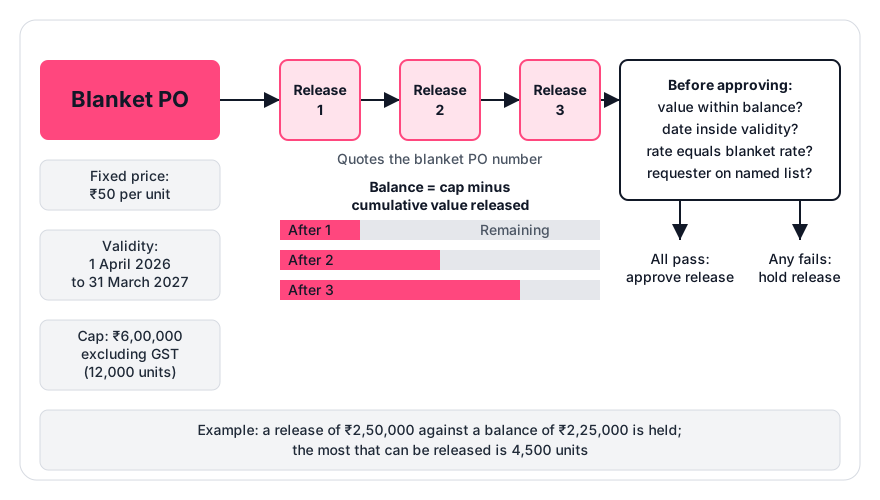
A fourth release, R4, asks for 5,000 units worth ₹2,50,000 against a balance of ₹2,25,000, so it is blocked: ₹25,000 over. The most that can be released is 4,500 units (₹2,25,000 ÷ ₹50). Anything more needs a written amendment first. GST is added on each invoice, and the GST-ready sample PO covers its format.
- Release (units)
- R1 (2,000)
- Value (₹)
- 1,00,000
- Balance after (₹)
- 5,00,000
- Goods accepted
- 10 Jun 2026
- Pay by (45 days agreed in writing / no written term, 15 days)
- 25 Jul 2026 / 25 Jun 2026
- Release (units)
- R2 (3,000)
- Value (₹)
- 1,50,000
- Balance after (₹)
- 3,50,000
- Goods accepted
- 8 Jul 2026
- Pay by (45 days agreed in writing / no written term, 15 days)
- 22 Aug 2026 / 23 Jul 2026
- Release (units)
- R3 (2,500)
- Value (₹)
- 1,25,000
- Balance after (₹)
- 2,25,000
- Goods accepted
- 5 Aug 2026
- Pay by (45 days agreed in writing / no written term, 15 days)
- 19 Sep 2026 / 20 Aug 2026
Ledger columns and the checks before approving and paying
Ledger columns: blanket PO number, release number, release date, requested by, units, rate, value, cumulative value, balance, receipt note number, acceptance date, invoice number, pay-by date, status.
Before approving a release, all four must pass. Fail any one and the release is held:
- Value is no more than the balance.
- Date is inside the validity period.
- Rate equals the blanket rate.
- The requester is on the named list.
Before paying, all three must pass. Fail any one and you query the supplier:
- The invoice quotes the release number.
- Its quantity matches the goods receipt note.
- It has not been paid before.
Why the payment rule for micro and small suppliers makes each release its own deadline
The payment limit runs from the day you accept the goods, not from the date of the blanket PO. As of October 2026, section 37(2)(g) of the Income-tax Act, 2025 (which replaced section 43B(h) of the Income-tax Act, 1961 from 1 April 2026) allows a deduction for an amount owed to a micro or small enterprise only in the year it is paid, unless it is paid within the section 15 limit of the Micro, Small and Medium Enterprises Development (MSMED) Act, 2006. That limit is the agreed period, 45 days at most, or 15 days if nothing is agreed in writing. Section 43B(h) of the 1961 Act still governs tax year 2025-26 and earlier.
A year-long blanket PO with monthly releases therefore carries twelve separate clocks. Put a payment term of 45 days or less in the blanket PO and get the supplier's written acceptance of it (a signed copy or an email confirmation). That written term is the agreement that sets the limit for every release.
How the 45-day clock is counted and who it covers
The limit counts from the "day of acceptance or deemed acceptance". If you do not object in writing within 15 days of delivery, acceptance is treated as the delivery day. The rule has applied since assessment year 2024-25 (financial year 2023-24 onwards), as introduced by the Finance Act, 2023. It covers goods and services and applies to suppliers registered as micro or small enterprises (together with medium enterprises, the micro, small and medium enterprise, or MSME, category) under the MSMED Act. Check the supplier's Udyam registration before applying the 45-day limit. Pay late and the deduction moves to the year you actually pay. A Finance Ministry reply in the Rajya Sabha (Unstarred Question No. 242, 21 July 2026) restated the 45-day limit.
Blanket purchase order vs standard PO and contract
A longer contract can sit above blanket POs, and the blanket PO then becomes the yearly ordering tool beneath it.
Related terms:
- Release or call-off order: one delivery drawn against the blanket PO.
- Standing order: a similar arrangement in which quantities and dates repeat on a fixed schedule rather than being called off.
- Blanket purchase agreement (BPA): the name used under US federal schedule contracts, set out in Federal Acquisition Regulation (FAR) 8.405-3, as noted on Wikipedia.
- Aspect
- What it covers
- Standard PO
- One purchase with known quantities
- Blanket PO
- Many deliveries inside a cap and a validity period
- Contract
- The wider legal and commercial obligations
Should you use a blanket purchase order? Six tests
Use a blanket PO when you buy the same items repeatedly from one dependable supplier and can accept the locked price. If any test fails, stay on standard POs for that item.
- Repeat demand. Pass if you expect at least three releases in the term.
- Forecast. Pass if you could consume any minimum even in your slowest recent months.
- Supplier. Pass if the last orders arrived on time and in full against your receipt notes.
- Price. Pass if the locked rate is within your agreed tolerance of the current quote from a second supplier on the day you sign. Fail otherwise, or add a price-review clause.
- Control. Pass if releasers are named and one person owns the ledger.
- Payment. Pass if you can pay each release inside the agreed term.
How Arka Inventory handles it
We handle the delivery side of every release: raise it as a purchase order, receive against it, and record what arrived. Purchase orders and transfers come with our Basic plan. Our forecasting and purchase automation lets you schedule purchase requisitions or purchase orders to keep stock at the right level.
We recommend the financial year, April to March, as the blanket PO term, and a price tolerance of 5% for the price test. We track each release as its own purchase order; the cap balance lives in the ledger above. Our suggested method:
- Raise each release as its own PO that quotes the blanket PO number.
- When goods arrive, select the supplier. Our inbound process then lists that supplier's outstanding purchase orders to receive against.
- Copy the receipt date into the acceptance column of your ledger.
- Keep the cap balance in the spreadsheet above.
- Size each release from your reorder point, so releases follow demand rather than the calendar.
We offer a 15-day free trial with full access and no credit card.
Example
A release of 2,000 units at ₹50 is a ₹1,00,000 delivery against the blanket PO, accepted on 10 June 2026. With no written payment term, the 15-day default makes payment due by 25 June 2026. With 45 days agreed in writing, the due date moves to 25 July 2026.
Frequently asked
Sources
- 1.Blanket order, Wikipedia
- 2.Blanket Purchase Orders, UC Berkeley Supply Chain Management
- 3.Income-tax Act, 2025: section 37(2)(g) (successor to section 43B(h)) and the MSME actual-payment rule, TaxUpdate
- 4.Finance Ministry clarifies Section 43B(h) and 45-day payment rule, reporting Rajya Sabha Unstarred Question No. 242, Taxguru
- 5.Section 43B(h) of the Income Tax Act (secondary explainer), ClearTax