
Glossary
Packing Slip
A packing slip is the document inside a parcel that lists the items and quantities actually packed. In India it is not the legal transit document; the invoice or delivery challan is.

By Praveen Nune, Co-Founder & CEO · Updated 24 Oct 2026
On this page
- 01Definition
- 02Quick facts
- 03What does a packing slip list, and what does it leave out?
- 04Why does the quantity on a packing slip disagree with the box?
- 05How the five-line slip-to-box check works
- 06Packing slip vs invoice, challan, pick ticket and label
- 07Which document must travel with goods in India
- 08When a delivery challan is used
- 09How Arka Inventory handles it
- 10Example
- 11Related terms
- 12Frequently asked
What is a packing slip?
A packing slip is a contents-only document placed inside a carton, listing the items and quantities packed for the receiver. It has no payment terms.
Key takeaways
- A packing slip lists what was packed and in what quantity. It has no payment terms and no legal standing as a transit document in India.
- The invoice, bill of supply (used instead of a tax invoice for exempt goods or composition dealers) or delivery challan travels with the goods.
- Print the slip from what was picked and packed, not from what was ordered, and show backorders as ordered versus packed.
Quick facts
- Goes to
- The receiver, inside the carton
- What it lists
- Order number, ship-to, SKU, quantity packed, backorders
- What it leaves out
- Prices, tax, payment terms
- Issued
- After picks are confirmed
- Legal standing in India
- Not a transit document under Rule 138 of the CGST Rules
A common source of packing slip errors is a slip printed from the order while the picker packs from the shelf. A customer orders 10 units of an item, the bin holds 8, and the slip still says 10.
The buyer opens a carton two units short of what the slip promises, and the dispute begins at the dock. Each short carton can lead to a phone call, a replacement or a return, and the cause traces back to a quantity that was never confirmed at the shelf.
This entry defines the packing slip and separates it from the pick ticket, invoice, delivery challan and shipping label. It then shows how to keep the quantities on it true by building the slip from confirmed picks, whatever software a dispatch team uses.
A short check at the end lets you test a dispatch team's cartons against their slips.
What does a packing slip list, and what does it leave out?
A packing slip lists the order or purchase order number, ship-to details, and each item with its SKU (stock keeping unit, your item code) and the quantity packed. Prices, tax and payment terms stay off a contents-only slip, because the receiver may not be the payer.
Add three things that help the receiver:
- A line for backordered items.
- The carton count for multi-box orders.
- A signature or "checked by" line for the packer.
Leave prices off business-to-business and gift slips. Add them only when the buyer's purchasing process requires it, and then the slip is a priced document, not a contents-only slip.
Why does the quantity on a packing slip disagree with the box?
A slip built from the order can disagree with a box built from the shelf. The gap is at the pick, not the printer.
An illustrative model, using assumed figures: a dispatch team ships 500 order lines a day. If 2 in every 100 lines are mis-picked (short, wrong item or wrong count), 10 lines a day leave with a slip that is wrong. Each such line risks a dispute, a return or a re-dispatch. The 2% is an assumption to replace with your own count; the arithmetic is 500 × 0.02 = 10.
How the five-line slip-to-box check works
The slip-to-box check compares a closed carton against its packing slip in five steps. Run it on ten closed cartons a week, adjusting the sample to your volume. Any fail means a process fix, not a reprint.
- Scan every item in the carton. Pass: the scanned count equals the quantity packed on the slip. Fail: any difference.
- Compare the order number on the slip with the order reference printed on the invoice or challan. Pass: they are identical. Fail: they differ or the reference is missing from either document.
- Check backorders. Pass: every short line reads ordered, packed and backordered. Fail: a short line shows the ordered quantity only.
- Check prices. Pass: none on a business-to-business or gift slip, unless the buyer's purchasing process requires prices. Fail: any other price visible.
- Check the carton count on multi-box orders. Pass: each slip says "box 1 of N". Fail: no box count.
For the buyer's side of the same discipline, see goods receipt note. When counts still drift, see why system stock differs from the shelf.
Packing slip vs invoice, challan, pick ticket and label
A packing slip lists what is in a box for the receiver. An invoice states what is owed, a delivery challan records what is moving and why, a pick ticket tells the picker what to fetch, and a shipping label tells the carrier where to deliver. The table is the quick reference.
Where each document sits in dispatch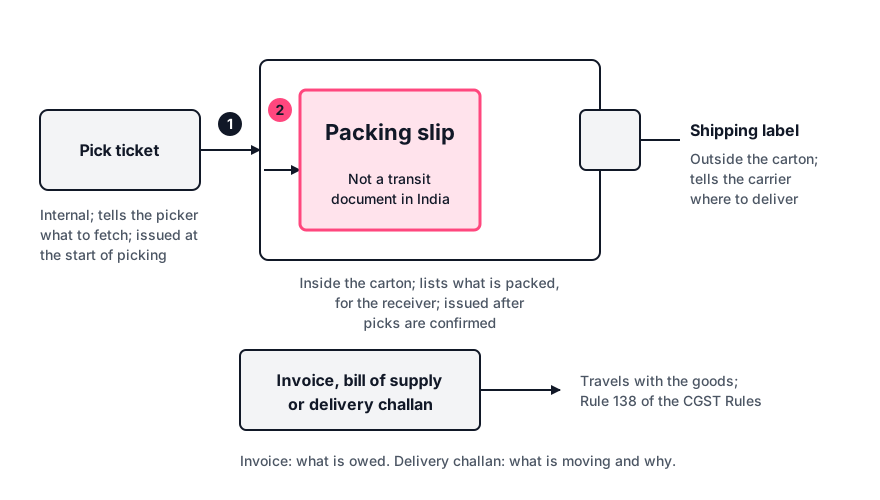
A pick ticket is internal and issued at the start of picking. The packing slip comes after picks are confirmed. The label goes outside the carton; the slip goes inside.
- Document
- Pick ticket
- Question it answers
- What do I fetch, and from where?
- Lists
- SKU, quantity, bin
- Leaves out
- Prices, customer details
- Goes to
- Picker
- Document
- Packing slip
- Question it answers
- What is in this box?
- Lists
- Order number, ship-to, SKU, quantity packed, backorders
- Leaves out
- Prices, tax, payment terms
- Goes to
- Receiver
- Document
- Tax invoice
- Question it answers
- What is owed?
- Lists
- Prices, Goods and Services Tax (GST), HSN (Harmonised System of Nomenclature) code, terms
- Leaves out
- Carton-by-carton packing detail
- Goes to
- Payer
- Document
- Bill of supply
- Question it answers
- What is owed, for exempt or composition supplies?
- Lists
- Items, value
- Leaves out
- Tax charged
- Goes to
- Payer
- Document
- Delivery challan
- Question it answers
- What is moving, and why?
- Lists
- HSN code, quantity, value, signature
- Leaves out
- Payment terms
- Goes to
- Consignee (the receiver), transporter, consignor (the sender)
- Document
- Shipping label
- Question it answers
- Where does this go?
- Lists
- Address, carrier, tracking barcode
- Leaves out
- Contents
- Goes to
- Carrier
Which document must travel with goods in India
The invoice, bill of supply or delivery challan must travel with the goods. Under Rule 138 of the Central GST (CGST) Rules, the person in charge of the conveyance carries one of those three. A packing slip is not on that list.
As of October 2026, an e-way bill (the electronic movement record) is required for a consignment above ₹50,000 moving between states, as the Central Board of Indirect Taxes and Customs (CBIC) e-way bill rules set out. For movement within a state, the state's own limit applies, and it is ₹1,00,000 in several states. Check your state's notification on the e-way bill portal. Consignment value includes the taxes charged.
Send the slip inside the carton and the invoice or challan with the driver. Never swap one for the other.
When a delivery challan is used
A delivery challan under Rule 55 covers goods sent for job work (processing of your goods by another business), goods moved for reasons other than supply, and liquid gas where the quantity is unknown at removal. An example of the second case is a stock transfer between your own warehouses under the same GST registration. Transfers to a branch with a different registration, including in another state, need a tax invoice. A challan is made in triplicate: original for the consignee, duplicate for the transporter, triplicate for the consignor. Confirm with your tax adviser for your case.
How Arka Inventory handles it
Our warehouse management feature suggests the items and bin locations to pick, lets pickers scan barcodes while picking and packing (QR codes are supported too), and generates pick tickets and packing slips in the same workflow. For lot- or batch-tracked stock, picking can follow lots that expire first; otherwise FIFO (first in, first out) picking applies.
Our recommendation, not a product setting: take slip quantities from confirmed picks, so the slip describes the box rather than the order.
As of October 2026, barcoding and packing slips are included from our Basic plan, at $199 a month billed yearly for one user (pricing). We build Arka Inventory natively on Salesforce and offer a 15-day free trial with no credit card. For the picking approach itself, see order picking methods. To test scanning before you buy, see what to test in inventory software with a barcode scanner.
Example
A customer orders 10 of item A, but the bin holds 8. The slip should read "ordered 10, packed 8, backordered 2". A slip that says 10 is wrong the moment the carton closes.
Frequently asked
Sources
- 1.CGST Rules, Rule 138: e-way bill, documents to be carried, CBIC
- 2.CGST Rules, Rule 55: transportation of goods without issue of invoice, delivery challan, CBIC
- 3.E-way bill rules, CBIC
- 4.E-way bill portal, state notifications, GST Network
- 5.Warehouse Management, Arka Inventory
- 6.Pricing, Arka Inventory