
Best Available-To-Promise Inventory Alternatives for Commit Teams
Compare available-to-promise inventory alternatives for ATP rules, channel stock, warehouse bins, reservations, pricing, and operating fit.

Best Available-To-Promise Inventory Alternatives for Commit Teams
An inventory count can look healthy while a sales team is already making promises against it. Retail inventory distortion still costs $1.7 trillion each year, which is why a live count needs explicit commitment rules.
An available-to-promise inventory alternative earns the label only if it calculates what can be promised by date, not simply what sits on a shelf. It must subtract allocations, commitments, holds, safety stock, and channel buffers, then add only eligible incoming supply. We recommend choosing the platform whose logic your team can test end to end.
Below, we separate stock states, compare the rules a system must prove, and show how multichannel, warehouse, and reservation decisions change a customer promise.
What Does Available-To-Promise Inventory Actually Mean?
Available-to-promise is a dated commitment decision. On-hand stock tells us what is physically recorded. ATP tells us what we can responsibly promise after considering who already has a claim on that stock, which locations can fulfill it, and whether inbound supply arrives in time.
| Inventory State | Plain-English Meaning | Should It Count Toward A New Promise? |
|---|---|---|
| On-Hand | Physical quantity recorded in a warehouse or bin | Only if sellable and eligible |
| Allocated | Quantity assigned to a specific order or fulfillment task | No |
| Committed | Quantity promised to an existing order, often before bin assignment | No |
| Held | Quantity blocked for payment review, quality, service, or another policy | No |
| Available-To-Sell | Sellable on-hand quantity after existing claims and buffers | Yes, for immediate sale |
| Available-To-Promise | Quantity that can be delivered by a specified date | Yes, if date and sourcing rules pass |
We calculate it as follows: ATP = eligible on-hand − allocated − committed − holds − safety stock − channel buffer + eligible inbound supply.
The terms must be configured so the same units are not subtracted twice. A supply management example similarly treats ATP as on-hand plus incoming supply, less committed customer orders.
When sales commitments happen in Salesforce, we keep the distinction visible with commit inventory workflows. That gives sales, purchasing, and fulfillment teams a shared view of what changed and why.
Which Available-To-Promise Inventory Alternatives Calculate a Real Promise?
A credible comparison does not reward a platform merely for showing stock by location. We look for evidence that it can apply rules to a dated promise, explain the result, and recalculate when an order, receipt, hold, or warehouse decision changes.
| Alternative Category | ATP Rule Evidence To Request | Channel Control | Warehouse And Bin Depth | Salesforce Workflow | Pricing Visibility | Best Fit |
|---|---|---|---|---|---|---|
| Our Salesforce-Native Workflow | Demonstrate commitments, on-order supply, lead times, and exceptions | Test buffers and order sync | Multi-warehouse, bins, directed picking | Native | Published plans begin at $199 monthly, billed yearly | Teams running sales commitments in Salesforce |
| Commerce-Focused Suite | Demonstrate dated supply and demand logic | Test marketplace and storefront updates | Test location eligibility | Validate connector behavior | Request current quote | High-volume channel operations |
| Manufacturing-Centered System | Demonstrate component and finished-goods availability | Test order reservation timing | Test production and warehouse handoff | Validate integration approach | Request current quote | Make, assemble, and kit workflows |
| Full ERP | Demonstrate ATP method and priority rules | Test channel-specific allocation | Test transfers, bins, and split shipments | Validate implementation scope | Request current quote | Complex multi-entity operations |
| Warehouse-First System | Demonstrate promise-date calculation | Test commerce synchronization | Test directed picking and exclusions | Validate CRM connection | Request current quote | Dense warehouse operations |
| Accounting-Led Stock Application | Demonstrate commitment lifecycle | Test oversell safeguards | Test bin and transfer depth | Validate record synchronization | Request current quote | Simpler inventory operations |
| Lightweight Inventory Tool | Demonstrate availability by date, not just count | Test buffer controls | Test multi-location limits | Validate automation options | Request current quote | Smaller teams with limited rules |
Test Incoming Supply and Lead Times
We count incoming purchase orders, production output, and transfers only when they are confirmed, routed to an eligible location, and scheduled before the promised date. A future receipt is useful context, but it is not a safe promise until those conditions are met.
Our forecasting and purchasing tools help teams bring expected supply and lead-time context into the same operating conversation as open demand.
Test Safety Stock and Channel Buffers
A safety-stock setting protects service levels across the business. A channel buffer protects a specific storefront, marketplace, or B2B path. Both should reduce what a new order can see, but the system must show which rule made the reduction.
For example, if shared stock is 80 units, 25 are committed to B2B, safety stock is 10, and a web buffer is 10, the web channel should expose 35 units, not 80.
Test Priority, Partial Fulfillment, and Backorders
Priority rules decide whose claim wins when demand exceeds supply. The test should include two orders for the same SKU, one urgent order, one standard order, and a receipt that arrives after only part of the demand can ship.
A useful result explains whether the system creates a partial shipment, places the remainder on backorder, or changes the promise date. A number without that explanation is visibility, not ATP.
How Should Multichannel Stock Visibility Change the Promise?
Multichannel visibility becomes valuable only when every order changes the shared availability picture quickly enough to stop the next channel from overselling. That includes ecommerce orders, marketplace orders, B2B sales orders, returns, edits, and cancellations.
We treat the sequence as an operational loop: an order enters, a reservation is created or updated, availability is recalculated, channel quantities refresh, and exceptions are logged. A late sync can make a technically correct stock count commercially unsafe.
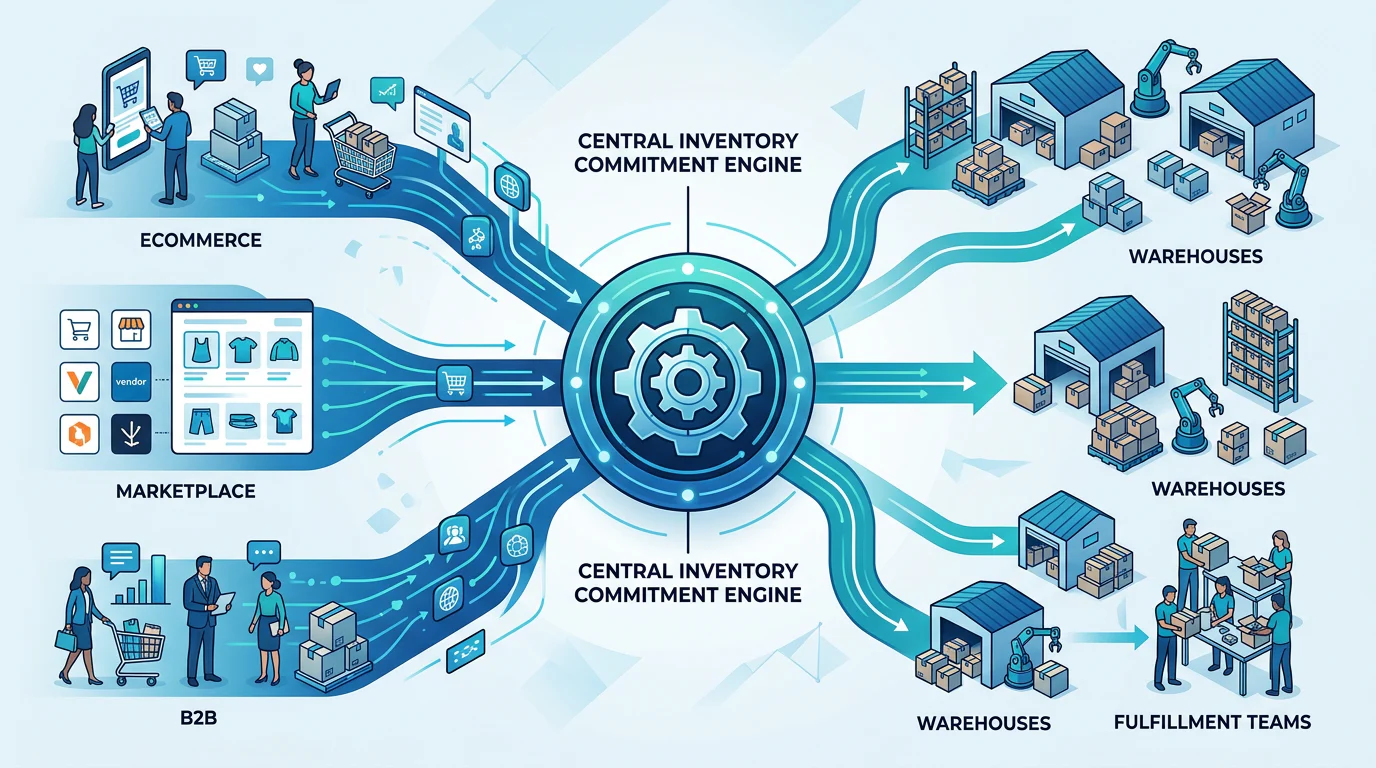
Our inventory visibility capabilities bring location-level inventory, inventory on order, expected lead times, and material availability into Salesforce. That context helps sales teams avoid treating every unit in the network as immediately promiseable.
The multichannel test should include a storefront order, a marketplace order, and a B2B order placed within minutes of one another. Ask whether the system reserves shared stock, applies channel-specific buffers, handles a failed payment, and records any quantity it could not safely publish.
How Should Warehouse and Bin Rules Affect Fulfillment?
A promise is not complete until the inventory can be sourced, picked, packed, and shipped. Stock in an excluded warehouse, a blocked bin, a quality-hold location, or a transfer that arrives too late should not inflate ATP.
Our warehouse workflows support barcode receiving, pallet handling, putaway, pick tickets, packing slips, and bin-directed picking. We use warehouse management to connect the promise a sales team makes with the physical route a warehouse team must follow.
Apply Sourcing Priorities
A sourcing rule should identify the preferred warehouse first, then identify acceptable fallback locations. If a fallback requires a transfer, the system should apply the transfer lead time before confirming a customer date.
Exclude Unsuitable Inventory
Quality holds, damaged inventory, quarantine stock, and restricted bins may exist physically but remain unavailable commercially. ATP must use sellable, policy-eligible inventory, not a broad warehouse total.
Handle Split Shipments Deliberately
Consider an order for 35 units when Warehouse A has 27 eligible units and Warehouse B is excluded by policy. The safe result is a 27-unit shipment with eight units backordered, or a revised promise date if the buyer requires one shipment.
Direct the Pick
The last test is operational. After ATP approves an order, the warehouse should receive a usable pick instruction that names the warehouse and bin, rather than forcing staff to rediscover the availability decision on the floor.
For process design, our warehouse guide helps teams connect physical inventory movement to the rules that support accurate commitments.
What Must a Reservation Lifecycle Handle?
Reservations are the bridge between a customer promise and physical fulfillment. Without an explicit lifecycle, stock can remain trapped in canceled orders, payment reviews, uncompleted picks, and abandoned carts while teams believe it is unavailable.
Create the Right Type of Claim
A quote may need no reservation. A confirmed order may create a soft commitment. Payment approval or fulfillment release may create a harder allocation. We recommend documenting which event creates each claim and who can override it.
Release Stock Reliably
Reservations should release on cancellation, expiration, payment failure, line edits, fulfillment short picks, and approved returns. The release must update availability across sales channels and retain an audit trail for customer service.
Monitor Exceptions
We use custom reports to surface shortages, late supply, broken allocations, and changed promise dates. The best exception report shows the affected SKU, order, quantity, warehouse, original promise, current promise, and next action.
A scheduling reference describes ATP as on-hand inventory plus scheduled production that is not already committed to customer orders. That is why our daily review asks which promises lost supply, which inbound receipts are late, which reservations are aging, and which customer dates changed overnight.
Why Arka Inventory Fits Commitment Workflows
Arka Inventory gives commitment-inventory teams one operating surface inside Salesforce, where sales, purchasing, warehouse, and finance teams can work from the same transaction trail. We pair real-time location visibility with inventory commitment, on-order information, lead-time context, bin-directed fulfillment, alerts, and reporting so a promise does not disappear into a spreadsheet handoff. Our published plans start at $199 per month when billed yearly, with multiple warehouses included at the Basic tier and sales orders plus bin tracking positioned in Enterprise. That makes the right next step a workflow review, not a feature checklist. We will map a real SKU, open order, inbound receipt, warehouse rule, and cancellation path with your team, then identify the controls that need configuration. The review gives every owner a shared standard for exception handling, changed customer dates, and daily fulfillment decisions before any configuration reaches production work. See Arka Inventory
FAQs on Available-to-promise Inventory Alternatives
ATP combines dated supply, existing demand, location eligibility, and reservation status. These questions help teams distinguish genuine promise calculations from ordinary stock visibility.
What Is Available-To-Promise Inventory?
Available-to-promise is the quantity we can responsibly commit by a specified date after applying eligible supply, existing demand, holds, buffers, warehouse rules, and fulfillment timing.
Is On-Hand Inventory the Same as ATP?
No. On-hand is a physical count, while ATP is a dated commitment calculation. It removes inventory already spoken for and adds only supply eligible before the promise date.
Can ATP Include Incoming Purchase Orders?
Only if the receipt is confirmed, policy eligible, available at the correct warehouse, and scheduled before the customer’s promised date. A purchase order alone is not a promise.
When Should a Reservation Release Inventory?
Release a reservation when payment fails, an order expires or is canceled, a line changes, a short pick occurs, or returned stock becomes eligible again.
How Do Warehouse Rules Affect ATP?
A reliable warehouse rule excludes stock in blocked or unsuitable bins and uses only locations that can fulfill within the chosen delivery date and sourcing policy.